



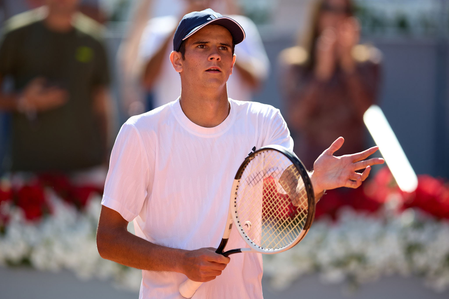
Paris, May 31 (IANS) Pablo Carreno Busta has had a front-row seat to Rafael Jodar’s rise. Long before the teenager established himself as one of the breakthrough performers of the clay-court season, the former world No. 10 identified traits that convinced him the young Spaniard was destined for bigger stages.
Now, fate has brought them together at Roland Garros, where a place in the quarter-finals will be on the line when they meet for the first time on the ATP Tour.
The matchup carries added significance for Carreno Busta, who first crossed paths with Jodar two years ago in Valencia. Fresh off his US Open boys’ singles triumph, the then-17-year-old joined Spain’s Davis Cup team as a sparring partner, sharing the practice courts with established stars including Carreno Busta.
Even then, the veteran saw glimpses of the player Jodar would become. Still physically developing and years away from making a sustained impact at the tour level, the Madrid native already possessed the power, confidence and baseline aggression that would later fuel his rapid ascent through the professional ranks.
“He was a skinny kid, obviously, but you could already see he played very well, even on an indoor court. With those levers, the big hitting, hogging the baseline, he was already showing real promise,” the Asturian recalled his first impression of Jodar, quoted by ATP.
Rather than rushing directly into the professional ranks, Jodar chose a less conventional route. He continued his development through college tennis, gradually building his game away from the spotlight that often follows highly regarded juniors.
That decision appears to have paid off. After impressing consistently on the ATP Challenger circuit in 2025, the teenager committed fully to the professional tour and has quickly established himself as one of the sport’s most promising young players. Busta believes that a quieter path may have accelerated Jodar’s growth.
“Afterwards, he went to university and I think it did him a lot of good, because he developed a bit out of the spotlight, perhaps unlike [Joao] Fonseca, who’s the same age,” Busta noted of the pair born in 2006, a generation that also includes their countryman, Martin Landaluce.
While Brazil’s Fonseca has spent much of the past year attracting headlines, Jodar has emerged more gradually before making a sudden leap into contention at the highest level.
“We’ve had Fonseca in the limelight for over a year now, but Jodar has come through a bit more under the radar, yet he’s made a huge leap in level and confidence very quickly. From the very start, we’ve seen he doesn’t crumble under pressure,” Busta continued when assessing his upcoming opponent.
The evidence has been visible throughout the clay-court season. Jodar reached the semi-finals in Barcelona before producing quarter-final appearances in Madrid and Rome. His debut campaign at Roland Garros has continued the upward trajectory, with victories over Aleksandar Kovacevic, James Duckworth and Alex Michelsen carrying him into the tournament’s second week. Yet the veteran standing across the net has authored a compelling comeback story of his own.
A lengthy injury struggle interrupted Busta’s career and forced him away from the consistency that once made him a fixture in the latter stages of major tournaments. In Paris, however, signs of his old form have resurfaced. Wins over 12th seed Jiri Lehecka, Australia’s Thanasi Kokkinakis and Argentina’s Thiago Agustin Tirante have delivered his deepest Grand Slam run in nearly four years.
His last appearance at this stage of a major came at the 2022 US Open. At Roland Garros, he had not advanced this far since 2021. The contrast between generations has become one of the tournament’s defining themes. Alongside Jodar, a wave of emerging talent has injected fresh energy into the draw, prompting discussion about the sport’s rapidly changing landscape.
Busta, however, views the transition with perspective.
“I don’t know if I’m the ideal person to talk about this because I haven’t had consistent time on Tour for a while, so I can’t really see how the youngsters are training or what their days are like at these tournaments,” Busta explained before sharing his opinion. “It’s true, though, that a lot of young players are coming through now. I don’t mean players as young as (Moise) Kouame, who (had) a fantastic tournament here in Paris, but those who are 19, 20, 21 or 22, of which there are many.”
While he acknowledges the impressive progress being made by the younger generation, he also believes experience remains an important asset at the elite level.
“I don’t know what they’re being fed or what they’re working on, but it’s clear they’re coming through with a lot of hunger and power in their shots,” Busta said. “They play with a lot of joy and perhaps my generation is starting to show our age, although we still manage to find the old magic now and then.”
That old magic has carried him into a meeting that feels symbolic for Spanish tennis: a respected veteran seeking one more memorable run against a rising star beginning to fulfil the promise others recognised years ago. Regardless of the result in the Court Suzanne-Lenglen, Spain is guaranteed a representative in the Roland Garros quarter-finals.
For Busta, the occasion carries an added personal significance as he said, “It’ll be very special to play him.”
–IANS
vi/