
India’s electronics exports outpace global growth: NITI Aayog report
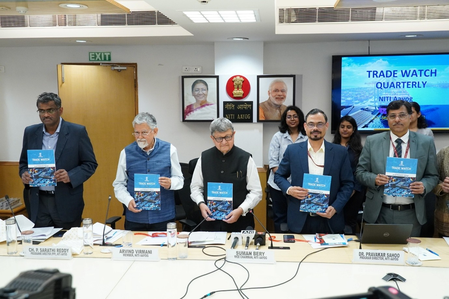
New Delhi, Feb 13 (IANS) India’s share in global electronics demand has expanded at a rapid compound annual growth rate (CAGR) of 17.2 per cent, significantly outpacing global growth of 4.4 per cent between 2015 and 2024, driven primarily by the sharp rise in mobile phone exports, according to NITI Aayog's Trade Watch Quarterly report for July-September 2025-26, launched on Friday.
Between 2016 and 2024, electronics exports increased nearly five-fold, reaching USD 42.1 billion. With global electronics trade valued at USD 4.6 trillion, the sector represents one of the largest and fastest-evolving segments of the world economy. India has demonstrated particular strength in products such as mobile phones, consumer electronics, and communication equipment, with exports increasingly directed towards major final-consumption markets including the United States, the United Kingdom, and the UAE, the report states.
Electronics, the thematic focus of this quarter's edition, has emerged as a cornerstone of India's manufacturing and export transformation. Now the second-largest item in India's export basket, the sector is both technology-led and deeply interconnected with industries such as automotive, renewable energy, telecom, defence, and digital services, making it a powerful multiplier for industrial growth.
The report states that having established a strong foothold in assembly and system integration, India is now entering the next phase of its electronics journey, moving decisively toward component manufacturing and higher value addition. This transition is supported by targeted policy measures, including the Union Budget's Rs 40,000 crore allocation under the Electronics Components Manufacturing Scheme, aimed at strengthening domestic capabilities.
The analysis underscores that sustained competitiveness will be driven by deeper integration into global electronics value chains, encompassing printed circuit board design, semiconductor assembly and testing, power electronics, and embedded systems. Complemented by continued improvements in logistics efficiency, tariff rationalisation, and industry-aligned skill development, these shifts position electronics as a key engine of India's export growth and technological advancement in the coming decade.
NITI Aayog Vice-Chairman Suman Bery said, "Electronics, as the organising core of modern manufacturing value chains, with semiconductors and components, plays a key role in determining trade balances and technological sovereignty. While India has achieved scale in final assembly, sustained competitiveness will depend on correcting structural cost disabilities, deepening domestic component ecosystems, and leveraging anchor investments in components to embed Indian firms more firmly within global production networks."
The publication also provides a comprehensive assessment of global and domestic trade trends at a time when global trade growth has moderated but remains positive, with services continuing to outperform goods and developing regions emerging as key drivers.
The analysis highlights that India's trade performance in Q2 FY26 was driven by export-led momentum sustaining the overall trade expansion amid heightened global uncertainty. Services and merchandise exports recorded robust growth of around 8.5 per cent, outpacing import growth in both merchandise and services.
At a structural level, the edition underscores the deepening of trade among developing economies, which has expanded nearly four-fold since 2005 and now accounts for a rising share of global exports, with India’s trade trajectory increasingly aligned with this Global South rebalancing through regional value chains and new trade corridors.
Further, this edition highlights the growing role of e-commerce as a key enabler of future export growth. India is now among the world’s top six e-commerce markets, with electronics accounting for nearly half of online retail.
--IANS
sps/svn
Centre okays 25 lakh metric tonnes wheat exports, 5 LMT of sugar exports
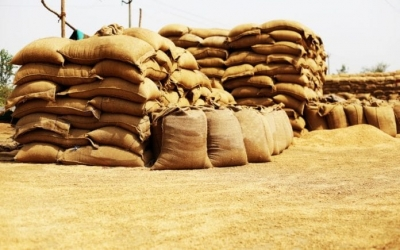
New Delhi, Feb 13 (IANS) In a farmer-centric step to stabilise domestic markets and ensure remunerative returns to producers, the Centre on Friday approved the export of 25 lakh metric tonnes (LMT) of wheat, along with an additional 5 LMT of wheat products.
According to a Consumer Affairs Ministry statement, wheat stock availability with private entities during 2025–26 stands at approximately 75 LMT, which is nearly 32 LMT higher compared to the corresponding period last year.
"This substantial year-on-year increase indicates a comfortable supply position in the country. Furthermore, as on April 1, 2026, total wheat availability in the central pool with FCI is projected at around 182 LMT, thus ensuring that export permissions will not impact domestic food security requirements," it said.
Moreover, wheat acreage in Rabi 2026 has also increased to about 334.17 lakh hectares compared to 328.04 lakh hectares last year.
This reflects strong farmer confidence in wheat cultivation supported by assured MSP and procurement mechanisms, and signals the likelihood of another robust harvest, the official statement further added.
The decision to permit export of 25 LMT of wheat and 5 LMT wheat products will help stabilise domestic prices, improve market liquidity, ensure efficient stock rotation, and further strengthen farmers’ income while ensuring national food security.
Meanwhile, to facilitate sugar exports, the government decided to allow export of an additional 5 LMT of sugar to willing sugar mills during the current Sugar Season 2025–26.
Earlier, the government had permitted the export of 15 LMT of sugar during the current Sugar Season 2025–26. This decision is expected to facilitate higher sugar exports and help in managing surplus sugar availability in the country.
As per data, only about 1.97 LMT of sugar has been exported up to January 31, 2026.
In addition, approximately 2.72 LMT of sugar has been contracted for export by sugar mills to date.
The ministry said that the additional export quantity of 5 LMT shall be made available to willing sugar mills, subject to the condition that at least 70 per cent of their allocated quantity is exported by June 30, 2026.
--IANS
na/vd
Rahul Gandhi meets farm union leaders in Parliament House amid opposition to India-US trade deal
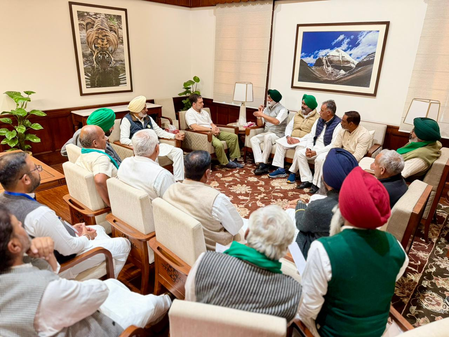
New Delhi, Feb 13 (IANS) Leader of Opposition in the Lok Sabha, Rahul Gandhi, on Friday met leaders of several farm unions from across the country at the Parliament House.
During the meeting, the farm union representatives expressed strong opposition to the India-US trade deal and conveyed their deep concern over the potential impact on farmers’ livelihoods, particularly those engaged in the cultivation of corn, soybean, cotton, fruits, and nuts.
The leaders told the Congress leader that they fear the agreement could open the door for agricultural imports, which may adversely affect domestic producers. Gandhi also reiterated his position, stating that the trade deal has opened the door for agricultural imports and warned that many other crops could soon be impacted as well.
The discussion also focused on the need for a large-scale national movement to oppose the deal and safeguard the livelihoods of farmers and farm labourers.
The farm leaders who participated in the discussion included Sukhpal S. Khaira (All India Kisan Congress), Ranjit S. Sandhu (GKS Rajasthan), Adv. Ashok Balhara (Bharatiya Kisan Mazdoor Union, Haryana), P.T. John (KMM Kerala), Baldev (BKU Krantikari, Zira), R. NandKumar (Progressive Farmers Front), Amarjit S. Mohri (BKU Shaheed Bhagat Singh), Akhilesh Shukla (All India Kisan Congress), Kedar Sirohi (Aam Kisan Union), Kiranjit S. Sandhu (Kisan Congress Punjab), Gurpreet S. Sangha (Rajya Sabha), Guramneet S. Mangat (Kisan Mazdoor Morcha - India), Hameed Malik (J&K Zamidara Forum), Tejveer Singh (KMM), Dharamvir Goyat (Haryana Kisan Sangarsh Samiti), Ishwar Singh Nain (Krishak Samaj), and Satbir Khatana (South Haryana Kisan Union).
Rahul Gandhi on Thursday asserted he would not be deterred by any FIR, criminal case or privilege motion and asserted that he would continue to fight for farmers' rights.
In a video post on X, Gandhi had reiterated his opposition to the India-US trade deal, claiming it would severely impact Indian farmers. He alleged that Prime Minister Narendra Modi had "opened the doors" of India’s agriculture market to foreign players at the cost of domestic producers.
"I have spoken the truth in Parliament. If you do not like the truth, that is a different matter. The country understands the truth. Do whatever you want to do. Let an FIR be filed, let a case be registered or bring a privilege motion. I and the entire party stand with farmers," Gandhi had said.
He had said any trade agreement that threatens farmers' livelihoods or weakens the country's food security is anti-farmer. Gandhi also claimed that corn, soybean, cotton and fruit growers would be the first to suffer, alleging that the government would eventually open the entire farm sector to foreign interests and corporate allies.
--IANS
jk/vd
Big twist in Sadhvi Prem Baisa death case as FSL report rules out poisoning
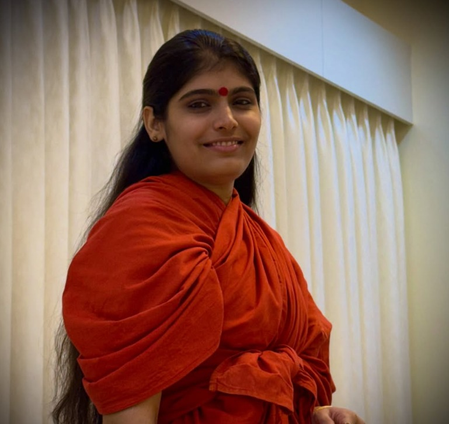
Jaipur, Feb 13 (IANS) In a significant development in the mysterious death of Sadhvi Prem Baisa, the State Forensic Science Laboratory (FSL) has submitted its viscera examination report to the police, ruling out poisoning or any unnatural cause of death.
The report, received late Thursday night, has brought a major twist to the case that had sparked widespread speculation and controversy.
According to sources, the FSL analysis found no traces of poison or toxic substances in Sadhvi Prem Baisa's body. This has dismissed earlier suspicions of foul play or forced poisoning.
However, the final cause of death will be determined by the medical board after a detailed review of the forensic findings. Investigators revealed that Sadhvi Prem Baisa had been suffering from asthma and had developed severe breathing difficulties after catching a cold on January 28.
As her condition worsened, she contacted a male nurse, Devi Singh, who administered Dexona and Dynapar injections.
Doctors at Mahatma Gandhi Hospital will now analyse whether these medications or underlying health conditions contributed to her death.
Sadhvi Prem Baisa fell seriously ill at the Aarti Nagar Ashram in Pal village under Boranada police station limits on January 28.
She was taken to a private hospital on Pal Road but was declared dead on arrival.
Following a complaint filed by her father, Biramnath, the police registered a case and conducted a post-mortem examination on January 29 through a medical board. Her viscera samples were sent to the FSL on February 2, and the forensic investigation was completed within 11 days.
During the investigation, compounder Devi Singh stated that the injections were administered based on a prescription allegedly given by a private hospital doctor.
Police are now examining who prescribed the injections and whether proper medical protocols were followed.
While the FSL report has ruled out poisoning, authorities say the case is still under investigation, and all aspects, including medical treatment, circumstances at the ashram, and statements of witnesses, are being scrutinised.
Officials said more clarity will emerge after the medical board submits its final opinion.
--IANS
arc/svn
Dalai Lama’s office rejects reports linking Tibetan spiritual leader to Jeffrey Epstein
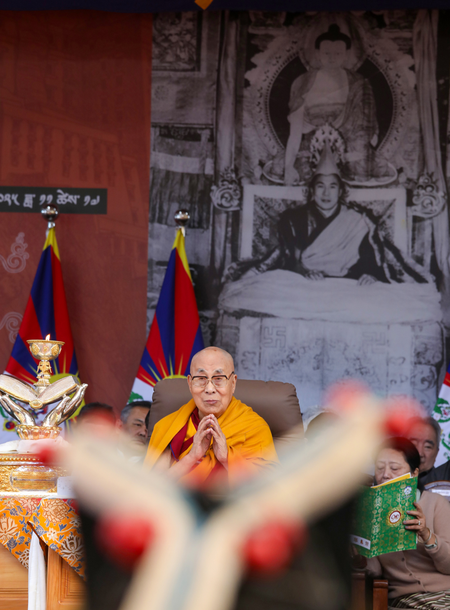
Dharamsala, Feb 8 (IANS) The office of the Dalai Lama on Sunday firmly denied media reports suggesting any association between the Tibetan spiritual leader and convicted sex offender Jeffrey Epstein.
The clarification comes after several media outlets, citing documents from the United States Department of Justice (DoJ), reported that the Dalai Lama’s name appeared 169 times in the widely discussed Epstein files.
According to some reports, the Buddhist leader’s name allegedly appeared in multiple personal emails and in the index of a book titled ‘Massage for Dummies’, which was included as a scanned document in files released earlier as part of the Epstein case records.
Following the circulation of these claims, the Dalai Lama’s office issued a statement categorically rejecting any alleged link.
“Some recent media reports and social media posts concerning the ‘Epstein files’ are attempting to link His Holiness the Dalai Lama with Jeffrey Epstein,” the statement read.
“We can unequivocally confirm that His Holiness has never met Jeffrey Epstein or authorised any meeting or interaction with him by anyone on His Holiness’s behalf,” it added.
Some reports have referred to emails dated October 2012 that allegedly contained references suggesting a meeting between the Tibetan spiritual leader and Epstein, and also indicated that the Dalai Lama was expected to attend an event alongside him.
Additionally, European media outlet 'Nexta TV' claimed that individuals described as followers of the Dalai Lama might have met Epstein, further fuelling speculation about possible indirect links.
The issue also gained attention last year after journalist Michael Wolff made claims during an appearance on the 'Daily Beast' podcast.
Wolff spoke about gatherings, described as “salons”, that were reportedly hosted at Epstein’s Manhattan residence and attended by several prominent personalities.
While naming attendees, Wolff included the Dalai Lama and speculated that the spiritual leader’s presence, if any, may have been connected to fundraising or philanthropic outreach, as several individuals were known to approach Epstein for financial contributions.
Independent journalist Jacob Silverman later referred to Wolff’s claims in an article titled “Why Was The Dalai Lama At Jeffrey Epstein’s House?”
In his report, Silverman mentioned that the Dalai Lama’s office did not respond to queries at the time, regarding whether the organisation had received any donations from Epstein or had any form of association with him.
The controversy has resurfaced after the US DoJ recently released a massive collection of records linked to Epstein.
The release reportedly includes more than three million files, over 2,000 videos and approximately 1,80,000 photographs connected to the disgraced financier’s activities.
According to reports, the newly released documents contain references to several influential personalities from across sectors, including political leaders, business figures, and globally recognised individuals.
Names mentioned in various reports include current and former US Presidents such as Donald Trump and Bill Clinton, as well as business leaders including Bill Gates and Elon Musk, among others.
--IANS
sd/dpb
CM Stalin urges PM Modi to expedite railway projects, release required funds in full
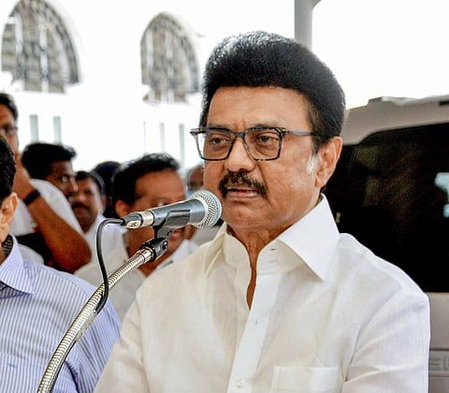
Chennai, Feb 8 (IANS) Tamil Nadu Chief Minister M.K. Stalin has written to Prime Minister Narendra Modi seeking urgent intervention to accelerate long-pending railway projects in the State, highlighting "delays" in fund allocation and stalled land acquisition that have slowed critical infrastructure development.
In his detailed letter, the Chief Minister underscored that Tamil Nadu has already completed most of the groundwork required for railway expansion but is facing setbacks due to the "delayed and piecemeal release" of funds from the Ministry of Railways.
He requested the Centre to release the required funds in full and on priority to ensure faster project execution and timely compensation to the landowners.
According to CM Stalin, administrative sanction has been granted for acquiring 2,500 hectares of land for various Union government railway projects.
Of this, land acquisition has been completed for nearly 94 per cent of the required area for 19 major projects, and the land has been handed over to the Railways.
However, funds have not yet been sanctioned for over 931 hectares, creating bottlenecks in several works.
He pointed out that delays in compensating landowners have disrupted progress and created uncertainty among affected families.
CM Stalin cited the Thiruvananthapuram–Kanniyakumari broad-gauge doubling project as a key example, where funds amounting to Rs 289.78 crore for land compensation are still pending, thereby holding up the project's completion.
The Chief Minister also called for the revival of projects that have been kept in abeyance, including the Thoothukudi–Madurai (via Aruppukottai) line and the Tindivanam–Tiruvannamalai line.
He further urged the Centre to sanction additional new railway projects in line with Tamil Nadu's growing economic stature.
Describing Tamil Nadu as India's second-largest economy and a major manufacturing and export hub, CM Stalin stressed that improved rail connectivity would significantly boost national growth.
He assured that the State government has established a robust monitoring system and is fully committed to extending cooperation for speedy implementation.
Expressing confidence in cooperative federalism, CM Stalin said timely Central support would benefit both Tamil Nadu and the nation at large.
--IANS
aal/svn
Not just business deal, but step to elevate strategic friendship: BJP leader on India-US trade agreement
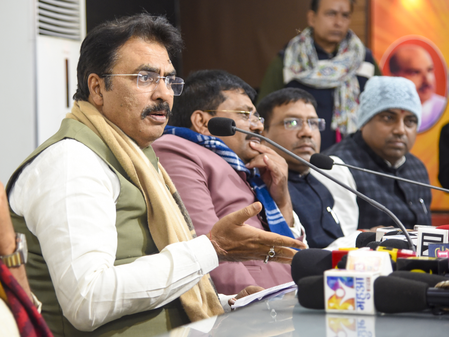
New Delhi, Feb 8 (IANS) Calling it a major boost to bilateral ties, Bihar BJP State President Sanjay Saraogi on Sunday said the India-US Interim Trade Agreement marks a new chapter in economic cooperation between the two nations.
Reacting to the development, Saraogi said, “The India-US interim trade agreement gives a new direction to economic cooperation between the two countries. This agreement will strengthen trade, investment, technology, and supply chains, helping India achieve its Viksit Bharat goals. It is not just a trade agreement but also a step to elevate the strategic and economic friendship between India and the United States.”
His remarks came after the US and India announced a framework for an Interim Agreement on reciprocal and mutually beneficial trade, aimed at paving the way for a comprehensive bilateral trade pact. As part of the announcement, the White House formally confirmed a reduction in tariffs on imports of Indian products from 25 per cent to 18 per cent, offering immediate relief to Indian exporters and industries.
According to a joint statement issued by both sides, the framework reaffirms India and America’s commitment to negotiations on a US-India Bilateral Trade Agreement, talks launched by US President Donald Trump and Prime Minister Narendra Modi on February 13, 2025. Officials said the interim arrangement is designed to deliver early outcomes while supporting more resilient and diversified supply chains.
“The Interim Agreement between the United States and India will represent a historic milestone in our countries’ partnership, demonstrating a common commitment to reciprocal and balanced trade based on mutual interests and concrete outcomes,” the announcement noted.
Earlier this week, President Trump also spoke with Prime Minister Modi and later wrote on 'Truth Social' that both countries had agreed on a trade deal. He highlighted reciprocity, expanded market access, and efforts to address long-standing trade imbalances, while underlining the broader strategic importance of economic ties with New Delhi.
Under the proposed framework, India will eliminate or reduce tariffs on all US industrial goods and on a wide range of American food and agricultural products. These include dried distillers’ grains, red sorghum for animal feed, tree nuts, fresh and processed fruits, soybean oil, wine and spirits, among others.
On another matter, reacting to the arrest-related developments involving MP Pappu Yadav, Sanjay Saraogi said, “Pappu Yadav has had ongoing cases for years and is currently absconding, with orders for attachment and seizure already issued. The court has emphasised that an absconding accused must surrender, and if warrants or attachment orders are executed, the administration must ensure their arrest and imprisonment.”
--IANS
rs/dpb
PM Modi’s efforts in peacekeeping are unequivocal: Malaysian PM Anwar Ibrahim
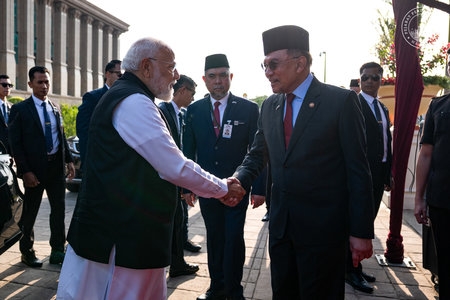
Kuala Lumpur, Feb 8 (IANS) Malaysian Prime Minister Anwar Ibrahim on Sunday hailed Prime Minister Narendra Modi's "unequivocal" peacekeeping efforts and thanked him for his firm commitment to support diplomatic talks regarding the same in the Russia-Ukraine war and the conflict in the Middle East.
In his remarks during the joint press meet with Prime Minister Narendra Modi in Kuala Lumpur, Malaysian PM Ibrahim said, "I must express my appreciation, because my discussions with Prime Minister Modi are not just normal diplomatic exchanges, but those between true friends, full of trust and understanding."
"Therefore, I must also take this opportunity to express my regard and thanks to him for his firm commitment to support all peace efforts, be it in Ukraine-Russia or in the case of the Middle East, particularly Gaza. His efforts in peacekeeping are unequivocal," he added.
"We consider this meeting and these exchanges very vital, very strategic and critical to advance and enhance relations between India and Malaysia... We had long-standing relations since 1957, but we have elevated it to a Comprehensive Strategic Partnership in 2024," he said, and highlighted the "deep historical ties, strong people-to-people linkages, and ever-expanding economic cooperation".
"We'll continue to deepen collaboration in all fields -- trade and investment, semiconductor, digital economy, trade in local currency, connectivity, energy, agriculture, food, security, defence, education, healthcare, tourism, culture and people-to-people. It is really comprehensive, and we believe that we can advance this and execute in a speedy manner with the commitment of both our governments, both foreign ministers," he said.
The Malaysian PM said that both nations exchanged 11 documents, including MoUs, in an exchange of letters which "extended beyond normal bilateral arrangements" as the peacekeeping cooperation on semiconductor, healthcare and security cooperation has also been covered in it.
Malaysian PM Ibrahim further expressed hope in expanding trade cooperation with India, extending beyond the $8.59 billion figure that was achieved in 2025. He also called the use of local currency -- the rupee and the Malaysian ringgit -- a "remarkable feat".
"India is growing by leaps and bounds, which is one spectacular rise in the international economic trade scene, and therefore Malaysia, in the ASEAN context, certainly benefits immensely if we could secure more ways and opportunities to collaborate with India to extend beyond the $18.59 billion that we achieved in 2025.
He said that the educational ties remain "pivotal" as many Malaysians were educated in India, and there is a growing number of Indian students in Malaysia too.
"Since the last decade or so under the premiership of my good friend Prime Minister Modi, you have seen the spectacular recognition of Indian centres of excellence in education. That's not only comparable, but many of them have achieved outstanding recognition beyond the known institutions in the West. Therefore, we would certainly explore this to increase the number of students in the disciplines and fields to study in India," the Malaysian PM said.
He also stressed the need to focus on tourism and connectivity.
"As a sign of our good relations, I have immediately agreed to support the decision of the Government of India to open a consulate of India in Kota Kinabalu, Sabah," he concluded.
Earlier in the day, both leaders held delegation-level talks, discussing ways to enhance bilateral ties across several sectors, including defence and security.
PM Modi accorded a ceremonial welcome at Perdana Putra in Putrajaya.
PM Modi's visit is being seen as a significant step toward further deepening the enduring friendship between India and Malaysia, rooted in mutual trust, shared values and common aspirations for the future.
--IANS
sd/
Our stance on terrorism firm, no double standards, no compromise: PM Modi in Malaysia
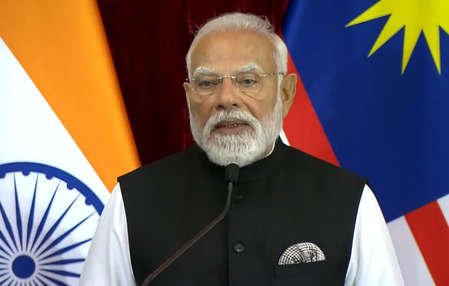
Kuala Lumpur, Feb 8 (IANS) Prime Minister Narendra Modi on Sunday said that India's stance on terrorism is firm -- "no double standards and no compromise" -- and also stressed that New Delhi will continue to expand cooperation with Malaysia in counter-terrorism, intelligence sharing and maritime security.
Addressing a joint press meet with his Malaysian counterpart, Anwar Ibrahim, in Kuala Lumpur, PM Modi said, "First of all, I thank my friend, Anwar Ibrahim, for this warm welcome. Last year, I was not able come to Malaysia for the ASEAN Summit, but I had promised my dear friend that I would soon visit Malaysia. For my first foreign visit of 2026, I have come to Malaysia."
Highlighting the "special" India-Malaysia relations, he said, "We are maritime neighbours. For centuries, there have been deep ties between people of our two nations. Today, Malaysia is the second biggest nation in the world that has an Indian-origin population. Our civilisations are connected to shared cultural heritage and democratic values."
He credited the Malaysian PM for his "significant contributions" in providing a "new pace" to the India-Malaysia ties in the past few years.
"Our cooperation in energy, infrastructure and manufacturing has strengthened. Mutual investment has also increased in the digital economy, biotech and IT. Tourism and people-to-people ties have also deepened. By drawing inspiration from these achievements, we have decided to bring in unprecedented speed and depth in our partnership," PM Modi said.
The Prime Minister further mentioned that the security cooperation between the two nations will be further enhanced by strengthening the cooperation in counter-terrorism, intelligence sharing and maritime security.
"We will also make defence cooperation more comprehensive," he said.
Along with AI and digital technologies, he said that India and Malaysia will further advance the partnership in semiconductor, health and food security.
"The CEO forum organised today has thrown open new opportunities for trade and investment. We will pave a path to economic transformation through strategic trust," he said.
On terrorism, PM Modi said, "We will continue to support all peacekeeping efforts. However, our stance on terrorism is very firm -- no double-standards and no compromise. I appreciate your (Malaysian PM Ibrahim) commitment to enhancing India-Malaysia ties. I hope that together we will continue to work towards achieving the resolutions of Prosperous Malaysia and Viksit Bharat."
PM Modi called the Indian diaspora living in Malaysia a "living bridge" between the two nations.
"Yesterday, I received the opportunity to meet the Indian diaspora living in Malaysia. With his presence, my friend PM Anwar Ibrahim enhanced the prestige of this event. This living bridge of 30 lakh people is a major power. Measures taken for their welfare provide a humanitarian focus to our relations," he said.
He also mentioned that steps like the Social Security Agreement for the protection of Indian workers in Malaysia, and a gratis e-visa, as well as a UPI digital interface for tourism in Malaysia, will "simplify the lives of citizens of both nations".
"Any partnership succeeds when the benefit reaches people directly," the Prime Minister said.
PM Modi highlighted the interest in the Tamil language in Malaysia and said, "Shared love for the Tamil language also connects India and Malaysia. In Malaysia, the strong and living presence of Tamil can be seen in education, media and cultural life. I am confident that with today's Audio Visual Agreement, film and music, especially Tamil films, will bring our hearts closer."
Emphasising that the Indo-Pacific region is emerging as a "hub of global growth", the Prime Minister said, "We are committed, along with ASEAN, to development, peace, and stability across the Indo-Pacific. India gives priority to ASEAN centrality."
"I once again congratulate Malaysia on its successful ASEAN leadership. With the support of friendly countries like Malaysia, India will further strengthen its ties with ASEAN. We agreed that the review of the ASEAN-India trade agreements should be completed soon," he added.
Earlier in the day, both leaders held delegation-level talks, discussing ways to enhance bilateral ties across several sectors, including defence and security.
PM Modi accorded a ceremonial welcome at Perdana Putra in Putrajaya.
PM Modi's visit is being seen as a significant step toward further deepening the enduring friendship between India and Malaysia, rooted in mutual trust, shared values and common aspirations for the future.
--IANS
sd/