
Two children killed, three injured in Balochistan blast
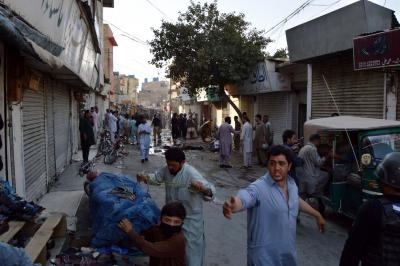
Quetta, Oct 6 (IANS) At least two children were killed and three others injured in an explosion in Gowargo tehsil of Balochistan’s Panjgur district, with locals alleging that explosives fitted to a quadcopter operated by Pakistani forces caused the blast, local media reported on Tuesday.
Citing sources, The Balochistan Post reported that the children were playing in Fateh Ali Bazaar area when they found a suspicious object hanging from a tree, which exploded after they tampered with it.
The deceased were identified as nine-year-old Arman and 10-year-old Amaal, while nine-year-old Shahid, seven-year-old Zahid, and 12-year-old Noorullah sustained severe injuries.
While the nature of the object was initially unclear, a source familiar with the case alleged that it had been fitted with explosives to a Pakistani military quadcopter. The source further claimed that Pakistani forces later directed local journalists to report the blast as having been caused by a hand grenade or another explosive device, The Balochistan Post reported.
The incident comes against the backdrop of rising civilian casualties in Pakistani military drone and quadcopter operations in Balochistan.
Last month, as many as four young men were killed and two others injured after the Pakistani military carried out a drone strike on a group that had gone for a picnic in the Balicha region of Tump, in Balochistan’s Kech district, local media reported.
Citing family sources, The Balochistan Post reported that six residents of Balicha had travelled to the nearby mountains for a picnic when the strike took place.
The four deceased were identified as Yasir, Zubair, Sameer, and Deedag, with three of the four being cousins from the same family.
Pakistani authorities alleged that the four were suspected militants, and weapons and ammunition were recovered from them. Families and local residents rejected the allegations, saying the victims were unarmed and had gone to the mountains for a picnic. They also called for an independent investigation into the attack.
Condemning the brutal killings in Balicha, the Baloch Yakjehti Committee (BYC) said, “There is no framework of law, international humanitarian law, the laws of armed conflict, or basic human decency under which a civilian picnic becomes a legitimate military target.”
The BYC called on international human rights bodies, the United Nations, and global civil society to demand an independent investigation into these killings and to end their silence over the Pakistani airstrikes in Balochistan.
--IANS
scor/ksk/as
Indian, Kazakh forces undertake joint training exercise to boost battlefield skills
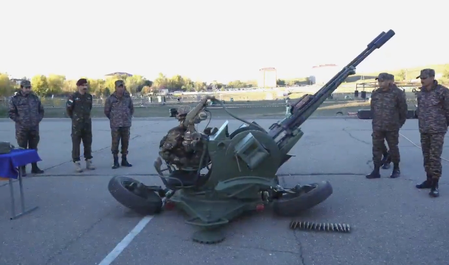
Astana, Oct 6 (IANS) Indian Army and the Armed Forces of Kazakhstan on Tuesday conducted combat drills under India-Kazakhstan joint military exercise 'Kazind 2026' in Kazakhstan’s Oskemen, aimed at sharpening battlefield skills, enhancing interoperability and strengthening operational preparedness.
“Indian Army and the Armed Forces of Kazakhstan are undertaking joint training during Exercise Kazind 2026 at Oskemen, Kazakhstan. The troops carried out tactical navigation through the Akhmirovo Training Area, engaged targets during live-firing drills and executed combined combat exercises, sharpening battlefield skills, coordination and interoperability between the two forces,” the Indian Army posted on X.
“The joint training is fostering the exchange of best practices and further strengthening military cooperation between India and Kazakhstan,” it added.
Last week, the opening ceremony of 'Kazind 2026 was held, with Major General Zhenis Maralov, Chief of Regional Command East of the Armed Forces of Kazakhstan, presiding over it, the Indian Army said.
"The Opening Ceremony of the India-Kazakhstan joint military exercise Kazind 2026 was conducted at Oskemen, Kazakhstan, today. The ceremony was presided over by Major General Zhenis Maralov, Chief of Regional Command East of the Armed Forces of Kazakhstan," the Indian Army said in a post on X.
"The exercise aims to enhance interoperability and strengthen the joint capabilities of both forces to undertake counter-terrorism operations in a sub-conventional environment under a United Nations mandate," it added.
According to the Indian Army, the training will focus on joint tactical operations in semi-urban and mountainous terrain, including Special Heliborne Operations, Air mobility and the integrated employment of Unmanned Aerial Systems and Counter-UAS capabilities.
A 60-member Indian Armed Forces contingent departed on September 28 for Oskemen to take part in the ninth edition of the exercise, which will run until October 11, the Ministry of Defence stated.
The Indian contingent is drawn mainly from a battalion of the Garhwal Rifles, along with troops from other arms and services, and personnel from the Indian Air Force. The Kazakhstan Armed Forces are fielding a contingent of matching strength, comprising primarily personnel from its Land Forces.
--IANS
scor/as
Capt Smit Machchhar making steady recovery, continues to regain health
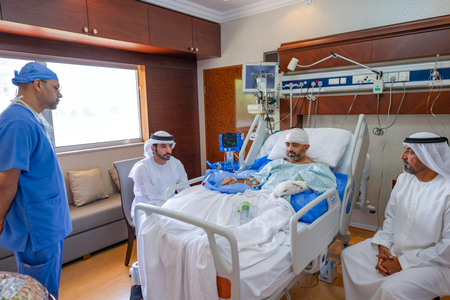
Abu Dhabi, Oct 6 (IANS) Indian pilot Captain Smit Machchhar, who fought against the attacking co-pilot in a Flydubai aircraft and helped save 174 people onboard, is continuing to make steady progress and is regaining his health, the Indian Embassy in the UAE said on Tuesday.
“Health Update: Capt Smit continues to make steady progress and is regaining his health. The Embassy remains in close touch with his family, doctors and local authorities, extending all possible assistance. We thank everyone for their prayers and wish him a speedy recovery,” the Embassy stated on X.
Machchhar on Saturday recounted the terrifying moments inside the cockpit when he realised that his co-pilot was attacking him.
He described the ordeal while speaking to Israeli Prime Minister Benjamin Netanyahu, who invited the pilot and Prime Minister Narendra Modi to light a celebratory flame at Israel's next Independence Day ceremony.
Machchhar said the flight had begun as a normal journey and that he was looking ahead while his co-pilot prayed.
According to Machchhar, he initially had no reason to suspect that anything was wrong. He said that the co-pilot had told him he wanted to pray, something he described as a common practice among local passengers and crew members, and that he therefore looked towards the front of the cockpit out of respect.
"While he was praying, out of respect, I was looking at the front and not at the back, and suddenly, after about four to five minutes, there was a big blow to the back of my head."
Machchhar said his immediate thought after the first heavy blow was that something catastrophic had happened to the aircraft itself.
"My first thought was that there was catastrophic damage to the aircraft, that something is not right ... but after that the blows kept coming, one after the other and that's when I realised that it's not the aircraft, it's the other guy who is in the cockpit with me," he said.
The pilot said he attempted to stop the attacker, but the initial blows had severely affected his vision and left him struggling to see clearly.
"I did try and stop him, but because of his initial blows, my vision was almost like nothing, and I was completely blurred out," Machchhar said.
"And at that point, the next feeling I had was that the aircraft was sharply going down," he said. "My memory is still in bits and pieces right now, but this is what I remember out of that time."
Machchhar said he managed to open the cockpit door once during the struggle, but believed that the co-pilot subsequently shut it again.
"I did try and manage to open the door once, but I think he shut it back closed. And at this point, I remember, I was lying down on the cockpit floor, and I felt the aircraft and the whooshing sound and people screaming," he said.
It was at that moment, Machchhar said, that he realised he had one final opportunity to prevent the aircraft from going down. Despite his injuries and the attack he had already endured, he decided to make another attempt to reach the cockpit door.
"And as I was telling the Ambassador here, I had that one last fight left in me... Call it personal or call it for people, I did it because if I didn't do it, I was going to die, and that's when I pushed against everything... I gave everything that I had and went for the door and opened the door."
–IANS
ksk/as
US goods trade deficit with India at $6.2 bn
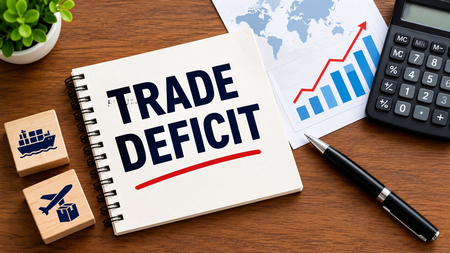
Washington, Oct 6 (IANS) The United States recorded a $6.2 billion goods trade deficit with India in August, according to official data released Tuesday, as America's overall trade deficit widened sharply during the month on a surge in imports.
The India deficit placed the country among the major economies with which the United States ran a merchandise trade gap in August, according to the US Census Bureau and the Bureau of Economic Analysis.
The figures come as trade remains a central issue in India-US economic relations and Washington seeks to reduce its deficits with major trading partners.
The $6.2 billion figure relates to trade in goods and is calculated on a Census basis. The monthly country figures released by the agencies do not represent the broader bilateral balance covering both goods and services.
India's deficit was the same as Germany's during August and smaller than the U.S. deficits with Mexico, Vietnam, Taiwan, China, the European Union, South Korea and Canada.
The largest US goods deficit among the countries and regions listed was with Mexico at $27.7 billion, followed by Vietnam at $24 billion, Taiwan at $18.3 billion and China at $16.4 billion.
The deficit with the European Union stood at $11 billion, while South Korea accounted for $9.4 billion and Canada $7.1 billion.
Malaysia followed India and Germany with a $6 billion deficit, while the U.S. deficit with Italy was $4.3 billion and with Japan $3.7 billion.
The United States, meanwhile, recorded goods trade surpluses with several major partners and regions, including the Netherlands at $7.7 billion, South and Central America at $5.6 billion, the United Kingdom at $3.6 billion and Hong Kong at $2.3 billion.
The India number was released as part of data showing a substantial deterioration in America's overall trade balance in August.
The US goods and services deficit rose to $105.6 billion, an increase of $12.7 billion, or 13.7 per cent, from a revised $92.8 billion in July.
Exports rose by $4.5 billion to $315.2 billion, while imports climbed much faster, increasing by $17.2 billion to $420.8 billion.
The widening of the overall deficit reflected a $12.8 billion increase in the goods deficit, which reached $136.6 billion. The United States continued to run a substantial surplus in services, which edged up by less than $100 million to $31 billion.
Goods exports increased by $4.4 billion to $205.7 billion in August. The increase was driven in part by industrial supplies and materials, including nonmonetary gold, crude oil and fuel oil.
Capital goods exports also increased, with shipments of semiconductors, computers and computer accessories rising during the month. Pharmaceutical exports, however, fell by $2.4 billion.
Goods imports increased by $17.2 billion to $342.2 billion. Industrial supplies and materials accounted for a $9.1 billion increase, including higher imports of crude oil and nonmonetary gold.
Imports of capital goods rose by $6.2 billion, with semiconductor imports increasing by $2.4 billion.
Despite the sharp monthly increase, the U.S. trade deficit for the first eight months of 2026 remained substantially below its level during the corresponding period last year.
The goods and services deficit fell by $138.2 billion, or 19.9 per cent, year-to-date compared with the same period in 2025. U.S. exports increased by $267.7 billion, or 11.8 per cent, while imports rose by $129.5 billion, or 4.4 per cent.
--IANS
lkj/ksk/as
Pakistan continues to create instability in neighbourhood through proxy groups
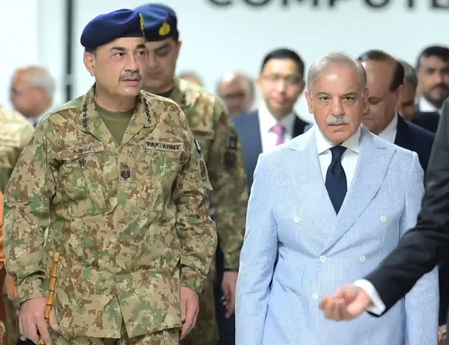
Islamabad, Oct 6 (IANS) Pakistan continues to use policy of creating instability in the neighbourhood through proxy groups as it is cheap, easy to deny, beneficial for its military and allows the Pakistan army to keep its budget and political power intact while the citizens of the country bear the ultimate costs, a report has detailed.
Pakistan using jihadist proxies against its neighbours is a key part of its policy, active on two fronts and backed by top military leadership. Pakistan originally used this approach against India in Jammu and Kashmir and is now targeting the Taliban in Afghanistan. Pakistan started using this strategy more than 70 years ago, according to a report in Afghan Diaspora Network.
The events of 2025 indicated that Pakistan continues to use this policy even today and uses it to create instability in the region and places the spotlight on the Pakistan military as their protector. In April last year, Pakistan-backed terrorists gunned down 26 civilians in Jammu and Kashmir's Pahalgam, and the Resistance Front (TRF), a Lashkar-e-Tayyaba (LeT) proxy, claimed responsibility for it.
In response to the heinous Pahalgam attack, the Indian armed forces in May last year launched 'Operation Sindoor', carrying out what officials described as a focused, measured and non-escalatory military action targeting high-value terror bases in Pakistan and Pakistan-occupied Kashmir (PoK). The close connection between the Pakistan military establishment and proxy outfits was showcased after India's Operation Sindoor, as pictures showed funerals of terrorists, with coffins covered in Pakistan’s national flag, and senior uniformed army officials present there.
Pakistan has also been using this approach against Afghanistan. Pakistan helped create the Afghan Taliban and backed the Haqqani network. Pakistan's Inter-Services Intelligence (ISI) chief was in Kabul just days after the Taliban seized power in 2021. However, the ties between Pakistan and Pakistan have been strained in recent times.
Recently, Afghanistan's Ministry of Defence said that its forces killed 28 fighters and captured 32 others in Nuristan and accused Pakistani security forces of financing and training those individuals to fight against the Taliban. Earlier this year, a Taliban spokesperson said a group within Pakistan's military was attempting to destabilise the region and accused Islamabad of sheltering Islamic State Khorasan (IS-K) rather than fighting it, the Afghan Diaspora Network report mentioned.
"Pakistan continues using this strategy of creating instability in the neighbourhood through proxy groups because it is cheap, easy to deny, and benefits the military. It helps the Pakistan Army keep its budget and political power intact, while the local population bears the ultimate costs. International sanctions have mostly targeted individuals and terrorist outfits, not the Pakistan Army itself," Rahmatullah Achakzai, journalist based in Balochistan, it stated.
"Moreover, Pakistan got off the FATF grey list by changing its paperwork, and since 2025, renewed US ties with Rawalpindi have removed the last bit of external pressure on terrorism. As a result, South Asia now faces increasing chances of instability, aided by the Pakistani military, that may lead to major military conflicts and possibly mass-casualty events," it added.
--IANS
akl/as
US House resolution honours brave Indian pilot Capt Machchhar
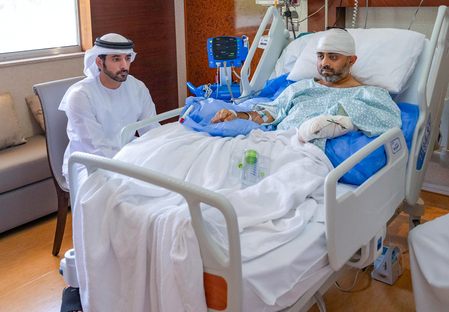
Washington, Oct 6 (IANS) Three US lawmakers have introduced a bipartisan House resolution honouring Indian pilot Captain Smit Machchhar for fighting off an attack in the cockpit of a Flydubai flight and helping save about 174 people aboard.
Representatives Josh Gottheimer, Michael McCaul and Don Bacon introduced the resolution, which condemns the September 30 attack on Flydubai Flight 1073 as an act of terrorism and calls for a full investigation by Saudi Arabia and the United Arab Emirates.
House Resolution 1612 was introduced on October 5 and referred to the House Foreign Affairs Committee.
The resolution recounts the events aboard Flight 1073, which departed Dubai International Airport for Ben Gurion Airport in Tel Aviv carrying about 174 passengers.
Most of the passengers were Israeli citizens. Four US citizens and 27 children were also aboard.
According to the resolution, midway through the flight, the first officer attacked Machchhar on the flight deck with the aircraft’s emergency crash axe and attempted to seize the flight controls.
The aircraft lost more than 14,000 feet of altitude in under 30 seconds.
Machchhar, an Indian citizen, fought off the attack despite suffering grave injuries, the resolution said.
He then used his remaining strength to unlock the cockpit door, allowing off-duty pilots to enter the flight deck and land the aircraft. Crew members and passengers were able to restrain the first officer.
The aircraft landed safely at Tabuk Airport in Saudi Arabia, with all passengers and crew accounted for.
The resolution cites an October 3 announcement by the Attorney General of the United Arab Emirates saying an Emirati investigation had determined that the first officer attempted to carry out a terrorist act.
The lawmakers are seeking formal House recognition of Machchhar’s actions.
The resolution “honors Captain Smit Machchhar for extraordinary courage in protecting every soul aboard his aircraft.”
It also “commends the heroic actions of the off-duty pilots, cabin crew, and passengers who secured the flight deck and brought the aircraft safely down.”
The House measure wishes Machchhar and all others injured in the incident a full recovery.
It condemns the attack on Flight 1073 “as an act of terrorism and as an attack on the safety of international civil aviation.”
The resolution also calls for a “full and expeditious investigation” by Saudi Arabia and the UAE and says the United States and Israel should be kept fully informed.
The measure puts the incident before Congress as an international aviation security issue and seeks formal recognition for Machchhar as well as the off-duty pilots, cabin crew and passengers who helped secure the flight.
The presence of four US citizens aboard the aircraft also gives the United States a direct interest in the investigation. The resolution specifically calls for Washington to be kept fully informed as Saudi and Emirati authorities investigate the attack.
The measure has been referred to the House Foreign Affairs Committee, which handles legislation and resolutions involving US foreign relations and international affairs.
A House resolution expresses the position or sentiment of the chamber. Unlike a bill or joint resolution, a simple House resolution does not require Senate passage or the President’s signature.
--IANS
lkj/ksk/as
Black flags in PoK put Islamabad’s unfulfilled promise under spotlight

Brussels, Oct 6 (IANS) A year after Islamabad signed a deal with the Joint Awami Action Committee (JAAC) to quell prolonged protests in Pakistan-occupied Kashmir (PoK), black flags raised by the group on October 4 have exposed fresh cracks in the agreement and put Pakistan’s promises under renewed scrutiny, a report has stated.
It noted that the October 4, 2025 pact was meant to address long-standing grievances over electricity costs, healthcare, education, infrastructure, political representation, government privileges and institutional reforms in the occupied territory.
Writing for Europa Wire, Greek lawyer, writer and journalist Dimitra Staikou drew a stark contrast between last year’s agreement and this year’s protests, noting that the Joint Awami Action Committee ( JAAC) has marked October 4 as a “Black Day”
“Between those two images lies a question that no new promise can evade: what is a state’s signature worth when, a year later, those to whom the promise was made are still demanding that it be honoured?” she questioned.
Staikou, citing 45-year-old construction worker Zaheer Iqbal, said the crisis in PoK was being felt not through political statements but through every litre of fuel and every minute lost in reaching medical care.
In mid-June, Iqbal’s elder brother collapsed with severe chest pains in the mountain village of Keri Kot, but no ambulance was available.
Iqbal, his sons and other relatives carried him on an improvised bed to the nearest road, while neighbours siphoned petrol from their motorcycles to take him to the government hospital in Hajira.
Although doctors managed to stabilise him, he still needed to be taken to Islamabad, around 140 km away, requiring another vehicle and more fuel, she mentioned.
“That is the human reality behind demands that can sound technocratic on paper: affordable electricity and essential goods, functioning public healthcare and education, infrastructure, limits on the privileges of the political elite and more meaningful representation,” Staikou noted.
According to the report, the October 2025 agreement was meant to translate assurances into measurable action.
It included funding for health cards, MRI and CT scanners, Rs 10 billion for upgrading the electricity system, new education boards and institutional reforms. It also proposed capping the cabinet at 20 ministers and setting up a committee to examine one of the most contentious issues — the 12 reserved seats in the so-called Legislative Assembly of PoK.
However, the report said, the ground reality presented a different picture, with JAAC demanding written and verifiable proof that the commitments had actually been implemented instead of fresh political assurances.
By September 28, almost a year after the agreement, the group was still pressing for implementation. It subsequently observed the anniversary of the pact as a “Black Day” with black flags and protest programmes in PoK, the report mentioned.
--IANS
scor/ksk/as
Chabahar-Zahedan railway part of broader vision for developing regional connectivity: Iranian envoy
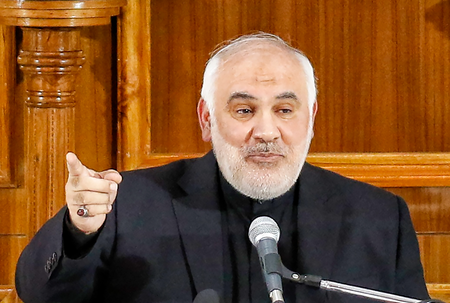
New Delhi, Oct 6 (IANS) Iran's Ambassador to India, Mohammad Fathali, on Tuesday said that the Chabahar-Zahedan railway was part of a broader vision for developing regional connectivity and could give India access to Afghanistan, Central Asia and wider trade routes in the region, with the line expected to become operational in the near future.
"The Chabahar-Zahedan railway is not merely a transport project for Iran and India. It is part of a broader vision for developing regional connectivity. As has been announced, rail-laying on this line is complete and the final stages of making it operational are under way. Provided the necessary conditions are in place, we expect the route to become operational in the near future," Fathali told IANS in an exclusive interview.
The envoy said the line's value lay in connecting Chabahar beyond Zahedan.
"The railway's significance goes beyond connecting Chabahar to Zahedan. It can link Chabahar to Iran's rail network and, through it, to Afghanistan, Central Asia and wider trade routes, facilitating India's access to these markets," he said.
"For this reason, we regard the project as one of the important infrastructure initiatives for economic and transit cooperation between India, Iran and the region, and for strengthening regional connectivity corridors. If this capacity is fully activated, it can play an important role in creating a reliable, sustainable and transformative trade route among India, Iran, Afghanistan and Central Asia," the Ambassador added.
Asked about progress on matters of mutual cooperation after the meeting between Prime Minister Narendra Modi and Iranian President Masoud Pezeshkian that took place on the sidelines of the BRICS Summit last month, Fathali said the Iranian President had acted on it immediately.
"From the very first days after these discussions, President Pezeshkian issued the necessary instructions to the relevant ministries and authorities, and the matters agreed during the meeting are being pursued seriously by the relevant institutions. Various issues are on the agenda in Iran-India relations. Implementing the agreements properly and turning them into practical results requires time and sustained follow-up," he said.
The envoy expressed hope that the process would soon produce results that benefit people in both countries.
"We hope that, by continuing this process and through close cooperation between the relevant institutions of the two countries, we will soon see tangible results from these discussions and agreements, and that the people of both countries will benefit," Fathali said.
"Iran is committed to further developing and deepening relations with India across various fields. We believe the existing capacities between the two countries provide a basis for broader and more productive cooperation," he added.
--IANS
ksk/as
Pakistan: Imran Khan’s PTI dismisses Shehbaz Sharif’s offer for talks as ‘merely symbolic’
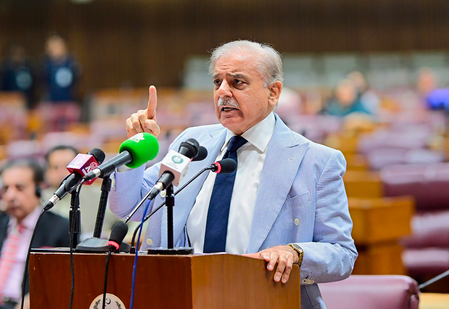
Islamabad, Oct 6 (IANS) Pakistan Tehreek-e-Insaf (PTI) chairman Gohar Ali Khan on Tuesday said that Pakistan Prime Minister Shehbaz Sharif's offer for talks was "merely symbolic" and no positive step has been taken beyond extending the invitation, local media reported.
Speaking to reporters in Rawalpindi, Gohar Ali Khan said PTI leaders had not been allowed to meet party founder Imran Khan for a year, and the last meeting took place in October last year, Pakistan's leading news network Geo News reported.
Gohar Ali Khan's statement came hours after Shehbaz Sharif offered to hold talks with PTI, provided the party ends its ongoing long march towards Islamabad.
While speaking at an event in Islamabad, Sharif said that the politics of sit-ins and long marches would impact Pakistan's economy. "I urge you to come to your senses, end the long march and sit-in, and then we will sit with you," he said.
On Monday, Khyber Pakhtunkhwa Chief Minister Sohail Afridi urged PTI workers to join the long march as the convoy reached Kohat. While addressing the participants during the long march in Kohat, he thanked the people of the city for their "magnificent welcome" and said that the long march would resume its journey towards Peshawar from University Chowk on Tuesday, 'The Express Tribune' reported.
Afridi said, “I am a soldier of Imran Khan. Even if the whole world comes together, it cannot put a price on me." He said that they have to convey the message that Khyber Pakhtunkhwa belongs to Imran Khan.
Sohail Afridi began the march from Lakki Marwat on Sunday, after the talks between PTI and the federal government failed to resolve a dispute over the party's planned protest, the newspaper reported.
The talks chaired by National Assembly Speaker Ayaz Sadiq ended on Saturday without yielding any positive outcome. The federal government wanted the PTI to cancel its march while the opposition demanded assurances that they would be allowed to meet Imran Khan. Subsequently, PTI leaders announced that the march would proceed as planned.
--IANS
akl/as
Cyprus: Indian envoy discusses outcomes of govt delegation’s visit with shipping minister
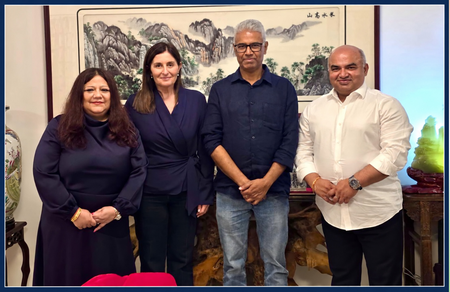
Nicosia, Oct 6 (IANS) India's High Commissioner to Cyprus, Manish, met country's Deputy Minister of Shipping Marina Hadjimanolis on Tuesday, holding discussions on the outcomes of the recent visit of the Indian government delegation from the Ministry of Ports, Shipping and Waterways.
“High Commissioner Mr. Manish met Deputy Minister Ms. Marina Hadjimanolis, Shipping Deputy Minister of Cyprus, to discuss the outcomes of the recent visit of the Indian Government delegation from the Ministry of Ports, Shipping and Waterways for the 1st India–Cyprus Joint Maritime Committee (JMC) meeting held on 29 September 2026,” the Indian High Commission stated on X.
The High Commissioner conveyed that he looks forward to welcoming to India the Cypriot shipping delegation led by the Deputy Minister and the accompanying business delegation from the Cyprus Chamber of Commerce and Industry, taking forward the momentum generated by the Joint Maritime Committee.
“The High Commissioner also thanked Mr. Prabhat Jha, CEO, and Ms. Nita Jha, Director, MSC Shipmanagement Limited, for hosting an informal gathering to discuss shared maritime and shipping interests,” said the High Commission.
The Joint Maritime Committee meeting in Limassol was co-chaired by Joint Secretary (International Cooperation) in the Ministry of Ports, Shipping and Waterways, Venkatesapathy S, and Acting Permanent Secretary in the Shipping Deputy Ministry of Cyprus, Theodoulos Mesimeris.
High Commissioner Manish also joined the Indian delegation's engagements with Cypriot maritime authorities and industry from September 28 to October 1. The delegation also included Deputy Director General, Directorate General of Maritime Administration, Deependra Singh Bisen.
The talks covered maritime education and training, investment opportunities in both sectors, the exchange of policies and strategies as best practices, and cooperation on matters of mutual interest at the International Maritime Organisation (IMO).
The delegation also met the Cyprus Shipping Chamber, leading shipping and maritime companies, the Cyprus Ports Authority and the Cyprus Marine and Maritime Institute, and visited the Port of Limassol.
"Opportunities explored included maritime services, shipping finance, ship repair and recycling, seafarer training and welfare, and green shipping," the High Commission stated.
–IANS
ksk/as