
Bangladesh: Ex-Awami League MP sent to jail over murder cased linked to July 2024 protests

Dhaka, Oct 6 (IANS) A Bangladeshi court on Tuesday sent former Awami League lawmaker Naimuzzaman Bhuiyan to jail in connection with a case involving the alleged disappearance and killing of a rickshaw puller during the July 2024 demonstrations, according to local media reports
Acting on the tip-off, police carried out a raid at his Kazipara residence in Panchagarh Sadar upazila and arrested Naimuzzaman on Tuesday morning, Inspector (Investigation) Ashish Kumar Shil of Panchagarh Sadar Police Station said.
He was subsequently produced before the Additional Chief Judicial Magistrate's Court, where Judge Mosharraf Hossain ordered that the Awami League leader be sent to jail.
Citing court and police sources, Bangladesh's leading newspaper The Daily Star reported that rickshaw puller Al Amin's father, Md Manu, filed the case with Panchagarh Sadar Police Station on November 10, 2024.
Former railways minister and former Panchagarh-2 MP Nurul Islam, Naimuzzaman and 17 others were named as accused, while 150 unidentified people were also implicated in the case.
According to police, Naimuzzaman faces 12 cases, including one over the alleged disappearance and killing of Al Amin and others related to vandalism and arson at a BNP office, Bangladeshi media outlet Views Bangladesh reported.
The latest arrest comes against the backdrop of an escalating crackdown on Awami League leaders and activists that began during the period of the previous Muhammad Yunus-led interim government and has persisted under the ruling Bangladesh Nationalist Party (BNP) administration.
Earlier in August, as many as 53 leaders and activists of the Awami League party and its affiliated organisations were arrested by Bangladesh police, local media reported.
According to a Dhaka Metropolitan Police (DMP) press release, the individuals were arrested from a building in the Bashundhara residential area of Dhaka.
Citing Bhatara Police Station in the capital, the DMP said that the Awami League leaders and activists had gathered to organise a preparatory meeting and a flash march linked to the August 15 mourning day.
Police from Bhatara Police Station subsequently carried out a drive and took 53 people into custody, Bangladesh's leading Bengali daily Prothom Alo reported.
Following the arrests, Bangladesh's Awami League strongly condemned the move, saying it demonstrated that there was now little room left in the country for democratic rights or the freedom to observe religious or national occasions.
--IANS
scor/sd/
El Nino, Atlantic warming could offer early warning of Amazon heat: Study
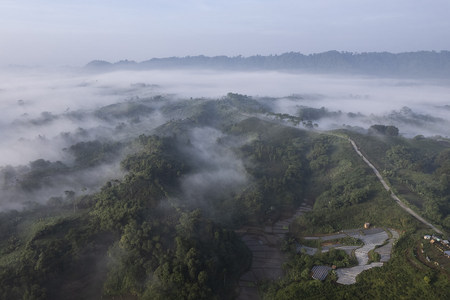
Melbourne, Oct 6 (IANS) El Nino and warming in the tropical Atlantic could help provide early warning of extreme heat in the Amazon, with some signals appearing as much as seven months earlier, new research has found.
Researchers from the Australian Research Council Center of Excellence for the Weather of the 21st Century and Brazil's National Institute of Space Research studied how major patterns of natural climate variability influence temperature and rainfall extremes across the Amazon Basin, according to a statement released on Tuesday by the Australian centre.
The study found Amazon heat extremes were more likely to follow unusually warm conditions associated with El Nino in the tropical Pacific and warming in parts of the tropical Atlantic, reports Xinhua news agency.
The clearest long-range signal occurred from March to May, when extreme heat across much of the Amazon was associated with climate conditions observed up to seven months earlier, according to the study published in the journal Earth's Future.
The research also found early-warning potential for compound hot-dry events, particularly in the northern and lower central Amazon, although predictability was considerably weaker elsewhere.
Researchers said machine learning allowed them to examine relationships with extreme compound events, which are harder to predict.
Compound hot-dry events can increase fire risk, damage ecosystems and threaten human health, food security and water supplies, while weakening the Amazon's ability to absorb carbon dioxide, they said, noting that hot-dry events have become more frequent and intense, with early warnings helping communities and governments prepare for dangerous heat and drought.
The study identifies regions and seasons where Pacific and Atlantic climate conditions could provide early warning, but further research is needed to translate these relationships into practical warning systems.
--IANS
sd/
Journalists attacked at Bangladesh university; sparks widespread condemnation

Dhaka, Oct 6 (IANS) At least 10 people sustained serious injuries after leaders and workers of Bangladesh's ruling BNP government's student wing, Jatiyatabadi Chhatra Dal (JCD), attacked journalists and students at Rajshahi University, local media reported.
The incident occurred on Sunday night outside Shaheed Ziaur Rahman Hall of the university, sparking widespread condemnation and calls for action against those responsible.
The injured journalists were identified as Arifuzzaman Korban, university correspondent of bdnews24; Zahidul Islam of Agamir Shomoy; Noor Ahsan Mridul of The Daily Star; and Mainul Islam Raju of Samakal.
Citing witnesses, Bangladeshi media outlet UNB reported that JCD leaders and workers marched in a procession from the university's Transport Market to the hall gate, allegedly with the intention of attacking hall parliament General Secretary (GS) Ariful Islam.
They were reportedly armed with locally made weapons, including machetes, cleavers, hockey sticks, pipes and baseball bats.
When the university proctor reached the spot, the JCD workers allegedly concealed the weapons. Journalists who arrived to film the incident were subsequently brutally attacked.
Condemning the incident, the anti-graft watchdog Transparency International Bangladesh (TIB) voiced serious concern over the "armed attack and death threats" against journalists at Rajshahi University and called for justice regardless of the political identity or influence of those responsible.
In a statement on Monday, it urged the leadership of the ruling BNP and opposition Jamaat-e-Islami to introduce fundamental reforms and take effective self-corrective measures within their respective parties and affiliated organisations to end violent power struggles.
"Justice must be ensured for the media workers and students who were attacked. Regardless of their political affiliation or power, the perpetrators of the attack, along with their accomplices and supporters, must be prosecuted and held to a high standard through an unbiased investigation," UNB quoted TIB Executive Director Iftekharuzzaman as saying.
Calling for decisive action by the political leadership, he further said, "Can the ruling BNP and the opposition Jamaat-e-Islami evade their primary political responsibility to end the violent struggle for asserting authority and to control their respective parties and affiliated organisations?"
Meanwhile, Dhaka University Journalists' Association (DUJA) also sharply criticised the attack on the journalists, while calling for exemplary punishment against those involved, as well as measures to ensure a safe working environment for media professionals on campuses.
Highlighting that the journalists were brutally beaten with machetes, cleavers, hockey sticks, iron rods, and baseball bats, and that attempts were made to snatch their mobile phones, DUJA leaders said, "We demand a speedy trial for this incident. If justice and accountability are not ensured following this attack, questions naturally arise regarding the performance of the relevant state institutions."
--IANS
scor/sd/
World Bank cuts Nepal growth forecast as floods disrupt economy
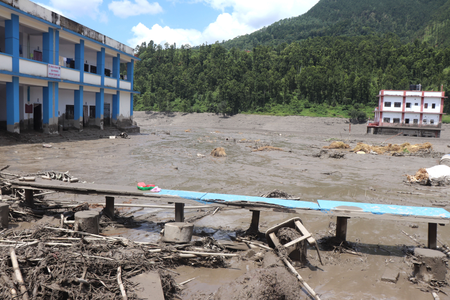
Kathmandu, Oct 6 (IANS) The devastating August floods in Nepal are expected to have a material negative impact on the country’s economic prospects in the short term, the World Bank said on Tuesday as it lowered its economic growth projection for the Himalayan nation.
The global development lender said Nepal’s economic growth is projected to slow to 3.7 per cent in the current fiscal year 2026-27, which began in mid-July, from the 4.2 per cent projected in April, reflecting disruptions to industry and services.
In its report titled Nepal Development Update: Building Back Differently for the Future, released on Tuesday, the World Bank said the August 2026 floods are expected to affect Nepal’s economy through four primary transmission channels: energy, transportation, trade and tourism.
“Agriculture and banking and insurance are also channels through which the economy would be affected, but with relatively lower potential impact,” it said.
According to the bank’s report, energy, particularly hydropower, is the most critical transmission channel. The floods affected 12 hydropower projects, including seven operational projects with a combined capacity of 256.1 MW and five projects under construction with a combined capacity of 395.02 MW, as well as a 25 MW solar facility.
“Damage to transmission infrastructure disrupted an additional 149.6 MW, bringing total affected generation and transmission capacity to approximately 430.7 MW, equivalent to 10.6 per cent of Nepal’s FY26 installed hydropower and solar capacity,” the bank said.
Transportation and trade are other key transmission channels, given the concentration of Nepal’s international and domestic trade along a limited number of corridors, according to the World Bank.
As many as 1,455 people have been confirmed dead and 5,285 remain missing to date following the disaster, which destroyed communities and infrastructure along the Bhotekoshi and Trishuli river corridors, according to the National Disaster Risk Reduction and Management Authority.
According to the Rapid Disaster Needs Assessment (RDNA) report prepared by a joint technical team of the National Planning Commission and the National Disaster Risk Reduction and Management Authority, the recent floods are estimated to have caused physical damage worth 274.48 billion Nepali rupees (about 1.93 billion US dollars), while overall losses and damages have reached 408.28 billion rupees (about 2.87 billion US dollars).
The preliminary assessment suggests that more than 723 billion rupees will be required for the reconstruction and recovery of affected infrastructure and assets. The Nepali government is now working on a Post-Disaster Needs Assessment involving a more extensive assessment of the damage.
The World Bank said industry is expected to be the main drag on growth, reflecting extensive damage to hydropower, solar energy, electricity transmission and transport infrastructure, which will constrain electricity generation and production and disrupt the movement of goods.
“For instance, it took nearly a year to fully restore generation at the 111 MW Rasuwagadhi Hydropower Project, which was severely damaged by the July 8, 2025, Bhotekoshi (Lhende River) flood,” it said.
The same project has once again been badly affected by the August floods.
“This illustrates the potential for flood-related damage to disrupt electricity supply and impose substantial reconstruction costs,” the global development lender said.
“Hydropower construction in areas not directly affected by the flood is expected to continue, although projects could face higher insurance premiums, financing reassessments, and cost overruns,” it added.
“Services are expected to be affected through disruptions to trade, transport, tourism, and financial activity, while agricultural losses are expected to have limited effects on aggregate output but significant impacts on livelihoods in affected areas,” the bank said in the report.
Tourism is expected to face a potentially prolonged impact, reflecting both physical disruptions and heightened perceptions of travel risks, according to the report.
It said more than 200 hotels and restaurants were damaged across the affected districts, while access to major trekking and pilgrimage destinations—including Langtang, Gosaikunda and the Kailash Mansarovar corridor—has been disrupted.
However, economic activity is expected to gradually recover in fiscal year 2027-28 as reconstruction activity begins to gain momentum and damaged infrastructure and productive capacity are progressively restored, the bank said.
--IANS
scor/as
Turkey: Eight students injured in stabbing at middle school in Istanbul
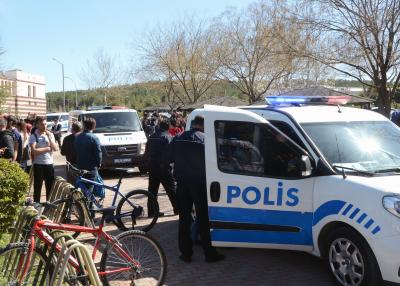
Ankara, Oct 6 (IANS) As many as eight students were injured in a stabbing attack at a middle school in the Basaksehir district of Turkey's Istanbul on Tuesday, local media reported.
As per the initial reports, the fight erupted among students at Kayasehir Sheikh Shamil Imam Hatip Middle School for an unknown reason. The injured students were taken to the hospital for treatment. Police and medical teams were sent to the school after the incident was reported to them, Turkey's leading newspaper 'Daily Sabah' reported.
Istanbul's Governor's Office said that a probe has been launched into the incident. Initial reports have indicated that a female student from another school entered the school wearing the school uniform and stabbed students indiscriminately. The female student suspected of carrying out the attack has been detained by police.
Turkey's Health Minister Kemal Memisoglu said eight injured students were undergoing treatment, including one in critical condition and two in moderate-to-severe condition and wished them a speedy recovery.
"I extend my wishes for a speedy recovery to our students and their families who were injured in the fight that took place at one of our middle schools in Basakşehir. The treatments of our 8 injured individuals affected by the incident —1 in critical condition and 2 in moderate to severe condition — are continuing in our hospitals, and we are closely monitoring their health status. I wish them prompt healing," Memisoglu posted on X.
Earlier in April, nine people were killed and 13 others were injured after a shooting at a middle school in Turkey's Kahramanmaras, local media reported, citing Turkish Interior Minister Mustafa Ciftci.
Kahramanmaras’s Governor Mukerrem Unluer said that an eighth-class student at Ayser Calik Secondary School carried out the attack, Anadolu Agency reported. Unluer said that the student brought firearms in a backpack and opened fire indiscriminately after entering two classrooms.
Unluer said that the suspected attacker also died. Kahramanmaras Chief Public Prosecutor Ramazan Murat Tiryaki said that a probe has been launched into the attack.
--IANS
akl/as
Bangladesh’s Dhaka ranked world’s most polluted city
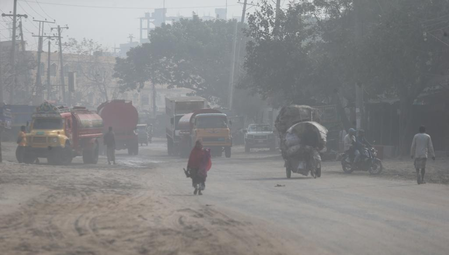
Dhaka, Oct 6 (IANS) Bangladesh's capital, Dhaka, was ranked first among the world's most polluted cities on Tuesday, with an Air Quality Index (AQI) of 213 at 11:10 a.m. (local time), local media reported.
According to the AQI scale, the air quality in Dhaka was labelled as "very unhealthy", indicating a serious health alert where people may experience health effects, United News of Bangladesh (UNB) reported.
Malaysia's Kuala Lumpur has been ranked second among the world's most polluted cities with an AQI of 208, while Singapore ranked third as it recorded an AQI of 179.
According to AQI standards, a reading above 301 is considered 'hazardous'; a reading between 201-300 is considered 'very healthy'; a reading between 151-200 is classified as 'unhealthy'; while a reading between 101-150 is deemed 'unhealthy for sensitive groups.'
Bangladesh's Dhaka has been grappling with air pollution for a long time, with air quality usually deteriorating during winter and improving during the monsoon season, UNB reported.
The AQI is calculated on the basis of five major pollutants: particulate matter (PM10 and PM2.5), nitrogen dioxide (NO2), carbon monoxide (CO), sulfur dioxide (SO2) and ozone.
According to the World Health Organisation (WHO), air pollution causes seven million fatalities each year across the world, mainly due to heart disease, stroke, chronic obstructive pulmonary disease, lung cancer and acute respiratory infections.
WHO data has indicated that almost all of the world's population (99 per cent) breathes air that is more than guideline limits set by WHO and contains high levels of pollutants, with low- and middle-income nations suffering from the highest exposures.
In July, a study conducted by researchers at Jahangirnagar University revealed that air pollution caused by fine particulate matter (PM2.5) kills an estimated 242 people every day in Bangladesh's six major cities and causes an economic loss of around $23 billion annually, Bangladesh-based daily The Daily Star reported.
According to the study, PM2.5 pollution causes about 88,240 premature deaths each year in Dhaka, Chattogram, Rajshahi, Khulna, Sylhet and Barishal -- equivalent to roughly 260 deaths per 100,000 people. The study estimates that Bangladesh faced an economic loss of nearly $23 billion annually from PM2.5 pollution, The Daily Star reported.
The study analysed data conducted by the Climate Change, Air Quality and Health Research (C2AHR) Unit under the Department of Public Health and Informatics at Jahangirnagar University analysed the data from 2013 to 2021.
--IANS
akl/sd/
Pakistan reports sixth polio case of 2026 in Khyber Pakhtunkhwa
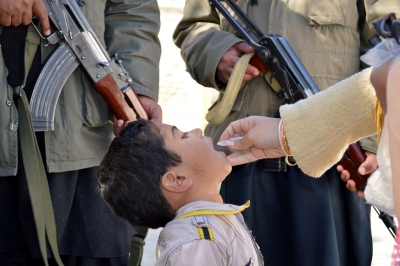
Islamabad, Oct 6 (IANS) Pakistan's National Emergency Operations Centre for Polio Eradication (NEOC) has said that the sixth polio case has been reported in the country in 2026, local media reported.
According to the statement from NEOC, the affected child was a seven-year-old boy from Khyber district in Khyber Pakhtunkhwa province, Pakistan-based daily Dawn reported.
It said that five of six polio cases have been reported in Khyber Pakhtunkhwa in 2026. The fresh polio case has been reported less than a week after the fifth case of 2026 was reported on September 29.
Pakistan and Afghanistan are the only two countries in the world where wild poliovirus remains endemic. Polio workers in Pakistan have been frequently targeted in attacks, particularly in Khyber Pakhtunkhwa and Balochistan.
On September 22, two police personnel guarding polio workers were killed by armed assailants in Noshki district of the Balochistan province.
Noshki City Station House Officer (SHO) Munawar Zaman said that armed assailants on a motorcycle opened fire on police personnel guarding a team of female polio workers who were inoculating children during the week-long vaccination drive, Dawn reported.
The polio team and its members were not hurt in the attack. The gunmen fled from the spot after taking the official weapons of police personnel. After the attack, the authorities suspended the anti-polio campaign in the area.
On May 24, a police official deployed with the polio vaccination team was seriously injured in a firing incident near the Ishaqzai Qila area of Chaman district in Pakistan's Balochistan province. However, the members of the polio team were not hurt in the attack.
On May 18, at least two police personnel escorting polio vaccination teams were killed in separate incidents in Bajaur district of Pakistan's Khyber Pakhtunkhwa, Pakistan-based Geo News reported.
Unidentified assailants attacked the polio vaccination teams in Tabbai and Dag Qila regions of Salarzai, according to a senior police official.
--IANS
akl/sd/
India, US discuss ways to strengthen defence, strategic cooperation
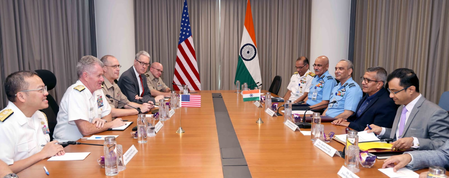
New Delhi, Oct 6 (IANS) Defence Secretary Rajesh Kumar Singh held talks with Admiral Samuel Paparo, Commander of the United States Pacific Command, in New Delhi on Tuesday, with the two sides exploring ways to deepen India-US defence and strategic cooperation and sharing perspectives on regional and global developments.
Following the meeting, the Ministry of Defence took to X and posted: “Defence Secretary Shri Rajesh Kumar Singh met with Admiral Samuel Paparo, Commander of the US Pacific Command, who is on a visit to India. During the meeting, both sides discussed strengthening India-US defence and strategic cooperation and exchanged views on regional and global issues.”
On Monday, Admiral Paparo met several Indian defence chiefs during his ongoing visit to India, underscoring the significance of the US-India Major Defence Partnership, US Ambassador to India Sergio Gor said.
“Honoured to host Admiral Samuel Paparo in India. One of America’s most consequential military leaders, Admiral Paparo commands U.S. Pacific Command, the nation’s oldest and largest geographic combatant command, overseeing approximately 400,000 military and civilian personnel across a region spanning roughly half the globe,” Ambassador Gor stated on X.
“Admiral Paparo joined India’s Chief of Defence Staff, General N. S. Raja Subramani; Chief of the Army Staff, General Dhiraj Seth; Vice Chief of the Air Staff, Air Marshal Ashutosh Dixit; Chief of Integrated Defence Staff, Air Marshal Tejinder Singh; and other senior Indian defence officials for an evening highlighting the growing strength, ambition, and importance of the U.S.-India Major Defence Partnership,” he added.
Earlier, Admiral Paparo also met External Affairs Minister (EAM) S. Jaishankar and discussed advancing the security partnership and maritime cooperation.
"Glad to meet Commander of the US Pacific Command, Admiral Samuel J. Paparo. Discussed advancing our security partnership and maritime cooperation in the Indo-Pacific," EAM Jaishankar posted on X.
Admiral Paparo arrived in New Delhi on October 3 for a six-day official visit to strengthen the defence partnership between the two nations.
Admiral Paparo's discussions with Indian counterparts were about shared security priorities, including harnessing digital transformation and emerging technologies, maintaining regional strategic stability, strengthening defence energy resilience, and navigating an increasingly competitive technology landscape.
"From emerging technology to maritime security, the United States and India are building a defence partnership equipped to meet the challenges of the future," the US Embassy in India said in a statement.
--IANS
scor/rs
South Korea’s National Assembly kicks off annual audit of govt agencies
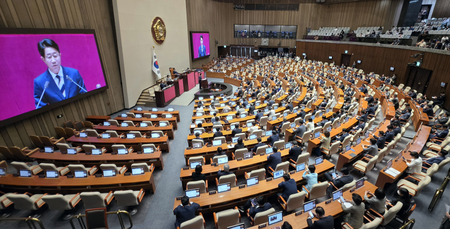
Seoul, Oct 6 (IANS) South Korea's National Assembly launched its annual audit of government agencies on Tuesday, with rival parties clashing over the Supreme Court chief's refusal to recommend a new justice nominee to the president and the recently publicised transfer of two North Korean prisoners of war (POWs) from Ukraine.
Eight of the Assembly's 17 standing committees opened their sessions starting at 10 am (local time) on the first day of the audit, scheduled to run through October 27.
During the audit of the legislation and judiciary committee, lawmakers mainly wrangled over Supreme Court Chief Justice Cho Hee-dae's refusal to recommend a new candidate for court justice as requested by the presidential office, Yonhap News Agency reported.
Earlier in August, the presidential office asked Cho to recommend a new candidate after taking issue with his written recommendation of two Supreme Court justice nominees to South Korea's President Lee Jae Myung. Cho rejected the request, citing a lack of constitutional grounds to do so.
Under the Constitution, Supreme Court justices are appointed by the president on the recommendation of the chief justice and with the consent of the National Assembly.
During the audit, Cho declined to take an oath as a witness, citing the principle of separation of powers among the legislative, executive and judicial branches.
The rival parties clashed from the beginning of the session over whether Cho should be allowed to leave after delivering his opening remarks.
The ruling Democratic Party demanded that he remain and answer lawmakers' questions, while the main opposition People Power Party argued that Cho should be allowed to leave, as chief justices have customarily done after the opening remarks with the approval of the head of the parliamentary judiciary committee.
During the audit of the foreign affairs and unification committee, recent diplomatic tensions with Ukraine over the transfer of two North Korean POWs to Seoul were a key point of contention.
Last month, Ukrainian President Volodymyr Zelenskyy publicly disclosed the transfer, a move South Korea has said was not agreed upon between the two sides.
Seoul has since accused Ukraine of breaching a bilateral agreement to keep the transfer secret, while Ukraine has denied the existence of such an agreement.
South Korea's Foreign Minister Cho Hyun said South Korea had received a message from Ukraine that included an apology over its disclosure, but that it "fell somewhat short of what we had expected."
The recent explosions of North Korea-planted land mines inside the Demilitarised Zone (DMZ), which injured three South Korean soldiers, also came under scrutiny during the audit sessions.
--IANS
akl/
India, Tanzania discuss deepening parliamentary cooperation
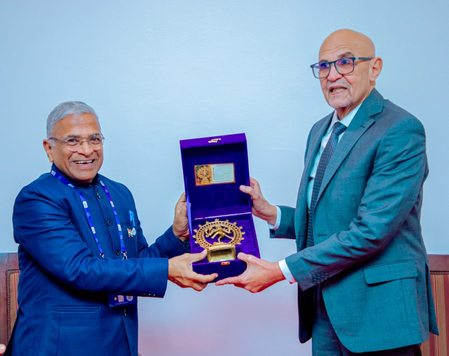
Dar es Salaam, Oct 6 (IANS) Rajya Sabha Deputy Chairman Harivansh held a meeting with Tanzania National Assembly Speaker Mussa Azzan Zungu on the sidelines of the 153rd International Parliamentary Union (IPU) in Tanzania's Arusha on Tuesday, with discussions held on further deepening parliamentary cooperation, capacity building, and skill development between the two nations.
During the meeting, Harivansh congratulated Mussa Azzan Zungu on successfully hosting the 153rd IPU.
"Shri Harivansh, Hon’ble Deputy Chairman of Rajya Sabha held a bilateral meeting with H.E. Mussa Azzan Zungu, Hon'ble Speaker of the National Assembly of Tanzania, on the sidelines of the 153rd International Parliamentary Union (IPU) in Arusha, Tanzania," the Indian High Commission in Tanzania posted on X.
"Discussion took place on further deepening parliamentary cooperation, capacity building, and skill development. Hon. Deputy Chairman congratulated the Speaker of Tanzania on successfully hosting the 153rd IPU," it added.
Harivansh, who is leading a parliamentary delegation attending the 153rd IPU Assembly and related meetings, arrived in Tanzania's Arusha on Sunday.
"Hon. Shri Harivansh, Deputy Chairman of Rajya Sabha and Shri Sasmit Patra, Hon’ble MP of Rajya Sabha was warmly received by H.E. Shri Bishwadip Dey, High Commissioner of India to Tanzania, upon their arrival in Arusha, Tanzania," the Indian High Commission in Tanzania posted on X.
"Hon’ble Deputy Chairman is leading a parliamentary delegation attending the 153rd International Parliamentary Union (IPU) Assembly in Tanzania. The visit symbolizes a landmark success in strengthening parliamentary cooperation," it added.
Rajya Sabha Secretariat stated that the IPU Assembly will bring together parliamentarians from across the world for discussions on the theme “Enhancing good governance and empowering communities through inclusivity, trust and opportunities for all.”
The Indian delegation comprises Harivansh; Lok Sabha MP Anurag Thakur,; Lok Sabha MP Aparajita Sarangi; Rajya Sabha MP Sasmit Patra, Lok Sabha MP Sanjay Jaiswal, Lok Sabha MP Kamaljeet Sehrawat, Lok Sabha MP Lata Wankhede, Lok Sabha MP Bijuli Kalita Medhi, and Lok Sabha MP N. K. Premachandran.
According to the Rajya Sabha Secretariat, the delegation will participate in a wide range of meetings, panel discussions and workshops on issues of contemporary global relevance, and articulate India's perspectives on these matters.
Deputy Chairman Harivansh will participate in the Governing Council, the General Debate, the debate on the emergency item and the hearing with candidates for the position of IPU President.
Members of the Indian delegation will participate in discussions on democracy and human rights, peace and international security, sustainable development, women’s participation, science and technology, counter-terrorism, health, mental health, critical minerals, artificial intelligence and the future of work, maritime security, climate change and protection of mountain and ocean ecosystems, among other subjects.
“The participation of the Indian Parliamentary Delegation reflects India's continued engagement with the IPU and its commitment to parliamentary diplomacy, multilateral dialogue and cooperation among parliaments on issues affecting global peace, development, democracy and the empowerment of communities,” the Rajya Sabha Secretariat stated.
--IANS
akl/rs