
EAM Jaishankar arrives in Ghana to advance comprehensive partnership
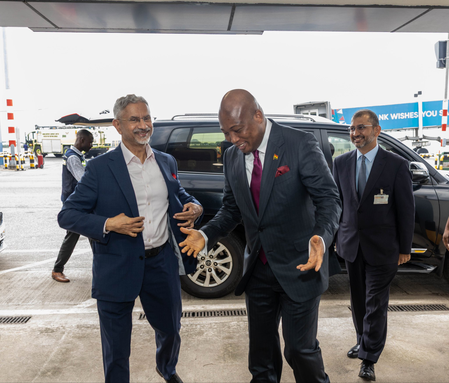
Accra, Oct 6 (IANS) External Affairs Minister (EAM) S Jaishankar arrived in Ghana on Tuesday as India looks forward to productive engagements to advance a comprehensive partnership between New Delhi and Accra.
“Delighted to arrive in Accra, Ghana today. Appreciate the warm welcome by FM Sam Okudzeto Ablakwa. Look forward to productive engagements to advance our Comprehensive Partnership,” EAM Jaishankar stated on X.
On Monday, the Foreign Ministry of Ghana stated that EAM Jaishankar's visit will provide an opportunity for the two countries to renew their bond of solidarity and shared values.
“The Minister of External Affairs of India, His Excellency Dr. Subrahmanyam Jaishankar, will pay an Official visit to Ghana from 6th to 7th October 2026 at the invitation of Ghana's Minister for Foreign Affairs, Samuel Okudzeto Ablakwa. Ghana looks forward to hosting His Excellency Dr. S. Jaishankar on this historic visit, which will afford the two countries the opportunity to renew their inseparable bond of solidarity and shared values,” the ministry stated.
“During the visit, Ghana and India will hold discussions that will advance their relations in pharmaceutical development within the framework of President (John Dramani) Mahama’s Accra Reset philosophy; deepening agricultural cooperation in mechanisation and value addition; support for President Mahama’s industrialisation and job creation agenda; and expanding scholarships and IT partnerships,” it added.
After Ghana, EAM Jaishankar will travel to Cote d’Ivoire and Ethiopia during his five-day official visit aimed at deepening India’s bilateral partnership with the three African nations.
According to the Ministry of External Affairs (MEA), during the visit from October 6 to 10, EAM will hold bilateral meetings with his counterparts and meet with the leadership of all three nations to review close bilateral ties of friendship and cooperation.
"Discussions will cover the whole gamut of bilateral ties across sectors, including trade and economic, development cooperation, capacity building, and people-to-people ties. He will also exchange perspectives on regional and global matters of mutual interest," the MEA stated
In Ethiopia's Addis Ababa, the External Affairs Minister will also chair the Regional Heads of Mission (HoMs) Conference.
"The visit of EAM is reflective of India's commitment to deepen its partnership with Africa, and will further India's solidarity with the Global South," the MEA mentioned.
–IANS
ksk/as
UN experts urge Pakistan to protect girls from forced religious conversion, marriage

Islamabad, Oct 6 (IANS) Three United Nations special rapporteurs have urged Pakistan to protect girls from kidnapping, forced religious conversion and child marriage, stressing that the existing laws in the country have little impact until authorities ensure access to justice and implement them consistently.
The experts made the remarks during a side event of the United Nations Human Rights Council (UNHRC) in Geneva, jointly organised by advocacy groups Jubilee Campaign and the European Center for Law and Justice (ECLJ). The UN experts spoke about the alleged kidnapping, forced conversion and marriage of Christian girls to Muslim men, Morning Star News, a US-based independent news service focusing exclusively on the persecution of Christians, reported.
UN special rapporteur on minority issues Nicolas Levrat; special rapporteur on violence against women and girls Reem Alsalem and Katarina Schwarz, the newly appointed special rapporteur on contemporary forms of slavery and trafficking in persons, participated in the event.
Levrat said that Pakistan, under its international obligations, needs to protect children from forced religious conversion and child marriage. He stated that the impunity surrounding forced religious conversions will not be resolved through new laws or legislation and demanded that religious minorities should have better access to justice in Pakistan, a press statement issued by Jubilee Campaign USA detailed.
In a virtual statement, Schwarz said child marriage can fall within the category of slavery and emphasised that slavery and other forms of exploitation take place in environments, where discrimination occurs, especially against women and girls. She urged Pakistan to take measures and provide "robust and effective protection" to fulfill its obligations, Morning Star News reported.
Reem Alsalem spoke about recent legal reforms in Pakistan, including Punjab’s Child Marriage Restraint Act 2026, which raised the minimum marriage age to 18 years for boys and girls and made underage marriage a non-bailable offense. However, she voiced concern over the inconsistent implementation of such laws and spoke about the pressure faced by victims and their families to withdraw complaints.
During the event, the families of the victims shared their ordeal, including the mother of 13-year-old Christian girl Maria Shahbaz, who disappeared from her home in July last year and later told a court that she had willingly converted and married her 30-year-old alleged kidnapped, Shehryar Ahmad.
In a video played during the event, Maria Shahbaz's mother said, "We don’t know where they are keeping her." "We have terrible thoughts about what is happening to her," the report quoted her as saying.
In July, the European Parliament adopted a resolution calling on the Pakistani authorities to end the abduction and forced conversion to Islam of girls belonging to religious minority communities. Citing United Nations data for 2025, the resolution stated that Christian girls account for nearly 25 per cent of cases involving forced religious conversion through marriage.
In the resolution, members of the European Parliament urged Pakistan to establish a comprehensive national framework to eliminate child marriage and "create a national mechanism for handling complaints from families of abducted or forcibly converted girls from minorities," a report published in The Christian Post stated.
--IANS
akl/as
North Korea warns of ‘powerful counteraction’ if South intrudes ‘even a millimetre’ into its territory

Seoul, Oct 6 (IANS) North Korea on Tuesday warned of an "immediate and powerful counteraction" if South Korea intrudes even "a millimetre" into its territory, after Seoul signalled corresponding measures over a recent land mine blast at the inter-Korean border that it has blamed on Pyongyang.
The North's foreign ministry issued the statement a day after the South's military concluded the mines planted by North Korea caused the September 21 blast on the southern side of the Demilitarised Zone (DMZ) that left two South Korean soldiers critically injured, Yonhap News Agency reported.
The South's military also conducted a mine-clearing operation at the blast site on the same day, in coordination with the UN Command (UNC), which oversees the border area. Defence Minister Kang Shin-chul called the mine-clearing operation a "decisive" response against Pyongyang in the first such mission inside the buffer zone between the two Koreas.
"We do not care about them trying to remove the mines irrelevant to us, and we have no reason to pay heed to such a farce of the ROK," the ministry said, calling South Korea by its official name, the Republic of Korea.
"However, if a jackboot or a spark of fire from the ROK goes even a millimetre beyond the border to violate our territory, the border guard forces of the DPRK will take an immediate and powerful counteraction," it said.
The South's Joint Chiefs of Staff (JCS) announced the final results of the investigation into the mine blast, concluding that antipersonnel mines deliberately planted by North Korean troops south of the Military Demarcation Line (MDL) caused the explosion.
Seoul sees that Pyongyang has violated the Armistice Agreement banning hostile activities and border crossings along the DMZ.
The North's ministry again categorically denied its involvement in the blast, accusing Seoul of shifting the blame onto Pyongyang to frame its border fortification as a military invasion.
"The ROK seeks to hold the DPRK accountable for the premeditated farce, fabricated and determined unilaterally by it, and tarnish the latter's international image," it said.
The ministry vowed to exercise its "just sovereign rights" in a "more resolute and bold manner" to ensure its border security.
"We make it clear that if a similar thing happens again in the ROK in the future, we are not responsible for it, but the side which sustained it is entirely accountable," it said.
The ministry also reaffirmed it has no intention of holding talks with Seoul about "exercising its military sovereignty within its territory," apparently ruling out inter-Korean dialogue to reset or clarify the border line.
"The DPRK will never discuss with the enemy countries the issue of exercising its military sovereignty within its territory but defend its territorial sovereignty by thoroughly exercising its power, not by negotiations," it said.
Unification Minister Chung Dong-young proposed the two Koreas meet to address the discrepancies in the border line, citing the fading visibility of the MDL lines as a primary factor behind the DMZ blast.
Upon the signing of the armistice agreement in 1953, the UNC and the North Korean military installed 1,292 signs along the MDL to mark the ceasefire line.
However, only around 200 remain intact today, as many have deteriorated over time due to weather exposure and lack of maintenance.
A defence ministry official in Seoul said Tuesday that a military task force was launched early this year to discuss the MDL line with the UNC.
The UNC has reportedly conveyed to Pyongyang the need to establish clear and consistent MDL markers along the border.
Seoul and the UNC proposed military-level talks with Pyongyang following a 2015 mine explosion that seriously injured two South Korean troops, but North Korea rejected the offer.
Speaking to reporters earlier, Kang also reiterated that all responsibility for the recent mine blast lies with North Korea, noting the South Korean military will respond to any activities that threaten the country's national security in a "decisive" manner.
Asked about potential follow-up measures, the defence chief said the country will continue to take necessary steps, without elaborating.
–IANS
ksk/as
Saudi diversification, accumulation couldn’t solve its fiscal dependence: Report

New Delhi, Oct 6 (IANS) Saudi Arabia’s accumulated oil wealth and diversification efforts have reduced some vulnerability to supply shocks but largely shifted the risk from reserves to the reliability of getting crude to buyers, a new report has said.
The report from India Narrative said redundancy in export routes helped Riyadh contain the damage when the western export corridor was shut, but the alternative eastern route depends on external security and the western route requires time‑consuming repairs.
“Oil abundance is not oil security, infrastructure is not autonomy — the western door depends on repairs and a contested Red Sea, the eastern on American cover Riyadh does not command,” the report noted.
The East–West pipeline from Abqaiq to Yanbu can carry about 7 million barrels per day and Riyadh used roughly 4–5 million barrels per day through the spring to keep exports at 60–70 per cent of pre‑war levels, the paper added.
The report mentioned Goldman that Saudi Arabia’s own deficit improvement at only about one point of GDP, proving that favourable prices are a shallow cushion against a structural problem.
“The fiscal position worsened, in other words, even as the price rose. The SAR 160 billion deficit, entirely debt-financed, had used 97 per cent of the year’s budgeted shortfall by June,” the report noted.
Analysts had flagged the regional pattern that fiscal sustainability across the GCC is “mostly unrelated to the degree of economic diversification.”
The publication said that the period of easy oil for Saudi Arabia is ending not because its fields are emptying but because the barrel can no longer be assumed to reach the buyer.
Meanwhile, last month in its Saudi Construction Index, Al Rajhi Capital said the kingdom's construction activity expanded for the fourth straight month in August, driven by resilient demand conditions and a sustained recovery in new orders.
The seasonally adjusted Alrajhi capital Saudi Construction Index, which was compiled by S&P Global Market Intelligence, climbed to 55.4 in August from 55.2 in July.
—IANS
aar/pk
India offers coastal resilience, space-based solutions to Pacific partners
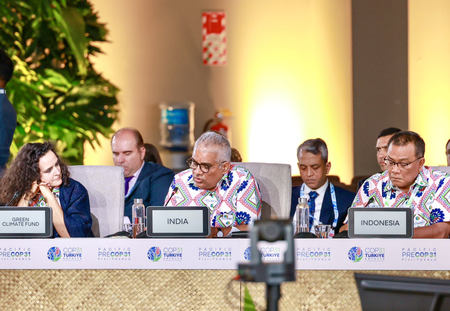
Suva, Oct 6 (IANS) Union Environment, Forest and Climate Change Minister Bhupender Yadav on Tuesday offered to share India’s expertise in coastal resilience, climate-risk assessment and space-based applications with Pacific partners, while calling for equal attention to adaptation, mitigation and means of implementation ahead of the COP31 conference.
Yadav is leading the Indian delegation at the Pre-COP31 meetings under the United Nations Framework Convention on Climate Change (UNFCCC), being co-hosted by Australia, Fiji and Tuvalu.
Pre-COP is a preparatory meeting held a few weeks before the annual UN Climate Change Conference, with COP 31 scheduled to be held in Turkey in November this year.
Addressing the Leaders’ Plenary at the Pre-COP in Fiji, Yadav emphasised that the principles of Equity and Common but Differentiated Responsibilities and Respective Capabilities (CBDR-RC) must be upheld in letter and spirit for meaningful and sustained climate action across countries.
The Union Minister said that India, with its vast coastline and islands, fully understands the challenges faced by Pacific Island Countries.
Yadav highlighted that India has developed a broad knowledge base and expertise in the area of ocean science through premier institutions and bodies like the Indian Space Research Organisation (ISRO), the National Centre for Sustainable Coastal Management (NCSCM), and the National Centre for Coastal Research (NCCR).
He also stressed that India has developed knowledge and expertise in vulnerability assessment of coasts, mapping of shoreline changes, development of marine spatial plans, integrated management plans for coastal areas, and unlocking the potential of the Blue Economy, according to the Ministry of Environment, Forest and Climate Change.
Yadav further said that India is also using its space ecosystem, Earth-observation capabilities and space-based applications for shoreline monitoring, inundation assessment, cyclone and extreme-weather early warning, and climate-risk assessment. He offered to share this knowledge and expertise with its Pacific partners.
Reaffirming New Delhi's commitment to its Pacific partners, the Union Minister said that India is working closely with them in areas including health and wellness, renewable energy, resilient infrastructure, early warning, IT, agriculture and capacity building.
Referring to his visit to Tuvalu, Yadav said the Tuvalu Coastal Adaptation Project was a strong reflection of how international cooperation, particularly the provision of means of implementation, can translate into tangible resilience on the ground, the Ministry mentioned.
The Union Minister reiterated that the experience has reinforced the importance of finding local solutions to emerging climate challenges.
--IANS
scor/as
Indian envoy presents credentials to Iran President, reiterates New Delhi’s commitment to strengthen ties
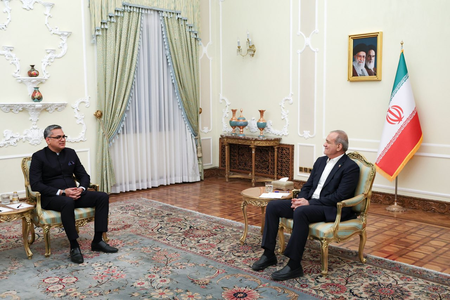
Tehran, Oct 6 (IANS) India's new Ambassador to Iran, Vishwesh Negi, on Tuesday presented his credentials to Iran President Masoud Pezeshkian and reiterated New Delhi's commitment to further strengthening the bilateral partnership.
In a statement shared on X, the Indian Embassy in Iran stated, "H.E. Shri Vishwesh Negi presented his credentials as Ambassador of India to the Islamic Republic of Iran to H.E. Dr. Masoud Pezeshkian, President of the Islamic Republic of Iran. The Ambassador reiterated India’s commitment to further strengthening the India-Iran partnership and advancing the vision set out by the leadership of both countries.
Negi assumed charge as India's Ambassador to Iran on September 3. Before joining as Ambassador of India to Iran, he served as Joint Secretary, Oceania and Indo-Pacific, at the Ministry of External Affairs (MEA).
Last month, Pezeshkian visited India to attend the 18th BRICS Summit held in New Delhi on September 12-13. Prior to his departure, Pezeshkian said that he is looking forward to seeing Prime Minister Narendra Modi in Iran very soon.
“Goodbye, my dear friend. I look forward to seeing you in Iran very soon,” the Iranian Embassy stated on X, sharing a picture of Pezeshkian and PM Modi.
During his visit, Pezeshkian met President Droupadi Murmu at Rashtrapati Bhavan in New Delhi, where they discussed the bond of friendship between India and Iran. President Murmu reiterated India's commitment to the pursuit of enduring peace through dialogue and diplomacy.
“President of the Islamic Republic of Iran Dr Masoud Pezeshkian met President Droupadi Murmu at Rashtrapati Bhavan. The two leaders discussed the long-standing bonds of friendship between Iran and India, including our strong cultural and people-to-people ties. The President reiterated India's commitment to the pursuit of enduring peace through dialogue and diplomacy,” the President’s Secretariat stated on X.
President Pezeshkian held a meeting with Prime Minister Narendra Modi in New Delhi, where they discussed bilateral ties and the prevailing situation in the region. PM Modi noted that President Pezeshkian’s visit was "more special" as he visited India for the first time.
“From Bishkek to Delhi, the productive discussions continue. Happy to have met Dr Masoud Pezeshkian, the President of Iran. This visit is more special because it is his first visit to India,” PM Modi posted on X.
“We talked about the India-Iran friendship. We believe that we should move forward with a long-term and win-win strategy. The prevailing situation in the region was also discussed. India remains steadfast in its commitment to the pursuit of enduring peace,” he added.
--IANS
akl/as
Attacks on civilian shipping are ‘unacceptable’: EU Chief on Black Sea situation
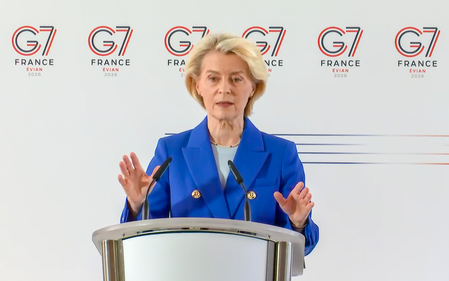
Brussels, Oct 6 (IANS) Terming attacks on civilian shipping ‘unacceptable’, European Commission President Ursula von der Leyen on Tuesday said that situation in the Black Sea is becoming "increasingly concerning".
“Commercial ships – and innocent crews – are being targeted, with lives already lost at sea. Today, two commercial vessels were hit in Bulgaria’s economic zone in Black Sea. This comes just one day after a Turkish ship carrying Ukrainian grain was struck and sunk off the Romanian coast,” Von der Leyen stated on X.
“While exact circumstances of these incidents are still being established, the developments are very concerning. Attacks on civilian shipping are unacceptable. We stand in full solidarity with our Member States on the Eastern flank,” she added.
Bulgarian Prime Minister Rumen Radev said that drones sank one merchant ship and set another on fire in the Black Sea off the coast of Bulgaria.
At around 3 am (0000 GMT), two merchant ships were attacked with sea and air drones around 70 nautical miles east of the town of Byala in the country's exclusive economic zone, Radev said at the beginning of a meeting with representatives of the Bulgarian institutions, Xinhua News Agency reported.
This was confirmed by eyewitnesses, Radev said.
The first ship, flying the flag of Togo, has sunk, and so far no people from the first ship have been found, Radev noted.
The second ship was on fire. The 18-member crew managed to evacuate and was rescued. There was one crew member with burns and one with a head injury. A naval ship picked them up to take them to hospital, Radev said.
The remaining 16 people of the second ship were unharmed. Eleven of these crew members were Turkish citizens, and the remaining seven were Indian citizens, he said.
As far as Bulgarian authorities knew, the second ship was loaded with wheat and was heading south, while the ship that sank was heading north, Radev said.
This was an absolutely unacceptable attack, Radev said, adding that Bulgaria would "do everything possible" to explore the entire area and, if possible, rescue survivors from the crew of the first ship.
–IANS
ksk/as
Saudi Arabia says three people injured in attacks on two airports
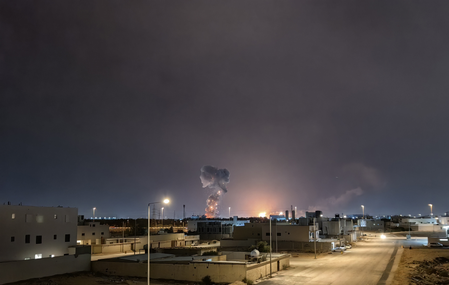
Riyadh, Oct 6 (IANS) As many as three people were injured, and property was damaged after attacks targeted two airports in Saudi Arabia on Monday evening, according to the country's civil aviation authority.
In a statement shared on X, Saudi Arabia's General Authority of Civil Aviation (GACA) said King Abdullah bin Abdulaziz International Airport in Jazan and Najran International Airport were targeted on Monday evening. It said that emergency response teams and relevant authorities responded immediately under established emergency plans.
The three injured people were taken to hospital for medical treatment. GACA said it was working with the relevant authorities to assess the damage, verify the safety of the airport facilities and take measures to ensure the safety of passengers and maintain the safety and security of Saudi Arabia's civil aviation system.
On Monday, the Houthis claimed responsibility for the attacks targeting sites in southern Saudi Arabia, including military facilities and airports, Gulf News reported.
Meanwhile, Saudi Arabia's Ministry of Foreign Affairs condemned the Houthis ' targeting of civilians and civilian and economic facilities in the country and Saudi vessels in the southern Red Sea and the Bab al-Mandab Strait.
"The Ministry of Foreign Affairs expresses the Kingdom of Saudi Arabia's strongest condemnation and denunciation of the terrorist Houthi militia's continued targeting of civilians and civilian and economic facilities in the Kingdom; its blatant and repeated attacks against the holiest sites on earth-Makkah and Madinah— the capital Riyadh, and the cities of Abha, Khamis Mushait, Jazan, Najran, Taif, and Yanbu; and its targeting of Saudi vessels in the southern Red Sea and the Bab al-Mandab Strait," the ministry posted on X.
"The Kingdom affirms that, since the terrorist Houthi militia's coup against Yemen's legitimate government in 2014, the Kingdom has made sustained and tireless efforts to support a comprehensive and lasting political solution in Yemen. However, consistent with its rejection of peace, the terrorist Houthi militia has instead chosen continued military escalation, dragging Yemen and the brotherly Yemeni people into further humanitarian and economic suffering to serve and advance external agendas," it added.
Saudi Arabia reaffirmed its right to defend its territory, resources, sovereignty, and the safety of its citizens and residents, and to take all necessary measures to protect its security in accordance with international law. It also renewed its political and military support for the Presidential Leadership Council, the Yemeni government, and the brotherly Yemeni people to end the coup and restore the state and its institutions from the control of the Houthi militia.
Saudi Arabia's Ministry of Foreign Affairs reiterated its call on the international community, particularly the permanent members of the Security Council, to fulfil its responsibilities, implement the relevant Security Council resolutions, and provide full support to Yemen’s legitimate government in confronting the Houthi militia and ending the threat it poses to Yemen, the region, and the world.
--IANS
akl/as
Ukraine offers ‘insufficient’ apology over North Korean POW disclosure: South Korean FM

Seoul, Oct 6 (IANS) South Korea has received a message from Ukraine containing an apology over its disclosure of the transfer of two North Korean prisoners of war (POWs) to Seoul, Foreign Minister Cho Hyun said Tuesday, but added that the apology fell short of Seoul's expectations.
Seoul demanded an official explanation and apology after Ukrainian President Volodymyr Zelensky disclosed the transfer last month, with his office subsequently denying there had been an agreement to keep the matter confidential, Yonhap News Agency reported.
"I have been in continuous contact with Ukrainian Foreign Minister Andrii Sybiha over the matter, and he has expressed how difficult the situation is," Cho said during a parliamentary audit of his ministry when asked by lawmakers whether Ukraine had apologised.
"Messages that I received (from Sybiha) included an apology. But there is a difference from the level we expect, so we intend to take firm measures," he said.
The minister added that the government is considering various options, including the possibility of recalling South Korea's ambassador to Ukraine, Park Hee-chang, as proposed by a lawmaker.
Cho reiterated that there had been an agreement from the outset to keep the matter confidential to protect the soldiers and their families, who remain in North Korea, noting that the Ukrainian side had first requested that the matter not be made public.
Following Seoul's demand for an official explanation and apology, Sybiha had described the issue as a "diplomatic misunderstanding" and expressed hope that it would be resolved soon.
The two North Korean soldiers were captured in January 2025 while fighting for Russia in the Kursk region and arrived in South Korea in mid-September, according to South Korean officials.
Asked why Zelensky had disclosed the transfer, Cho speculated, while stressing it was his personal interpretation, that the Ukrainian president may have wanted to demonstrate to the United Nations that Ukraine had acted appropriately as a liberal democracy.
South Korea has sought to resolve the dispute through diplomatic channels while emphasising the importance of maintaining its relations with Ukraine.
–IANS
ksk/as
Bangladesh’s economic crisis deepens amid banking woes, energy shortages: World Bank
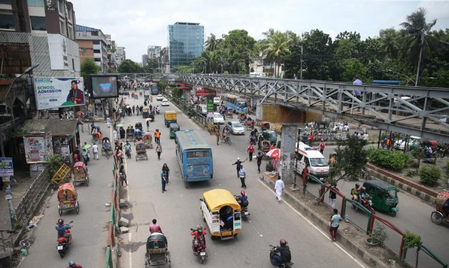
Dhaka, Oct 6 (IANS) Bangladesh faces mounting economic pressures, including a fragile banking sector, energy shortages, weak revenue collection, persistent inflation, eroding competitiveness and growing fiscal pressures that could keep growth subdued without faster structural reforms, local media reported on Tuesday, citing the latest World Bank Report.
The economic assessment was detailed in the World Bank's October 2026 Bangladesh Development Update, titled 'Make Subsidies and Social Protection Work Better for the Poor', released on Tuesday.
Bangladesh's economic growth is projected to remain at 3.4 per cent in fiscal year FY27, the same as in FY26 and significantly below its decade-long average of 5.6 per cent, the World Bank said.
While growth could rise slightly to 3.9 per cent in FY28, it warned that banking sector risks, energy constraints, a weak business environment and limited fiscal room are likely to hamper growth, Bangladesh's leading newspaper The Business Standard reported.
Reports suggest that the main reason for the decline in growth was the contraction in investment. In the 2025-26 fiscal year, private investment fell by 0.5 per cent and public investment by 0.7 per cent. At the same time, real exports of goods and services fell by 4.8 per cent.
Energy security remains another major constraint, as declining domestic gas production has forced Bangladesh to rely increasingly on imported liquefied natural gas (LNG).
Bangladesh now meets around one-third of its gas demand through imports. Fuel and gas shortages have disrupted industrial activity, while bottlenecks in transmission and distribution have restricted the effective utilisation of power-generation capacity.
Factories have been forced to operate below capacity or temporarily suspend operations, while businesses have faced higher costs due to power shortages and dependence on diesel generators, The Business Standard reported.
The World Bank has warned that prolonged energy supply constraints could postpone a recovery in private investment and industrial activity.
Bangladesh's social protection system is failing to adequately shield those most vulnerable to economic shocks.
Around half of the poorest households remain excluded from safety-net programmes, while nearly 62 million people living just above the poverty line face the risk of slipping into poverty.
Meanwhile, subsidy spending remains poorly targeted, with many benefits failing to reach the most vulnerable.
Bangladesh allocates about 3.5 per cent of GDP annually to energy and fertiliser subsidies and social protection, yet the richest urban receive nearly half of all electricity subsidies, the World Bank report highlighted.
--IANS
scor/sd/