



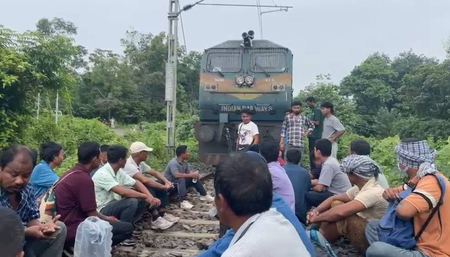
Agartala, June 12 (IANS) Hundreds of surrendered militants on Friday afternoon withdrew their road and railway blockades in Tripura after a series of negotiations with senior government officials, officials said.
Tribal Welfare Minister Bikash Debbarma, Inspector General of Police (Intelligence and Security) Krishnendu Chakraborty and other senior officials held several rounds of talks with the agitating former militants and discussed their demands.
“Following the talks with the surrendered militants, they lifted their road and railway blockades on Friday afternoon,” a senior official said, adding that details of the outcome of the discussions would be disclosed later.
Vehicular movement, including the transportation of essential goods by trucks and the movement of passenger vehicles, as well as train services, was severely affected across Tripura from 6 a.m. on Friday due to the road and railway blockades enforced by hundreds of surrendered militants.
In view of the railway line blockade, the Northeast Frontier Railway (NFR) controlled the movement of five passenger trains at various stations in Tripura.
As announced earlier, the surrendered militants belonging to the now-disbanded National Liberation Front of Tripura (NLFT) and All Tripura Tiger Force (ATTF) launched a 72-hour blockade of highways and railway lines early on Friday morning, protesting the alleged non-implementation of key provisions of a tripartite agreement signed with the Centre and the Tripura government.
A police official said that around 450 tribal youths, all surrendered former extremists, organised blockades at three locations in West Tripura and Khowai districts along National Highway-8 and the railway line since 6 a.m. on Friday. National Highway-8 is considered the lifeline of Tripura, while the state has only one railway line connecting the landlocked Northeastern state with the rest of the country.
Leaders of the surrendered militants claimed that despite repeated assurances, the government has yet to fulfil several commitments made under the tripartite agreement signed in New Delhi on September 4, 2024.
The agreement was signed in the presence of Union Home Minister Amit Shah, Tripura Chief Minister Manik Saha, senior political leaders and officials of the Ministry of Home Affairs (MHA) and the Tripura government. Under the agreement, NLFT and ATTF militants formally surrendered before Chief Minister Saha during a ceremony held at the headquarters of the 7th Battalion of the Tripura State Rifles (TSR) at Jampuijala in Sepahijala district on September 24, 2024.
During the ceremony, cadres of the two insurgent outfits laid down a substantial cache of arms and ammunition and returned to the mainstream under the state’s peace and rehabilitation process.
Former NLFT leader Prasanjit Debbarma said that around 1,200 former militants had surrendered before the Government of India and the Tripura government under various peace accords with the expectation of rehabilitation and socio-economic reintegration.
He alleged that several commitments made under the tripartite agreement remain unfulfilled despite repeated appeals and representations submitted to the authorities.
Debbarma further claimed that although more than two years have passed since many former militants renounced violence and returned to normal life, only 79 cadres have so far been identified as beneficiaries of the rehabilitation package.
According to him, the Central government had announced a rehabilitation package worth Rs 250 crore, which included provisions for economic assistance, livelihood generation, welfare measures and other initiatives aimed at ensuring a secure and sustainable future for those who abandoned insurgency and joined the democratic mainstream.
However, the surrendered militants alleged that a large number of former cadres continue to face financial difficulties and social hardships as several provisions of the rehabilitation package have not yet been fully implemented.
The leaders of the surrendered militants said that they had submitted several memoranda highlighting their grievances to both the state and Central governments on multiple occasions, including recently to Chief Minister Manik Saha, Tribal Welfare Minister Bikash Debbarma and Chief Secretary J.K. Sinha, but claimed that no concrete response had been received.
“Getting no response from the government to our demands and issues, we were compelled to launch a 72-hour blockade of national highways and railway lines at three locations in West Tripura and Khowai districts,” Prasanjit Debbarma told the media.
Following the surrender of NLFT and ATTF militants, Chief Minister Saha, who also holds the Home portfolio, had stated that the decades-old insurgency in Tripura had effectively come to an end, marking a significant milestone in the state’s peace and reconciliation process.
–IANS
sc/uk