



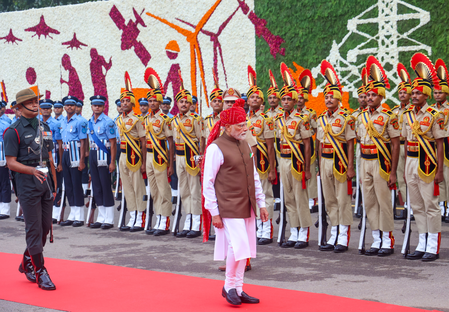
New Delhi, Aug 15 (IANS) On India’s 80th Independence Day, Prime Minister Narendra Modi outlined a bold vision of Viksit Bharat by 2047 from the historic ramparts of the Red Fort.
He placed citizens, youth, farmers, entrepreneurs and innovators at the heart of the nation’s transformation.
The speech highlighted India’s progress over the past decade while setting out seven key streams of strength—from manufacturing and agriculture to technology, defence, energy, infrastructure and soft power—that can propel India towards a stronger and more developed future.
Here are 15 key takeaways from PM Modi’s speech, highlighting India’s journey towards Viksit Bharat 2047, self-reliance, economic growth, technological innovation, national security and inclusive development.
1 Aatmanirbhar Bharat: Self-reliance will remain central. In this context, a strong push for Make in India, Swadeshi and Vocal for Local is a must. It needs to be ensured that Indian products compete successfully in global markets.
2 Manufacturing at global scale: India must own the entire value chain. It will be from design and components to finished products. The focus should be on reliability, precision and quality as its global identity.
3 Agriculture to global markets: Farmers must move beyond production to food processing and exports. The greater emphasis should be on chemical-free farming and meeting global standards.
4 Technology & Innovation: AI, quantum technology, robotics, space, data centres, semiconductors and next-generation communications will be a major pillar of India’s growth story.
5 Semiconductor self-reliance: India is building a domestic semiconductor ecosystem. Three plants have already been initiated. More are expected in the coming years.
6 Energy security: India is targeting 100 GW of nuclear power capacity by 2047. Similarly, focus is on rapidly expanding solar, renewable energy, green hydrogen, energy storage and green mobility.
7 Gati Shakti & connectivity: Seamless connectivity across the country will be strengthened. This will be possible through high-speed rail and modern highways. Airports, inland waterways and multimodal logistics will also be under focus.
8 Defence self-reliance: In fact, India has a clear-cut goal to become a global defence supplier. For this to be a reality, focus is on developing advanced capabilities in drones, counter-drone systems, hypersonic technologies and cybersecurity.
9 Railways & clean transport: The push towards cleaner and more advanced transport is underlined by near-total railway electrification, modern coaches and the development of hydrogen-powered trains.
10 Digital India & Global Leadership: There is no doubt that UPI and Digital Public Infrastructure have underlined India’s capabilities. To take Indian digital public technologies and Made-in-India 6G to the world is the next goal.
11 Youth as the engine of growth: Young Indians are being positioned at the centre of entrepreneurship, research and innovation. More than 2.5 lakh registered start-ups and a Rs 1 lakh crore Innovation Fund are a clear signal for that.
12 AI-ready India: The government plans to train 1 crore young people in AI skills over the next year. The aim is to make India’s youth leaders in the global AI economy.
13 Women, social security & inclusion: The goal of 6 crore Lakhpati Didis, expanded healthcare and social-security coverage, and the call for 33 pc representation for women in legislatures underline the focus on inclusive development.
14 India’s soft power & global ambition: From yoga, Ayurveda, culture and textiles to tourism, sports, films, VFX, animation and gaming, India will leverage its soft power to strengthen its global presence.
15 The overarching message: India’s next chapter must turn dreams into resolve, resolve into strength, and strength into success—with every citizen contributing to the journey towards a Viksit Bharat by 2047.
–IANS
brt/dan