



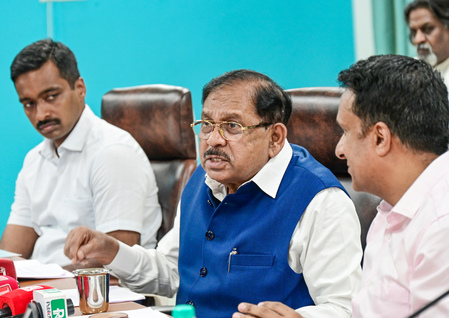
Bengaluru, Aug 18 (IANS) Karnataka Deputy Chief Minister G Parameshwara on Tuesday urged the Union Government to reconsider the Mines and Minerals (Development and Regulation) Amendment Bill, 2026, expressing concern over its provisions that restrict the constitutional powers of states to levy taxes on mineral rights and mineral-bearing lands.
In a letter to Prime Minister Narendra Modi and Union Minister for Coal and Mines G. Kishan Reddy, Parameshwara objected to the proposed provisions and sought a reconsideration of the Bill.
The Deputy Chief Minister referred to Supreme Court’s landmark 2024 judgment, which affirmed the legislative and fiscal powers of states under Entries 49 and 50 of the state list, concerning taxation of mineral-bearing lands and mineral rights.
Parameshwara said the Centre’s “unilateral” approach raised serious concerns about the federal structure of the country. He called for meaningful consultation with all the state governments before bringing changes that could affect their constitutional and fiscal powers.
Parameshwara warned that its provisions of the Act could undermine the constitutional fiscal autonomy of mineral-producing states.
Parameshwara called for a structured and time-bound consultation with all state governments, particularly mineral-producing states, before proceeding with legislation affecting their powers to levy taxes on mineral rights and mineral-bearing lands.
He also urged the Centre to establish a Centre-State consultative mechanism to examine the constitutional, fiscal, economic, environmental and investment implications of mineral taxation.
“The proposed amendment to the MMDR Act has direct implications not merely for a theoretical future source of revenue but for a legislative field which the State Legislature has already exercised pursuant to the constitutional position clarified by the highest court of the country,” Parameshwara pointed out.
The Deputy Chief Minister argued that the issue must be viewed in the broader context of India’s changing fiscal federal structure. He said that states had surrendered significant taxation powers following the introduction of the Goods and Services Tax (GST), while their responsibilities in areas such as public infrastructure, education, healthcare, drinking water, agriculture, urbanisation and welfare programmes had continued to grow.
“States are carrying growing responsibilities with shrinking fiscal space,” he said, stressing that mineral-producing states also bear substantial social, environmental and infrastructure costs associated with mining.
Further, calling for a predictable mineral taxation framework, Parameshwara said concerns over excessive or distortionary taxation could be addressed through consultation and rational limits, while national priorities relating to critical minerals could also be protected without eliminating the fiscal voice of States.
He further cautioned that curtailing a constitutionally recognised taxation field immediately after the Supreme Court had clarified its scope, could create a precedent extending beyond mineral taxation.
“The Union Government must therefore consider not merely whether Parliament possesses a power, but also how that power ought to be exercised within the spirit of cooperative federalism,” he said.
Parameshwara proposed that the Centre consider five measures: withdrawing the MMDR Amendment Bill in its present form; holding structured consultations with State governments; establishing a Centre-State consultative mechanism; taking into account existing and proposed State legislation, including Karnataka’s 2024 Mineral Rights and Mineral Bearing Land Tax Bill; and evolving a consensus-based national framework that protects investment, mineral development and critical-mineral security without extinguishing the constitutional fiscal autonomy of States.
“A developed India requires developed States. An Atmanirbhar Bharat requires financially self-reliant states. And cooperative federalism requires states that are empowered partners, not financially dependent implementing agencies,” Parameshwara said.
–IANS
mka/mr