



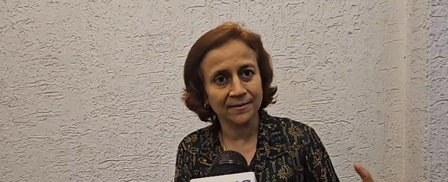
Bhubaneswar, Sep 3 (IANS) Gitanjali Angmo, wife of climate activist Sonam Wangchuk, on Thursday said the government should take the ongoing protests as a ‘wake-up call’ and proactively implement comprehensive reforms in the examination and education systems.
She said the issue should not be viewed as a small or isolated matter, warning that failure to undertake meaningful reforms could lead to significant social pressure and a larger movement in the future.
In an exclusive interview with IANS, Angmo spoke at length on several issues, ranging from the National Education Policy (NEP), examination reforms and the role of teachers, to the debate surrounding ‘Vande Mataram’, Indian philosophical traditions, political polarisation, patriotism and the need to rediscover Indian knowledge systems.
IANS: Can the NEP pave the way to bring the Indian thought process back into the education system?
Gitanjali Angmo: Yes. The NEP as a document is very good. But the biggest question right now is how to implement it. We often talk about the Gurukul system. Its greatest strength was not a fixed curriculum or a particular pedagogy. Its pivotal point was the Guru. The teacher used to shape a child’s behaviour and personality through his or her conduct and influence. The teacher was not merely someone who delivered information or completed a syllabus. The Guru had a much deeper role in shaping the child’s overall personality.
Today, teaching has often become a profession of last resort. When someone fails to become an engineer, doctor or IAS officer, some turn to teaching. We must break this mindset.
Change is necessary. If we want the NEP to be implemented well, teachers must receive a high status in society and better remuneration. Teaching must be made one of the most respected and high-paying professions.
The teacher has an enormous influence on the development of a child. Therefore, if we want to transform the education system, we cannot ignore the person who stands at the centre of that system. We have to create an environment in which talented and capable people actively want to become teachers, rather than treating teaching as something one chooses only when other career options do not work out.
Every child should receive a strong and equal basic education until at least the tenth grade, whether they attend a government or private school. A minimum quality education should be every child’s right.
Today, we see many children moving to private schools, while government schools are closing or are in poor condition in many places. Even basic things like child nutrition remain a challenge in many places. If we talk about becoming a world leader, we must first strengthen our children.
The NEP is an idea. But any idea is only as good as its implementation. The education system will not change simply by creating a document. It requires extensive groundwork. Countries around the world that have successfully reformed their education systems have done so consistently over many years. Therefore, education reform needs to be separated from political cycles.
I believe that for 20 to 30-year-old issues like education, there should be a separate educational commission. Such a commission should not be affected by the comings and goings of political parties. Sometimes, one government initiates a reform and the next government undoes it. This impacts long-term reforms. Education isn’t a five-year project. It’s a decades-long endeavour. Therefore, it should receive some degree of institutional protection from politics.
So far, we’ve primarily tried to improve how examinations are conducted to prevent problems like paper leaks. But the examination system needs much more substantial reforms.
First, we must ask: What exactly are we testing in examinations? Are we simply testing memory? Or are we assessing a child’s understanding and ability to apply their knowledge?
And beyond that, are we simply filling their minds with information, or are we developing their entire personality?
A child’s physical, emotional, mental and spiritual personality should be developed. Education should not merely be about how much information a child can remember and reproduce in an examination. It should be about developing the person as a whole.
IANS: Do you think that if the current education and examination system isn’t reformed, a major movement could emerge?
Gitanjali Angmo: I think the government should take this movement as a wake-up call and proactively implement reforms. This isn’t just a small issue. If comprehensive reforms aren’t implemented in the examination and education system, significant social pressure and a movement could arise in the future.
Every parent wants their child to receive a good education. This is a very emotional and important issue for every family. This is our future and our youth.
Over the past years, we have focussed heavily on infrastructure, roads and hard infrastructure, which is essential. But a country needs soft infrastructure just as much. Education and healthcare are soft infrastructure. Therefore, it is important to make education a national priority.
The NEP should be viewed as a long-term national project. When Finland reformed its education system, it took decades. Education reform is not something whose results will be visible in a year or two.
Therefore, we need an institutional structure that will continue to advance education reforms despite changing governments. The NEP should not simply be a document that is put on a shelf. It must be implemented at the ground level. The real challenge is implementation. We can have the best document, the best policy and the best intentions, but unless these are translated into action in schools, classrooms and the lives of children, there will not be meaningful change.
The government should, therefore, look at the present situation as an opportunity to undertake reforms before the issue becomes much bigger. If parents, students and young people begin feeling that the system is not giving them the opportunities or education they deserve, social pressure will naturally increase. That is why I think the government should act proactively rather than waiting for a major movement to emerge.
IANS: Nandan Nilekani’s committee is working on examination reforms. What suggestions would you like to give them?
Gitanjali Angmo: They are all very senior and experienced people. I don’t consider myself in a position to give them suggestions. As far as I understand, their main focus is to make the examination process end-to-end secure through technology ensuring the confidentiality, fidelity and integrity of the papers.
However, my point is slightly different. With technology, we can ensure that there are no paper leaks in the examination system and that the process remains secure. But the real question is: What are we testing through examinations, and what kind of development is it providing for children?
This is not just a question of technology. It is also a question of education philosophy and examination philosophy. We must ask what the purpose of an examination actually is. If the examination only tests whether a student can remember information and reproduce it under pressure, then we are testing only one limited aspect of the child’s capabilities.
We need to think about whether examinations can test understanding, creativity, application of knowledge, problem-solving ability and the ability to think independently. Technology can certainly make the process more secure. It can help prevent paper leaks and improve the integrity of examinations. But technology cannot answer the larger philosophical question of what education and examinations are supposed to achieve. That is a much deeper issue.
IANS: Why is there still controversy over ‘Vande Mataram’? Do you think our collective memory has weakened regarding this?
Gitanjali Angmo: I think there are a lot of obstructions and objections regarding Vande Mataram. Some are opposing it because there are references to Hindu gods, so they ask how people of other faiths can sing it. This is not a mature way of thinking.
If we read or learn a ghazal and sing it in Urdu, it is not as if a Hindu singing it would have their religion corrupted. Similarly, if we read any shloka or something and associate it with a particular party or with Sanskrit, then that is also very wrong. Sanskrit is a language, so what is the problem?
There is Durga. Durga stands for power. Lakshmi stands for abundance. So, if anyone has a problem with singing a song, you cannot change it. The first two stanzas were initially chosen because the song was too long. It doesn’t mean that the remaining stanzas were not accepted. You cannot cut any work of art.
Secondly, yes, I think Vande Mataram is fading from our collective memory more than it should. Therefore, it needs to be sung and understood again among people, especially among the youth. For me, Vande Mataram is not just a song, but a very profound symbol. Sri Aurobindo also explained this very deeply. When Bankim Chandra Chatterjee wrote ‘Anandamath’, he was not just a novelist; he was a sage. A sage means someone who can see reality. He saw the land of India not just as land, but as a power as a ‘mother’ with whom we can have a living relationship. Therefore, in my opinion, this awareness should not have taken so long to come. If we had come to this understanding earlier, perhaps many of the problems India faces today would not have been so serious.
‘Vande Mataram’ represents a particular sentiment towards the land. It is not simply about a piece of territory. It is about seeing the country as something with which we have a relationship and towards which we have responsibilities. That sentiment, in my view, needs to be understood again, especially by the younger generation.
IANS: Why did it take so long to bring the full national song?
Gitanjali Angmo: As a national song, it was always there, but it was fading from collective memory more than it should have. It took 80 years to sing it from the Red Fort on Independence Day, and I think it is a welcome step. Sri Aurobindo said that Bankim Chandra was a sage. He saw this landmass not as a physical landmass, but as Shakti — a living being.
This Mother is a living being with whom you can have a relationship. So it shouldn’t have taken 80 years.
For me, the important point is not only whether the song is sung, but whether people understand what it represents. If something becomes merely a ritual, then its deeper meaning can be lost. Therefore, I think it is important that Vande Mataram is not only sung but also understood. Young people should know why it became important historically, what it represents and why it inspired people.
IANS: Do you think politics has created a kind of division over Vande Mataram and Hindu culture?
Gitanjali Angmo: That’s the problem. When politics enters public life with its agenda, it often attempts to distance individuals or society from their essence in the name of bringing people together. But there’s no need to amputate oneself to bring everyone together. I can reach the essence of who I am and express it, and the other person can also reach their essence and express it, that’s true beauty.
If, to please others, I close myself off, silence myself and prevent myself from expressing who I truly am, that’s not harmony. It’s a very important principle of collective living. When we talk about harmony, we must understand that harmony doesn’t mean making everyone the same.
Socialism says everyone should have equality, and capitalism offers its own unique system. But reality perhaps lies beyond both. When I can truthfully express my deepest self, and you too have complete freedom to express yours, only then can we together create a perfect society. It’s like a jigsaw puzzle. Each piece is different, but together they form a complete picture. When you go to a botanical garden, not all the flowers are the same. Each flower has a different colour, shape, fragrance and appearance. This diversity is what creates the beauty of a botanical garden.
Even in agriculture, we know that monoculture isn’t always good. When different plants grow together, like in the Miyawaki forest, synergy is created between them. Similarly, in society, we need diversity that uplifts each other without making everyone equal. We should grow through education to the point where we can respect the unique identity and perspective of others. India has always assimilated influences from outside. Whether it’s Mughal influence or any other cultural influence, India has absorbed and assimilated a lot.
But assimilation doesn’t mean we should be ashamed to express our culture that existed ten thousand years ago. We shouldn’t shrink ourselves to accommodate others.
If every person brings their inner nobility to their heart, diversity automatically becomes a strength. We have many good examples of this. Abdul Kalam used to read the Upanishads, the Gita and Sri Aurobindo. I myself read Sufi poetry. There’s no question of religion being corrupted by this. If a Hindu speaks Urdu or a Muslim speaks Sanskrit, that doesn’t corrupt their religion. Rather, we should learn from each other.
The essence of Vande Mataram is–I bow to you, O Mother. For thousands of years, we have seen this land not merely as territory, but as a mother. Therefore, we cannot let go of that sentiment.
We should have a heart big enough to accept everyone, but at the same time, we should also keep our life force, our culture and our heritage alive. This combination can make India a great nation. I don’t think there is as much of a problem among common people as there sometimes is in narratives created because of political agendas. Many times, politicians promote a mindset of division for their own agenda.
Vande Mataram became a war cry because it inspired. So, you can’t negate it due to polarisation. You will have to accept it.
IANS: Why do you feel the need to bring Vande Mataram into use today, when the country is facing poverty and other major problems?
Gitanjali Angmo: Because some things aren’t just solutions to practical problems; they give us the inner strength and inspiration to fight those problems. The sentiment for ‘Mother’ in ‘Vande Mataram’ is not merely a political slogan. It embodies a deep emotional and spiritual connection to the land of India.
Words like ‘Sujalam, Suphalam’ give us an idea of such a motherland which is rich and life-giving. And Vande Mataram gives us a collective aspiration. When we have a deeper emotional connection with the country, it can provide us with a greater sense of responsibility towards it. That doesn’t mean that poverty, unemployment or other practical problems become less important. Rather, the sentiment of belonging to the country can give us greater energy to address those problems.
IANS: There is poverty, unemployment and other problems in the country, then why so much emphasis on Vande Mataram?
Gitanjali Angmo: Because this question of Vande Mataram versus other problems is wrong. If I have to do my job, build my career and work for my livelihood, that doesn’t mean I have to leave my mother behind. Today, a major mental shift is necessary within us from “What can India do for me?” to “What can I do for India?”
This shift is crucial. When we only think about what the country will give us, our perspective becomes one of taking. But when we ask what I can give to the country, then nation-building begins. Nation-building cannot be the responsibility of the government alone. The government has its role, but citizens also have a role. If every citizen begins thinking about what they can contribute to the country, then the collective approach towards nation-building changes.
IANS: So, is Vande Mataram a medium of national inspiration?
Gitanjali Angmo: The purpose of high poetry and high mantras isn’t just to make us emotional. They inspire us, awakening a greater purpose within us. If we have this feeling for our country, we can fight poverty, unemployment and other problems with more energy. Therefore, saying, ‘Why Vande Mataram, when there are other problems?’ isn’t the right framing.
Vande Mataram isn’t against other problems. Vande Mataram is a sentiment that inspires us to fight those problems. When we develop the feeling that this country is mine and I have to make it better and hand it over to the next generation, then nation-building isn’t just the government’s responsibility, it becomes the responsibility of every citizen.
IANS: Terms like ‘Dimagi Naxals’ are being used in India today. How do you view this?
Gitanjali Angmo: There has definitely been a ‘Dimagi Naxal’ phenomenon. If you look at our economic frameworks, educational frameworks, physics, mathematics, every field most of our frameworks come from people who developed their theories and frameworks during the Renaissance, especially in the 16th and 17th centuries. But an interesting thing is that when the Renaissance was taking place in Europe, Sanskrit was taught in European universities.
We know that Oppenheimer read the Gita and Einstein read the Upanishads. Many Western philosophers and scientists, including Plato, read Indian texts and drew ideas from them. But often they presented those ideas as their theories, and we later accepted them as second-hand knowledge. We made little effort to go back to our original sources and see what our texts actually said.
We gradually drifted away from the knowledge systems we had been building on for thousands of years. Our libraries like Nalanda and many original texts were destroyed. Then, during the Colonial period, we were constantly told that we were inferior. This led to a psychological shift. Even today, many of our mainstream frameworks do not incorporate Indian knowledge systems at the level they should.
In recent years, there have been attempts to re-examine Indian knowledge systems, but they haven’t yet been fully integrated into mainstream education. For example, Vastu Shastra is discussed separately, but it isn’t taught in an integrated way with mainstream architecture education. This is part of the slave mentality — that we don’t yet have the passion and curiosity to go back to our original Indian texts and frameworks and see what wisdom they contain. They contain many ideas that are important not only for the past, but also for the future.
However, to me, calling someone a ‘Dimagi Naxal’ is a very insensitive way to describe someone who asks questions. In our own tradition, enquiry has never been considered negative. The Upanishads also have a consistent tradition of questioning. Nachiketa questions Yama. Throughout the Gita, Arjuna questions Krishna. Arjuna even disagrees with Krishna’s views at times.
So, would we call Arjuna a ‘Dimagi Naxal’? No. Because enquiry was part of our education system. Asking questions was a good thing.
Yes, intent is important. Some children genuinely ask questions out of curiosity, while others do so for other purposes. Therefore, it’s not wrong to ask questions; we should consider the intent behind the question. I myself teach the Vedas, Upanishads and Gita from Sri Aurobindo’s perspective, so I’m not just saying this theoretically.
If we delve deeper into our texts, there’s a lot there. Nyaya philosophy talks about reality and logic. Vaisheshika also provides a framework for understanding the nature of reality. Our nine philosophies contain very deep philosophical enquiry. If we’re studying logic today, why not Nyaya? If we’re studying quantum physics, why not Vaisheshika? If we’re studying philosophy, why not Advaita Vedanta? We can’t complete our philosophical understanding by reading only Western philosophers. We must also understand Indian philosophies. Only then can we truly defeat polarisation. This was the beauty of our Sanatan tradition.
Different philosophical paths were presented to children, even contradictory philosophies. Whether it was Charvaka’s materialism, Purva Mimamsa, Uttar Mimamsa or philosophies related to consciousness, the child was introduced to diverse ideas. Then, they had the freedom to understand, reflect and choose which philosophy to follow. This freedom is a significant characteristic of Sanatan Dharma.
IANS: Generally, the Left is considered liberal, and the Right is considered traditional or orthodox. Is this division correct in the Indian context?
Gitanjali Angmo: This division between Left and Right is not that meaningful in the Indian context. It is generally believed that those who are atheists or believe in a philosophy that does not include the concept of God are on the Left, while those who believe in Hinduism or any religious philosophy are on the Right. But if we understand Sri Aurobindo, these two things merge seamlessly.
What we call Hinduism is actually Sanatana Dharma. It is not a fixed or rigid philosophy. It has been evolving over the last ten thousand years from the Vedas to Vedanta, from the Gita to Meera’s Bhakti movement and up to today. Sri Aurobindo’s perspective is also a part of this evolution. When Krishna comes, he explains the profound teachings of the Upanishads through the Gita for the people of that time. Similarly, Sri Aurobindo presents the Gita and Indian philosophy from a new perspective for the modern age. Therefore, it is not correct to simply call it Right Wing or traditional. The tradition itself contains an ongoing process of enquiry, evolution and reinterpretation.
IANS: So, do you consider Sanatan Dharma a liberal philosophy?
Gitanjali Angmo: For me, Sanatan Dharma is very liberating because its fundamental purpose is liberation. If liberation is the goal, then, for me, the meaning of Right also becomes Liberal. Therefore, the usual political division between Left and Right does not fully fit the Indian context.
During Napoleon’s time, those on the Left wanted a new way of thinking about the world, while those on the Right favoured following tradition. But in India, Sanatan Dharma has always had an eternal quest, a spirit, a reality, to be discovered. There can be different paths to reach that reality, different philosophies and different ways of expressing it. Therefore, it fundamentally possesses a liberal mindset. The fact that there can be different paths and different philosophical approaches itself shows that it cannot simply be reduced to one rigid framework.
IANS: Does the same apply to Socialism and Capitalism?
Gitanjali Angmo: In India, we don’t need to view everything solely through the Western frameworks of Socialism and Capitalism. We have considered the four goals of life, Artha, Kama, Dharma and Moksha. Suppose I am earning money, which is a capitalist activity. But if I’m using that money for public good and for the betterment of society, then it also has a social dimension. The idea of Corporate Social Responsibility in India is also connected to this broader cultural understanding. The term CSR is modern, but even before that, large business houses in India built temples, schools and did many other forms of social work.
Similarly, in ancient times, kings didn’t just think of themselves. They supported artisans, village systems and different sections of society. Therefore, applying Western categories of Socialism and Capitalism to India exactly as they are doesn’t always hold true. Indian thought has historically attempted to bring different aspects of life together rather than placing everything into mutually exclusive categories.
IANS: So, does India need to rediscover its own philosophical frameworks?
Gitanjali Angmo: Absolutely. We need to rediscover our own philosophical frameworks. We shouldn’t allow ourselves to become so politically and ideologically polarised that we start viewing everything only through the lens of Left or Right. Many core concepts of our philosophy are not even directly translated into English.
For example, we have mistaken Dharma for ‘Religion’ and called Sanatan Dharma ‘Hinduism’. But Sanatana means eternal. And what is eternal can also be universal. Therefore, it is not correct to understand Sanatan Dharma simply as an ‘ism’. We need to understand these concepts in their original context. If we translate everything into Western categories, there is a danger that we will lose the deeper meaning of the original concepts. Therefore, rediscovering Indian thought does not mean rejecting everything from outside. It means developing the confidence and ability to understand both Indian and Western thought from a broader perspective.
IANS: What is the true meaning of ‘Dharma’?
Gitanjali Angmo: The word ‘Dharma’ comes from the root ‘Dhri’, which means ‘that which holds together’. Therefore, Dharma is not just a religion. Dharma is the principle that holds you together through life’s ups and downs. It gives direction to your life and connects you to your own dharma. Therefore, viewing Dharma only as a method of worship or religious identity would be a very narrow interpretation. Dharma has a much broader meaning in this understanding. It relates to the principles that give direction and coherence to one’s life.
IANS: Do you think India has forgotten its own philosophical language and frameworks?
Gitanjali Angmo: Yes. But I don’t think it’s solely our fault. For thousands of years, we weren’t able to express our own religion and intellectual traditions in the right way. First came invasions, and then Colonial rule. In this process, we drifted away from many of our frameworks. Therefore, today we need to recover them. We must learn to see ourselves through our own lens, rather than just through the lens of the West. And this doesn’t mean we have to reject the West. We can also understand the West through our own lens.
This happens even in Western universities today. For example, they try to understand world literature through Aristotle’s lens. That is, they use their intellectual framework as an interpretive lens. India can also understand the world through its philosophical lens. The objective should not be to reject one system in favour of another. Rather, we should have enough confidence in our own intellectual traditions to engage with other systems from a position of understanding rather than dependence.
IANS: Do you think polarisation is happening?
Gitanjali Angmo: Yes, unfortunately, it is being created by politics. Political leaders are dividing people based on vote-bank agendas. It’s quite unfortunate. So, nation comes first, then parties, then ideologies, and then narratives. But, as I said, there is polarisation, like BJP versus Congress and Left versus Right.
There is diversity in our country. That doesn’t mean that everyone will be the same or that everyone should be forced into the same mould. Everyone is quite different. We should respect and learn from each other. Every country has something unique. If we disregard parties that are polarising and accept those who are uniting people, then we can move towards a healthier form of collective life. The diversity of India should not become a source of conflict. It should become a source of strength.
IANS: You are currently in Odisha. After so many experiences and diverse circumstances, returning to your birthplace, Odisha, what significance does it hold for you?
Gitanjali Angmo: Odisha is my birthplace, and I have learned a lot from this land. Especially, the love and respect that people here have for Sri Aurobindo has been very important to me. Sri Aurobindo’s philosophy has profoundly shaped my worldview. Therefore, Odisha is not only my birthplace, but also a very important part of my intellectual and spiritual journey. Sri Aurobindo’s philosophy has been a major departure point in my life.
When I was young, I found it very difficult to understand the world. Whether it was geopolitics, international relations, or the different ideologies and viewpoints within India, it wasn’t easy to understand them all at once. I always felt I needed a worldview that could bring these different perspectives together, synthesise them and understand the world holistically. I found that framework in Sri Aurobindo’s philosophy. And the love and reverence shown for Sri Aurobindo’s philosophy in Odisha is one of the greatest gifts of my life.
This philosophy helped me understand that the binaries we view the world in, such as Left versus Right, Socialism versus Capitalism, Secular versus Sacred, and Individual versus Collective are all primarily Western frameworks. We have imposed these frameworks on ourselves, often without thinking, and then try to understand our society and our country based on them.
From an Indian perspective, there’s no need to see things in just binaries. Different ideas and perspectives can be seen in a larger synthesis. For me, the greatest beauty of Sri Aurobindo’s philosophy is that it allows us to transcend these limited binaries and offers a more comprehensive and integrated worldview. It gives us the possibility of looking beyond oppositions and understanding how seemingly different ideas can exist within a larger whole. That is why Odisha has such a special place in my life. It is not only where I was born; it is also a place that helped shape the intellectual and philosophical journey that I have undertaken.
IANS: How do you define patriotism?
Gitanjali Angmo: Every human being has their own dharma. We are born with a purpose in life. Discovering and expressing that purpose is our dharma, which we can also call Ikigai. Similarly, every community, every country, has its own dharma. India’s dharma has always been to discover reality, to seek truth, and to share the light of that truth with the entire world. Therefore, for me, patriotism means understanding the spiritual and profound side of our country, which has illuminated the world for thousands of years. We must empower ourselves to bring that light to the world for thousands of years to come. To give something to someone, one must first cultivate it within oneself. Therefore, patriotism requires us to discover our highest potential as individuals, live it, and then use it to build the nation.
Every Indian’s aim should be to work for the country so that our country can illuminate the entire world. If we are bureaucrats, we should do our work honestly. Then we will not indulge in corruption. If we are ministers, we should prioritise national interest. If we are teachers or educators, we should promote education and research. That is, patriotism is not just a matter of sentiment. True patriotism lies in how well and honestly we work in our respective fields.
We often think of external enemies like Pakistan or China. But for me, the enemies within the country are those who do not work in national interest. Anyone who works only for their own selfish interests rather than for national interest is not contributing to nation building. So, we must first examine ourselves: Is whatever we are doing just for ourselves, or is it also improving the country and society?
For me, patriotism means thinking, How can I make what I have inherited even better and pass it on to the next generation? This spirit is patriotism. No matter what circumstances arise in life, we must remain committed to our purpose. Initially, everyone works for their own needs and desires. But gradually, we must channel our energy into nation-building. Because if we live our entire lives solely for ourselves, we will eventually become selfish. But when we devote our abilities and energy to society and the nation, our lives become connected to a larger purpose.
IANS: Why is Odisha so special to you?
Gitanjali Angmo: Odisha is very dear to me because it has an innate natural spirituality. Devotion here is very spontaneous and natural. Perhaps that’s why I was born in such a land, because I needed such soil and such spiritual energy. It has traditions of Jagannath, Krishna, Shiva, Durga, Saraswati, and many other gods and goddesses. We should not limit ourselves to worshipping them, but also understand the meanings and values behind their iconography and symbols. Every iconography represents an eternal value. And humanity has always been searching for those eternal values.
Therefore, we must pay attention to the deeper meanings behind these symbols and respect each other’s different iconographies and traditions. Only when we understand and respect each other’s diversity can we build a beautiful and strong nation. For me, nation building means this, understanding our roots, developing our highest potential, working in the national interest, and sharing that knowledge and light with the entire world.
–IANS
jk/rad