
India signs Rs 1,943 crore contract for two MQ-9B Sea Guardians drones for Navy
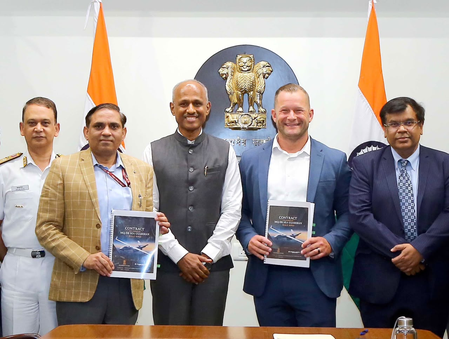
New Delhi, Aug 17 (IANS) The Ministry of Defence on Monday announced that it has signed a contract with General Atomics Aeronautical Systems, Inc. (GA-ASI) to lease two MQ-9B Sea Guardian High-Altitude Long-Endurance (HALE) Remotely Piloted Aircraft Systems (RPAS) for the Indian Navy for 30 months.
The contract, valued at approximately Rs 1,943 crore, was signed at Kartavya Bhawan-2 in New Delhi in the presence of Additional Secretary and Director General (Acquisition), Department of Defence, A. Anbarasu.
"The MQ-9B Sea Guardian HALE RPAS, equipped with advanced systems, state-of-the-art sensors and sophisticated payloads, will significantly enhance the Indian Navy’s Maritime Domain Awareness capabilities," the ministry said.
The induction of the MQ-9B Sea Guardian systems is expected to significantly strengthen the Indian Navy’s Maritime Domain Awareness capabilities.
Equipped with advanced systems, sophisticated sensors and state-of-the-art payloads, the remotely piloted aircraft will provide persistent Intelligence, Surveillance and Reconnaissance (ISR) coverage across large stretches of the maritime domain.
The systems will enable the Navy to maintain sustained surveillance over vast areas and improve its ability to track and assess developments at sea. Their deployment is expected to enhance India’s capacity to monitor maritime activity and respond more effectively to emerging developments across the Indian Ocean Region.
"The systems will provide persistent Intelligence, Surveillance and Reconnaissance coverage over vast areas of the maritime domain, strengthening India’s ability to monitor and respond to developments across the Indian Ocean Region," it added.
Meanwhile, last week, the ministry signed another contract worth approximately Rs 1,577 crore with Tata Advanced Systems Limited and NIBE Private Limited for the procurement of Loiter Munition Systems, along with associated munitions and accessories, for the Indian Army.
“The Ministry of Defence has signed contracts with TATA Advanced Systems Limited and NIBE Private Limited for the procurement of Loiter Munition Systems, along with munitions & other accessories, at an approximate cost of Rs 1,577 crore for the Indian Army,” it said.
--IANS
pk/na
Air India de-rosters two pilots after preliminary drug test results

New Delhi, Aug 17 (IANS) Two more Air India pilots have failed preliminary drug tests conducted by the airline as part of an expanded screening programme introduced after a recent in-flight incident on a Phuket-Delhi service, according to a report.
A report by NDTV -- citing sources -- said that the final test results are still awaited and both pilots have been de-rostered pending confirmation.
The Tata-owned carrier ordered drug testing for all pilots under a new standard operating procedure (SOP) after the pilot-in-command of a Phuket-Delhi flight allegedly failed two urine tests following the aircraft's landing.
In addition, marijuana was reportedly detected in his system.
Reports suggest more than 300 Air India pilots have undergone the testing process so far.
However, final drug test results typically take between 24 and 48 hours to be processed.
A cabin crew member on the Phuket-Delhi flight is believed to have lodged a complaint alleging that the pilot had previously smoked marijuana.
The airline's decision to intensify testing followed an incident involving an Airbus A320neo operating the Phuket-Delhi route.
The aircraft reportedly experienced a sudden loss of control over key flight control surfaces and descended approximately 300 feet. Initial reports had attributed the event to turbulence, but subsequent analysis of aircraft system data pointed to multiple hydraulic system failures.
The aircraft's elevators, ailerons and spoilers were affected for several seconds following failures across the jet's hydraulic systems, according to the reports. These systems are essential for controlling the aircraft's pitch, roll and descent.
According to the letter addressed to pilots, from August 13, the airline firm began conducting mandatory screening of all pilots across the group for substances or medications prohibited under aviation regulations as part of a measure aimed at reinforcing safety standards and public confidence.
--IANS
ag/
449 S. Korean YouTube channels taken down by Google over political content in Q2

Seoul, Aug 17 (IANS) Google shut down 449 South Korean YouTube channels in the second quarter of this year for their politically charged content, a report showed.
According to "Influence Operations Bulletin Q2 2006" by Google's Threat Analysis Group, the U.S. company terminated 22 YouTube channels in Korean in April, 367 more in May and another 60 in June.
The largest share came in May, just before the June 3 local elections, reports Yonhap news agency.
Per the report, these channels were terminated for sharing content that was either critical or supportive of the South Korean government and for expressing support for or disapproval of particular South Korean political parties or political figures.
Google had not terminated any South Korean YouTube channel between the second quarter of 2025 and the first quarter of 2026. During that span, Google shut down 9,173 channels linked to China, followed by 2,083 linked to Russia.
Last week, South Korea's media watchdog concluded that U.S.-based Google and Apple violated related laws by abusing their dominance in their respective app marketplaces.
The level of sanctions will be decided at a later date, the Korea Media Communications Commission (KMCC) said at a regular meeting.
The two U.S. tech companies are accused of bypassing the revision to the telecommunications business act passed in 2021, which aims to prevent large app market operators from forcing app developers to use only their in-app payment systems.
Following the revision, Google and Apple had allowed customers to purchase apps through a third-party payment gateway but imposed a transaction fee of around 26 percent on non in-app purchases -- a move that drew criticism for effectively nullifying the law.
In October 2023, South Korea's media watchdog had warned it would impose the highest fine possible on the two tech giants but has yet to carry out such a punishment.
—IANS
na/
PM Modi’s speech emphasises India’s semiconductor push for global chip leadership: Industry

New Delhi, Aug 15 (IANS) India’s push for a major semiconductor and electronics build‑out highlighted in Prime Minister Narendra Modi’s 80th Independence Day speech marks shift from ecosystem creation to global leadership, industry experts said on Saturday.
They lauded the ambitious roadmap mentioned by PM Modi to establish another 5 to 8 advanced chip facilities within the next 7 to 8 years.
Ashok Chandak, President, IESA and SEMI India, said the speech underscored a 'massive, unwavering commitment from the government to position our nation as a global powerhouse for chip design and manufacturing, electronics design, and advanced mobile technology.'
PM Modi mentioned three operational mega semiconductor plants with chips successfully entering global export markets and that mobile phone manufacturing has expanded 33 times over the past 12 years.
The broader electronics manufacturing sector has expanded 7 times, turning India into a global hub for hardware innovation.
The Prime Minister also talked about integrating 200 GW of clean nuclear energy to flawlessly power the humongous grid requirements of chip fabs, AI nodes and data centres.
“India is no longer just dreaming of semiconductors, digital and hardware self-reliance—we are executing it at an unprecedented scale,” Chandak said.
Semicon 2.0 & next-gen manufacturing policies will take India from ecosystem creation to global ecosystem leadership, he forecasted.
India is building a resilient, full-stack tech value chain driven by the Semicon 2.0 framework of 1,27,000 crores which focuses on chip design, machines & materials, fabrication facilities, advanced packaging (ATMP/OSAT), R&D, and talent development, he added.
“By aligning the 'Sapta Dhara' initiative for world-class manufacturing with the strategic mobilisation of a million-strong AI workforce, the PM Modi has delivered a decisive blueprint for global value chain leadership," said Pankaj Mohindroo, Chairman of the India Cellular & Electronics Association (ICEA).
"India’s electronics sector is no longer content to be seen as a secondary option; it is setting the standard for trust, resilience and dominance in the world’s digital economy,” Mohindroo added.
—IANS
aar/ag
Technology-driven faster logistics key to Viksit Bharat: Piyush Goyal
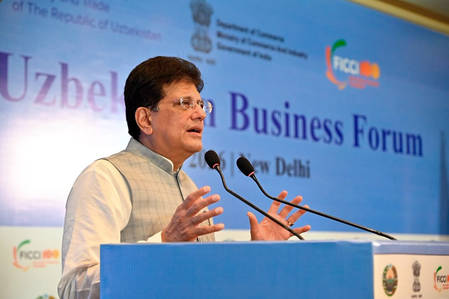
New Delhi, Aug 14 (IANS) Technology is helping make India's logistics ecosystem simpler, faster and more efficient, strengthening the competitiveness of domestic industry and supporting the country's manufacturing and export ambitions, Commerce and Industry Minister Piyush Goyal said on Friday as the Logistics Data Bank (LDB) achieved the milestone of tracking 10 crore EXIM containers.
He said efficient logistics would play a crucial role in strengthening manufacturing, expanding India's presence in global markets and realising the Prime Minister's vision of a Viksit Bharat.
“The tracking of 10 crore containers through the Logistics Data Bank is an important milestone in India’s logistics journey. Technology is helping us make logistics simpler, faster and more efficient, while improving the competitiveness of Indian industry,” Goyal said.
“Efficient logistics will be central to strengthening manufacturing, expanding our presence in global markets and realising the Prime Minister’s vision of a Viksit Bharat,” Goyal added.
The Logistics Data Bank provides end-to-end visibility of EXIM container movement across India through RFID-based tracking technology.
The platform currently offers visibility into 100 per cent of the country's EXIM container movement, covering 19 ports and 32 container terminals.
Its network spans 103 Inland Container Depots (ICDs), 439 Container Freight Stations (CFSs), empty yards, parking plazas and industrial zones, along with 89 manufacturing Special Economic Zones (SEZs), 5,569 railway stations, 269 toll plazas and three Integrated Check Posts.
The platform enables stakeholders to monitor container movement across the logistics chain and generates analytics related to dwell time, transit time, and port and terminal performance.
The data helps logistics operators, exporters, importers and policymakers identify bottlenecks and improve operational efficiency.
In September 2025, Piyush Goyal launched LDB 2.0, which significantly enhanced the platform's capabilities.
The upgraded version introduced high-seas tracking of India's export containers and provided multimodal shipment visibility, allowing users to monitor cargo movements more comprehensively.
--IANS
pk
India’s science and technology clusters accelerating innovation
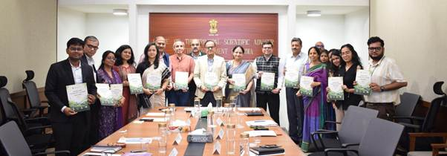
New Delhi, Aug 13 (IANS) The Office of the Principal Scientific Adviser to the Government of India on Thursday launched the Science and Technology (S&T) Clusters Annual Report 2025–26, which highlights their evolving role as regional innovation ecosystems and “National Technology Accelerators”, driving technology translation through shared infrastructure, public‑private partnerships, startup support and industry engagement.
Several initiatives have progressed from research and pilot validation to field deployment and commercialisation, including E‑Yantram, AI‑enabled Digital Podiatry Clinics, AI‑enabled agriculture and weather intelligence, indigenous pacemaker components, patient‑specific 3D‑printed implants, ChemAmaze and One Health initiatives, as well as national platforms such as Kalaanubhav.in and i‑Passport.
The Report also mentions the growing international engagement of the Clusters, including the First International Conference on S&T Clusters held in December 2025, which brought together participants from over 35 countries and resulted in 12 international MoUs, followed by collaborations with the University of Western Australia, the India‑Australia Smart Farm Network and the UK Catapult Network in areas including health, emerging technologies and net‑zero technologies.
The S&T Clusters also presented their international collaborations underway across areas such as healthcare, advanced manufacturing, smart agriculture, sustainable mobility, climate resilience, emerging technologies, and capacity building. Inter‑Cluster collaborations have enabled successful solutions to be replicated and scaled.
The Digital Podiatry Clinic, for instance, has expanded from BeST to PI‑RAHI. Kalaanubhav.in, an initiative of JCKIC, is being scaled across Clusters, and I‑RISE, a programme of I‑STEM, is strengthening access to advanced scientific infrastructure through the S&T Clusters. The i‑Passport initiative of AMTZ is also being considered for national scale‑up, providing innovators with access to shared infrastructure, testing, mentorship, regulatory support and industry networks.
During the launch, Principal Scientific Adviser Ajay Kumar Sood emphasised stronger inter‑cluster collaboration, industry engagement and technology translation, with a focus on adapting and scaling successful regional solutions and measuring outcomes through higher TRLs, real‑world validation, commercialisation and societal and economic impact.
Scientific Secretary Parvinder Maini highlighted the growing maturity of the S&T Clusters through a consortium‑based model and emphasised the need to prioritise the national interest while strengthening industry participation in technology validation and translation.
The event was attended by CEOs, COOs and Principal Investigators of the eight S&T Clusters established under the Office of the PSA: Andhra Pradesh Medtech Zone (AMTZ Vizag); Bengaluru Science and Technology Cluster (BeST); Bhubaneswar City Knowledge and Innovation Cluster (BCKIC); Delhi Research Implementation and Innovation Cluster (DRIIV); Jodhpur City Knowledge and Innovation Cluster (JCKIC); Panjab University–IIT Ropar Regional Accelerator for Holistic Innovations (PI‑RAHI); Pune Knowledge Cluster (PKC); and Research and Innovation Circle of Hyderabad (RICH).
--IANS
sps/dan
Manufacturing GVA grows at 10.88 pc during FY23-FY26 as per revised series: Govt

New Delhi, Aug 12 (IANS) The government on Wednesday said the compounded annual growth rate (CAGR) of manufacturing GVA at constant prices as per the revised series during 2022-23 to 2025-26 is 10.88 per cent.
Minister of State (Independent Charge) Rao Inderjit Singh informed the Lok Sabha that the available data under the respective series “do not indicate any significant change in the share of manufacturing in total Gross Value Added (GVA)”.
The government has undertaken several structural reforms and initiatives to strengthen the resilience of the manufacturing sector and reduce its vulnerability to external shocks, said the minister.
These include the Production Linked Incentive (PLI) Schemes, PM GatiShakti National Master Plan, the National Logistics Policy, Bharat Audyogik Vikas Yojana (BHAVYA), initiatives to promote semiconductor and electronics manufacturing, critical minerals and Micro, Small and Medium Enterprises (MSMEs), and the Scheme for Promotion of Surface Coal/Lignite Gasification Projects, improvement of the ease of doing business, National Industrial Corridor Development Programme (NICDP).
“Collectively, these initiatives seek to strengthen domestic manufacturing, diversify supply chains, reduce import dependence in strategic sectors, enhance energy security and improve the resilience and competitiveness of India's manufacturing ecosystem,” according to the minister.
The Ministry of Statistics and Programme Implementation (MoSPI) has revised the base year of the National Accounts Statistics from 2011–12 to 2022–23, and the revised series was released in February 2026.
The Economic Survey 2025-26 highlighted that medium- and high-technology industries now contribute 46.3 per cent of India’s manufacturing value added, signalling a gradual shift towards more sophisticated production structure. Notably, manufacturing today sits as the engine of growth for India’s ambition to become a $35 trillion economy by 2047, with reforms, sectoral initiatives, and resilient supply chains.
Meanwhile, India's manufacturing activity remained in expansion territory in July, with the HSBC India Manufacturing Purchasing Managers' Index (PMI) coming in at 53.5 due to resilient demand and stronger export orders.
This performance has indicated a continued improvement in operating conditions as the index remained above the 50-mark that separates expansion from contraction.
However, the HSBC data highlighted that the pace of growth eased from 54.2 in June.
Manufacturers reported sustained growth in new orders and output during the month, with firms citing advertising efforts and demand resilience as factors supporting sales.
--IANS
na/
Investors lose Rs 68,000 crore as Tata stocks slide on Chandrasekaran’s resignation

Mumbai, Aug 12 (IANS) Shares of Tata Group companies came under broad selling pressure on Wednesday after N. Chandrasekaran decided not to seek reappointment as chairman of Tata Sons, wiping out more than Rs 68,000 crore in combined market capitalisation despite gains in a handful of group stocks.
The combined market capitalisation of the group's 17 listed companies fell by Rs 68,119 crore to Rs 26.32 lakh crore from nearly Rs 27 lakh crore in the previous session.
Tata Consultancy Services (TCS) accounted for the largest share of the market value erosion.
The IT major's market capitalisation declined by Rs 42,440 crore to Rs 8.40 lakh crore after its shares fell 4.79 per cent to Rs 2,323.30.
Titan emerged as the second-largest drag on the group's valuation, with its market capitalisation shrinking by Rs 9,304 crore as the stock declined nearly 2 per cent.
Other major contributors to the decline included Tata Motors Passenger Vehicles, which saw its market value fall by Rs 4,898 crore, and Tata Steel, which lost Rs 4,745 crore in market capitalisation.
Tata Consumer Products shed Rs 3,098 crore, while Tata Power and Indian Hotels lost Rs 1,598 crore and Rs 1,566 crore, respectively.
Several other Tata companies also closed lower. Tata Communications lost Rs 812 crore in market value, Tata Elxsi declined by Rs 606 crore, Trent by Rs 907 crore, Tata Investment Corporation by Rs 508 crore and Tejas Networks by Rs 265 crore.
Tata Teleservices (Maharashtra) also registered a decline in market capitalisation. Not all Tata Group stocks participated in the sell-off.
Tata Motors added Rs 1,786 crore to its market value, while Tata Capital gained Rs 700 crore.
Tata Chemicals and Voltas also ended with modest gains, adding Rs 167 crore and Rs 66 crore, respectively.
The selling pressure followed Chandrasekaran's decision not to seek an extension of his tenure as chairman after a board member opposed the proposal for his reappointment.
According to Chandrasekaran, the prolonged uncertainty surrounding the issue made it necessary for the board to move forward with succession planning.
In a statement, Chandrasekaran said he had completed four decades of professional life within the Tata Group and described his nearly ten-year stint as chairman of Tata Sons as both a privilege and a significant responsibility.
--IANS
pk
Indian chip startups raise $206 mn since 2022 as funding concentrates on later‑stage firms

New Delhi, Aug 12 (IANS) Indian semiconductor startups have raised approximately $206 million across 51 funding rounds since 2022, with investor interest currently shifting to fewer but larger bets on companies closer to commercialisation, a report said on Wednesday.
The report from venture capital firm Speciale Invest said semiconductor startups secured $61.9 million in the first half of 2026, already equivalent to 81 per cent of the total 2025 fund raise of $76.6 million.
The number of funding rounds fell from 16 in 2024 to 13 in 2025 and seven in H1 2026, even as capital deployed rose sharply.
The funding trend indicated that investors are concentrating money behind companies that have moved further along product development and commercialisation, rather than spreading bets across a wider set of early-stage startups.
The report added that seven recent Series A rounds totalled $73.7 million, roughly one‑third of all capital raised since 2022, and that seed‑to‑Series A timelines spans seven to 22 months for many firms.
The report mentioned a growing link between government-backed semiconductor programmes and private venture funding.
Of the 24 chip-design projects supported under the Design Linked Incentive (DLI) programme, 14 have subsequently raised institutional venture capital, together pulling in $100.8 million across their first and second rounds.
"The next test is whether this momentum can carry companies from design and validation into scaled products, repeat customers and globally relevant businesses,” Rajaram added.
“The next generation of investible semiconductor companies in India will not come from chip design alone. We see significant room to build across equipment and materials, design IP and EDA, analog and RF, advanced packaging and AI infrastructure," said Arjun Rao, Co-founder and General Partner, Speciale Invest.
The report identified a broadening of India's semiconductor startup base. The first wave of companies focused largely on digital, RF, RISC-V and edge SoCs. Newer companies are emerging in photonics, power and compound semiconductors, fab tooling and metrology, AI data-centre silicon, AI-led semiconductor design workflows, and analog AI inference.
—IANS
aar/pk
India’s deal activity rises to $11.6 billion in July

New Delhi, Aug 12 (IANS) India's dealmaking activity accelerated in July as overall transaction value reached $11.6 billion across 210 deals due to a rebound in mergers and acquisitions (M&A), steady private equity (PE) investments and the strongest capital markets activity of the year, a report said on Wednesday.
A report by Grant Thornton Bharat said that M&A and PE activity together accounted for 187 transactions worth $7.3 billion during the month, up 15 per cent in volume and 73 per cent in value from June.
The increase in deal values was supported by the return of large strategic transactions, including three billion-dollar deals and six transactions valued at more than $100 million, it said.
However, together these deals contributed about $5.7 billion.
"July witnessed the return of billion-dollar M&A transactions and the strongest monthly activity this year in the capital markets, which lifted overall deal values," Shanthi Vijetha, Partner, Deals Lifecycle, Grant Thornton Bharat, said.
He said that private equity activity remained stable with investors continuing to back early-stage and growth-focused businesses, while strong cross-border dealmaking reflected sustained investor interest in India.
In addition, M&A activity rose sharply during the month with 76 deals worth $6 billion. Transaction volumes increased 25 per cent from the previous month, while deal values more than doubled.
Outbound deals contributed 54 per cent of total M&A value despite recording the lowest outbound deal count of the year.
Meanwhile, private equity activity remained resilient and recorded 111 deals worth $1.2 billion. While the number of transactions rose 9 per cent, deal values declined 4 per cent as investors continued to favour smaller, early-stage and growth-oriented investments.
Additionally, capital markets posted their strongest performance of 2026 as 11 initial public offerings (IPOs) raised $1.5 billion and 12 qualified institutional placements (QIPs) mobilised $2.8 billion.
Sector-wise, retail & consumer continued to lead deal activity by transaction volume across M&A and PE deals, while banking and financial Services (BFSI) recorded strong momentum and emerged as the largest sector by PE deal value for the first time this year.
--IANS
ag/