
Foreign ownership of S. Korean stocks reaches highest in nearly 6 years
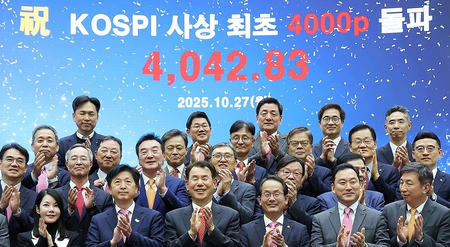
Seoul, Jan 25 (IANS) Foreign ownership of South Korean stocks as a share of total market capitalisation reached its highest level in five years and nine months in January, driven by net purchases in the shipbuilding, defence and nuclear power industries, the main bourse operator said on Sunday.
Foreigners' stock holdings rose to 37.18 per cent of total market capitalisation on January 7, the highest level since April 9, 2020, when the rate was at 37.34 percent, according to data from the Korea Exchange (KRX), reports Yonhap news agency.
The increase largely came as offshore investors scooped up shares in the semiconductor sector in the second half of last year, followed by shares in the shipbuilding, defence and nuclear power sectors this month.
Foreign investors net purchased 14.1 trillion won (US$9.7 billion) worth of Samsung Electronics shares in the second half of last year alone.
This month, the most popular shares were Hanwha Ocean, Doosan Enerbility and Naver, in that order.
Investments in the shipbuilding and nuclear power sectors were driven by anticipation of large-scale orders amid an increase in global demand, while those in the defence industry were likely buoyed by the tension surrounding U.S. President Donald Trump's threat to acquire Greenland.
Meanwhile, South Korean stocks closed higher on Friday at a fresh peak, led by gains in technology and brokerage shares, after hitting another intraday record high. The Korean won increased against the U.S. dollar.
After a choppy session, the benchmark Korea Composite Stock Price Index (KOSPI) went up 37.54 points, or 0.76 percent, to close at 4,990.07.
Trade volume was heavy at 595.6 million shares worth 29.6 trillion won (US$20.2 billion), with winners far outpacing losers 677 to 212.
Institutions and foreigners purchased 491.2 billion won and 133.3 billion won worth of stocks, respectively, while individual investors offloaded a net 725.6 billion won alone.
The index opened sharply higher, briefly breaching the 5,000-point threshold for the second consecutive session and reaching an intraday record of 5,021.13.
—IANS
na/
Half of economists forecast 1 pc growth range for S. Korea
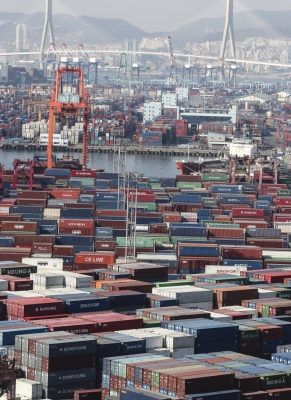
Seoul, Jan 25 (IANS) More than half of economic experts expect South Korea's economic growth to remain in the 1 per cent range for the time being, a local survey showed on Sunday.
In a survey conducted by Southernpost Inc. at the request of the Korea Enterprises Federation (KEF), 54 percent of 100 economics professors polled said South Korea is likely to post growth in the 1 per cent range this year, reports Yonhap news agency.
Another 36 per cent projected Asia's fourth-largest economy to achieve growth in the 2 per cent range starting in 2027, driven by a gradual recovery in consumption and demand. Six per cent said growth would fall below 1 per cent, according to the survey.
On average, the economists forecast the South Korean economy to grow 1.8 percent this year, slightly below the government's 2 percent outlook and the International Monetary Fund's (IMF) 1.9 percent projection.
South Korea's economy expanded 1 percent last year, down from 2 percent growth the previous year.
Regarding exchange rates, the respondents projected the won-dollar rate to move between 1,403 won and 1,516 won this year.
Nearly 60 percent of the economists said the outcome of U.S.-South Korea tariff negotiations would have a negative impact on exports to the United States and on domestic corporate investment.
Asked about the growing use of artificial intelligence (AI) in workplaces, 92 percent said the spread of AI would serve as a substitute for labor shortages and improve productivity, particularly in manufacturing.
Nearly 90 percent also called on the government to adopt effective measures to prevent the overseas leakage of semiconductors and other core technologies, including imposing strict penalties on related violations.
Meanwhile, major global investment banks (IBs) have upgraded their forecasts for South Korea's economic growth, citing a strong semiconductor upcycle, but warned that the economy is showing signs of an uneven "K-shaped recovery," a report by the international finance centre said.
According to a report by the Korea Center for International Finance (KCIF), the median growth forecast by major foreign institutions for 2026 was raised to 2.0 percent in January from 1.8 percent in early November.
—IANS
na/
Samsung chief warns against complacency after strong earnings
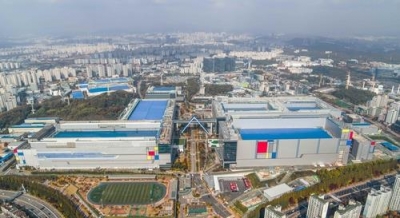
Seoul, Jan 25 (IANS) Lee Jae-yong, chairman of Samsung Electronics Co, has urged the company's executives not to become complacent despite a sharp rebound in earnings, stressing that the company faces a "last chance" to restore its competitiveness, industry sources said on Sunday.
Lee delivered the message during a recent seminar for Samsung Group executives, following the company's announcement of a record operating profit of 20 trillion won (US$13.8 billion) for the fourth quarter amid a semiconductor industry upcycle, reports Yonhap news agency.
His remarks were aimed at warning some 2,000 executives against settling for short-term performance gains and calling for stepped-up efforts to fundamentally rebuild Samsung's technological edge, according to the sources, who asked not to be identified.
During the seminar, Lee shared key remarks by his late father and Samsung Group Chairman Lee Kun-hee, along with the company's core business strategies, including those related to artificial intelligence (AI).
The session also revisited the late chairman's well-known "sandwich crisis" theory. In January 2007, Lee Kun-hee warned that South Korea's economy was "sandwiched" between Japan, which was pulling ahead technologically, and China, which was rapidly catching up in terms of cost competitiveness.
Comments by Lee Jae-yong from last year's executive seminar were also recalled, when he said Samsung had "lost its Samsung-like resilience" and called for a "do-or-die" mindset.
At the time, he said, "Korea is still stuck in a sandwich position. What has changed is that the competitive landscape has shifted and the situation has become even more serious," referring to intensifying strategic rivalry between the United States and China.
To navigate the current challenges, Lee urged executives to focus on AI-centred management, securing top talent and fostering innovation in corporate culture.
Samsung Electronics struggled from 2023 through the first half of 2025 due to a downturn in its semiconductor business. However, in preliminary earnings released on January 8, the company signalled a turnaround by posting record quarterly operating profit on sales of 93 trillion won.
Samsung resumed group-wide executive seminars last year for the first time in nine years after holding annual executive seminars from 2009 to 2016.
—IANS
na/
Bank Unions call nationwide strike on Jan 27 over 5-day work week demand

New Delhi, Jan 24 (IANS) Major bank employee and officer unions in India have announced a nationwide strike on January 27 to press for the introduction of a five-day work week in the banking sector.
The strike will begin at midnight on January 26 and continue until midnight on January 27, potentially affecting banking services across the country, according to NDTV Profit report.
The strike notice has been issued by the United Forum of Bank Unions (UFBU), a joint platform representing nine bank unions.
The notice has been sent to the Indian Banks’ Association (IBA), the Chief Labour Commissioner and the Department of Financial Services (DFS) under the Industrial Disputes Act, 1947.
According to the unions, the main demand is government approval to declare all Saturdays as bank holidays, thereby introducing a five-day work week.
The UFBU said that the IBA has already recommended this proposal to the government. The recommendation is based on a memorandum of understanding signed between the IBA and UFBU on December 7, 2023, followed by a settlement and joint note issued on March 8, 2024.
However, the unions said the proposal is still awaiting final clearance from the government and banking regulators.
The unions explained that their demand for a five-day work week is not new.
It dates back to 2015, when banks started observing holidays on the second and fourth Saturdays of every month.
Since then, several rounds of discussions have taken place with the IBA, and broad agreements have been reached.
The unions have also agreed to extend daily working hours by about 40 minutes so that there is no reduction in total weekly working time.
Despite these discussions and assurances given during conciliation meetings, the unions said there has been no concrete progress for more than nine months. This delay, they said, has forced them to resume agitation.
--IANS
pk
Govt committed to inclusive development, last-mile delivery in underserved regions: MoS
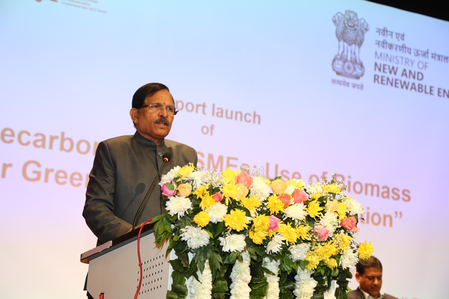
New Delhi, Jan 24 (IANS) The Government remains firmly committed to inclusive development and ensuring that the benefits of welfare schemes reach the last mile, Minister of State for Power and New & Renewable Energy, Shripad Yesso Naik, said on Saturday.
During an interaction with beneficiaries of key government schemes here, Naik highlighted the achievements of the Pradhan Mantri Janjati Adivasi Nyaya Maha Abhiyan (PM-JANMAN).
These beneficiaries have been specially invited to attend the Republic Day celebrations this year.
The interaction reflected the Government’s focus on inclusive growth under the visionary leadership of Prime Minister Narendra Modi.
"Out of around 1.43 lakh identified households, nearly 1.36 lakh homes have already been electrified, achieving about 95 per cent progress," Naik added.
"This success has been made possible through coordinated efforts of the Ministry of Power, State Governments and electricity distribution companies," the minister stated.
The Minister also spoke about the Dharti Aaba Janjatiya Gram Utkarsh Abhiyaan (DA-JGUA), launched in October 2024 to bring development benefits to Scheduled Tribe habitations.
"Under this scheme, a central grant of Rs 4,203 crore has been approved to electrify more than 2.83 lakh households and over 4,200 public places," Naik added.
"So far, around 56,000 households have already received electricity connections," he mentioned.
He noted that special relaxations in cost norms have been provided to ensure that even the most remote and previously unconnected villages are covered.
Naik further underlined the impact of the PM-KUSUM scheme, which is the world’s largest programme for the solarisation of agriculture.
He shared that 10.4 gigawatt of solar capacity has been installed so far and over 21.7 lakh solar pumps have been deployed across the country.
"These initiatives have benefited more than 21 lakh farmers by reducing their dependence on diesel, lowering input costs, and cutting carbon emissions," he stated.
The Minister also briefly referred to the PM Surya Ghar: Muft Bijli Yojana, stating that the scheme is helping households adopt rooftop solar power, reduce their electricity bills and move towards energy self-reliance.
A total of 249 beneficiaries from 15 States have been invited to participate in the Republic Day celebrations this year.
The three-day programme in New Delhi began with this interaction.
--IANS
pk
‘India Energy Week 2026’ to focus on global partnerships: Hardeep Puri
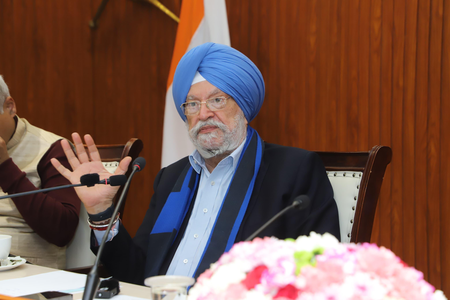
New Delhi, Jan 24 (IANS) Under the leadership of Prime Minister Narendra Modi, India Energy Week has emerged as a strong platform for building long-term global energy partnerships, Union Petroleum and Natural Gas Minister Hardeep Singh Puri said on Saturday.
In a post on social media platform X, Puri said that India Energy Week 2026 will mark a shift from discussions to direct collaboration in the global energy sector.
“Under the leadership of PM Modi, India Energy Week has become a platform for sustained global energy partnerships,” Puri said.
He said the event will bring together key international and domestic stakeholders to strengthen cooperation across energy value chains.
“As part of the event, the 9th Prime Minister’s Roundtable will be held, bringing foreign CEOs, Indian private sector leaders and public sector representatives on one platform,” he stated.
“This will be complemented by the India-Arab Energy Dialogue, an India-Japan Roundtable following earlier discussions in Tokyo, and additional roundtables with Iceland, the Netherlands and the India-US Business Council,” he mentioned.
Puri said this will help align global investment and policy thinking with India’s fast-growing energy needs.
He added that the roundtable will be supported by several focused dialogues, including the India-Arab Energy Dialogue and an India-Japan Roundtable, which will follow earlier discussions held in Tokyo.
Apart from this, India will also hold energy roundtables with countries like Iceland and the Netherlands, along with interactions involving the India-US Business Council.
According to Puri, India Energy Week 2026 will also see participation from 11 country pavilions -- reflecting strong international interest.
Several bilateral meetings are also planned, involving senior leadership, including the Prime Minister.
Puri said these engagements further reinforce India’s role as a global energy convenor and highlight how India Energy Week has grown into a key forum for sustained global energy cooperation under the leadership of Prime Minister Narendra Modi.
--IANS
pk
Ministry of Panchayati Raj to launch ‘Pancham’ chatbot with UNICEF
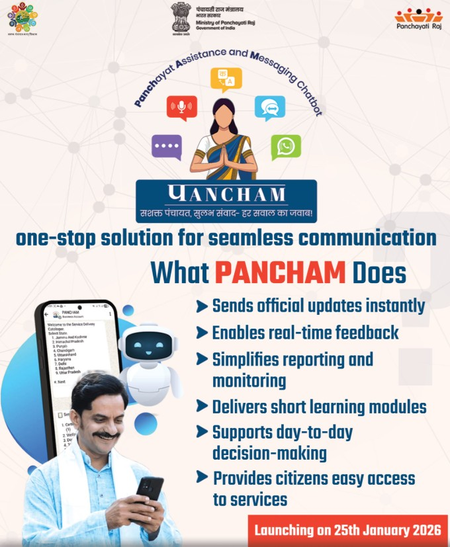
New Delhi, Jan 24 (IANS) The Ministry of Panchayati Raj is set to launch initiatives, including PANCHAM – Panchayat Assistance and Messaging Chatbot -- developed in collaboration with UNICEF, it was announced on Saturday.
The Ministry will organise a felicitation function on Sunday to honour elected Panchayat representatives invited as Special Guests to witness the Republic Day Parade 2026 at Kartavya Path in New Delhi.
The honourees will be felicitated by Union Minister of State for Panchayati Raj, Professor SP Singh Baghel, according to a ministry statement.
The event will also mark the launch of the 17th issue of Gramoday Sankalp magazine, the Compendium of Basic Statistics on Panchayati Raj Institutions–2025, the Expert Committee Report on Service Delivery at the Panchayat Level and the PESA Performance and Implementation Rank Indicators.
“The honourees include Sarpanches, Mukhiyas, Gram Pradhans and Block and District Panchayat Presidents from Panchayats that have achieved saturation in flagship Central Government schemes,” said the statement.
Around 240 panchayat heads, nominated by states and union territories are being recognised for their grassroots contributions and their role in advancing the vision of Viksit Bharat.
For the Republic Day Parade, the Ministry is hosting Heads of PRIs/RLBs along with their spouses, totalling nearly 450 Special Guests.
The special invitees will visit the Pradhanmantri Sangrahalaya on January 25 to experience India’s leadership and governance journey since Independence and also witness the Ministry's Tableau during the Parade, themed “SVAMITVA Scheme: Aatmanirbhar Panchayat se Samriddh evam Aatmanirbhar Bharat.”
Meanwhile, President Droupadi Murmu will address the nation on the eve of the 77th Republic Day on Sunday. The address will be broadcast from 7 PM on the entire national network of Akashvani and telecast over all channels of Doordarshan in Hindi, followed by the English version.
--IANS
na/
India can create $1.3 trillion in exports through deregulation push by 2035: Report

New Delhi, Jan 24 (IANS) India is aiming to nearly triple its exports to $1.3 trillion by 2035 by pushing manufacturing-led growth through structural reforms and deregulation, rather than relying on heavy government spending, according to reports.
The strategy marks Prime Minister Narendra Modi’s third major attempt to turn India into a global manufacturing hub and a key driver of world trade.
The government is focusing on 15 priority manufacturing sectors, including high-end semiconductors, metals, electronics and labour-intensive industries such as leather, as per the reports.
Officials believe that easing regulations, simplifying compliance and improving the business environment will help companies scale up production, attract investment and compete globally.
The renewed push comes at a time when India is being seen as a stable growth engine amid global uncertainty.
With supply chains under stress worldwide and geopolitical tensions rising, India is positioning itself as a reliable alternative manufacturing destination.
Recent data suggests that the manufacturing sector is already responding positively to policy support and reforms.
India’s manufacturing performance touched a record high in the third quarter of FY26, with industry sentiment improving further, according to a latest survey by the Federation of Indian Chambers of Commerce and Industry (FICCI).
As per FICCI’s Quarterly Survey on Manufacturing, 91 per cent of companies reported higher or stable production levels in Q3 FY26, up from 87 per cent in the previous quarter.
Industrial confidence also strengthened, with 86 per cent of respondents expecting higher or similar order levels compared to the previous quarter, helped in part by recent GST rate cuts.
The survey, which covers manufacturing units with a combined annual turnover of over Rs 3 lakh crore, showed that financial conditions remain supportive.
The average interest rate for manufacturers stood at 8.9 per cent, while nearly 87 per cent of firms said they had sufficient access to bank funding for working capital and long-term needs.
--IANS
pk
India heralds new chip industry, commercial production set to begin this year
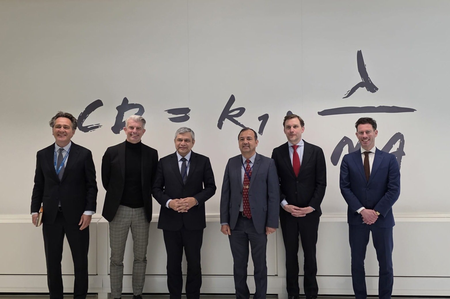
New Delhi, Jan 24 (IANS) India has started a new semiconductor industry and that lithography, which involves printing the circuit on the wafer, is the most complex and precision-intensive process in the entire semiconductor manufacturing chain, according to the government.
Union Minister Ashwini Vaishnaw said that Dutch multinational company ASML is the world’s leading provider of lithographic tools and added that ASML enables practically every chip manufactured in the world.
“Our fab in Dholera will be using ASML equipment. So, I have come here to visit and understand their technology,” Vaishnaw said as he visited the headquarters of ASML in Veldhoven, Netherlands.
Vaishnaw said that ASML coming to India would be a significant development.
Several equipment manufacturers from across the world are now looking to establish a base in India due to the country’s design capabilities, large talent pool, and the consistent policies of Prime Minister Narendra Modi, he emphasised.
On semiconductors, the Minister said that pilot production has commenced in several approved facilities, with commercial production expected to begin shortly.
In Davos, He emphasised that the government is proceeding in a careful and methodical manner to build a robust semiconductor ecosystem and strengthen India’s long-term capabilities in this critical sector.
“Commercial production is set to begin shortly at one of the four semiconductor plants where pilot production has already commenced, with the first plant expected to start production in February,” Vaishnaw informed.
He described this as a major milestone achieved after six decades of effort, reflecting the Prime Minister Narendra Modi's strong focus on building foundational technologies.
With a strong and mature electronics ecosystem now in place in the country, the time is right for India to develop its own indigenous mobile phone brands.
India is also expected to see its own mobile phone brands emerge within the next 12 to 18 months, the minister noted.
--IANS
na/
India is a stable growth engine, best time for youth to join workforce: Hardeep Puri
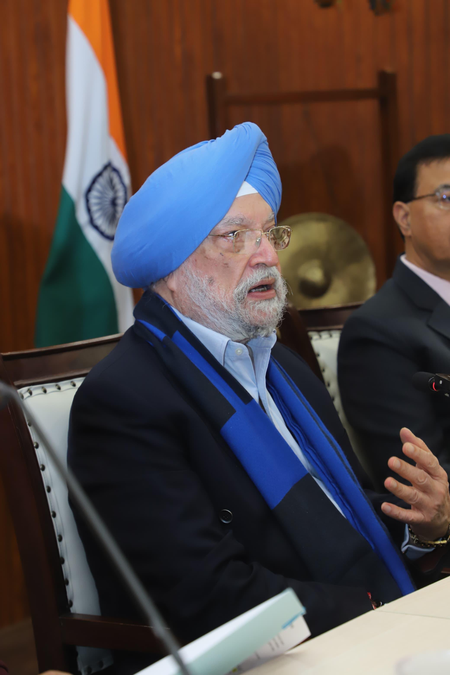
New Delhi, Jan 24 (IANS) Union Minister for Petroleum and Natural Gas Hardeep Singh Puri said on Saturday that current times are opportune for inspired and aspirational young people to join the workforce as India is being recognised as a stable growth engine with improving fundamentals.
In a social media post on X, the minister noted Prime Minister Narendra Modi has handed over appointment letters to more than 11 lakh qualified candidates nationwide through Rozgar Melas, and that 61,000 letters were distributed during the 18th edition held at 45 locations on Saturday.
"In a world marked by conflict, fragmented supply chains, and rapid technology disruption, India is being recognised as a stable growth engine with improving fundamentals under the decisive, firm and visionary leadership of PM Modi," Puri said.
"This is a good time for India’s inspired and aspirational young people to join the workforce. PM Modi has handed over appointment letters to more than 11 lakh qualified candidates across the country through Rozgar Melas," the minister added.
Puri said he joined the event from Chandigarh and personally handed over appointment letters to 25 young candidates out of the total 107 that were distributed to selected individuals after a rigorous recruitment process.
"Placements included those in ITBP, CRPF, CISF, Assam Rifles, Bank of Baroda, Union Bank and the Ministry of Electronics and Information Technology," the minister said.
Puri recalled his entry into the Indian Foreign Service in 1974, and contrasted India’s past scale and limited resources with today’s scenario.
"India’s population was about 609 million, and our nominal GDP was just under $100 billion, with per capita income in the low hundreds of dollars. A vast country, limited resources, and very little fiscal room for error," he stated.
India's economy is now measured in trillions, with deeper markets and stronger institutions, the minister said, adding that for a public servant the work is no longer about managing scarcity but building capability at speed and integrity.
--IANS
aar/pk