



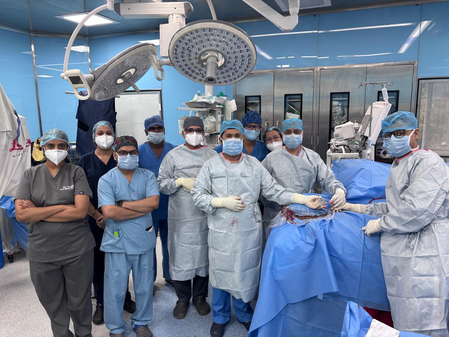
Kolkata, Nov 13 (IANS) Army Hospital (Research & Referral) in New Delhi has successfully performed an advanced Deep Brain Stimulation (DBS) surgery on a 33-year-old serving soldier diagnosed with young-onset Parkinson’s disease, offering him renewed prospects of improved motor control, independence, and quality of life.
Parkinson’s disease causes progressive slowness of movement, limb stiffness, and tremors, leaving patients in advanced stages dependent on assistance for routine daily tasks.
While oral medications initially extend symptom-free ‘ON’ periods, patients continue to experience drug side effects and eventually develop resistance, causing ‘ON’ hours to shrink while dosage limits prevent further increases.
Deep Brain Stimulation serves as an effective surgical alternative by delivering measured electrical pulses to the Subthalamic Nucleus, a deep-seated brain structure measuring roughly 5 millimetres.
During the multi-stage procedure, neurosurgeons first pinpoint the Subthalamic Nucleus using high-resolution MRI scans. Two small openings are then made on either side of the skull to implant fine electrodes into the target nucleus. These electrodes are linked via subcutaneous leads to an internal pulse generator, or pacemaker, placed beneath the skin near the collarbone, leaving no visible external hardware.
By delivering controlled electrical stimulation alongside reduced medication dosages, the therapy can dramatically extend a patient’s symptom-free ‘ON’ state, in some cases up to 24 hours a day.
Neurosurgeons note that while neither medication nor DBS cures Parkinson’s disease, carefully calibrating electrical pulses with drug therapy enables younger patients to lead near-normal, independent lives.
In civilian healthcare facilities, DBS surgery typically costs between Rs 12 lakh and Rs 18 lakh, placing it beyond the reach of many patients.
The Ministry of Defence’s approval of the high-cost procedure for a serving soldier suffering from a non-service-related neurological condition underscores the welfare support extended to Armed Forces personnel.
“The procedure reflects the expertise, multidisciplinary teamwork and commitment of the Armed Forces Medical Services to providing world-class healthcare to its personnel,” the Ministry of Defence said in a statement.
–IANS
jg/dan