



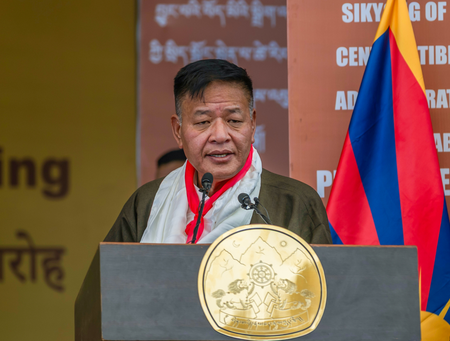
Washington, Nov 13 (IANS) China is seeking to reshape the language, religion and cultural identity of Tibetans, particularly children, in a campaign that could eventually weaken their historic ties with India, Sikyong Penpa Tsering, the elected political leader of the Central Tibetan Administration, has said.
In an exclusive interview with IANS during his visit to Washington, Tsering said Chinese policies in Tibet had moved beyond visible security restrictions to a pervasive system of surveillance, political control and cultural assimilation.
“It’s getting worse and worse,” he said of the situation in Tibet. “So there’s no political space whatsoever.”
He said China was using education as a central instrument of change, with Tibetan-medium schooling giving way to institutions where Mandarin dominates. He alleged that even children as young as four were being sent to residential schools in which the environment discouraged the use of Tibetan.
“They are striking at our language in the form of colonial style boarding schools,” he said.
Tsering said the impact went beyond classroom instruction. He accused Beijing of trying to shape how young Tibetans viewed their own heritage, including their language, beliefs and sense of belonging. Children returning home were increasingly reluctant to speak Tibetan, he said.
He linked these developments to what he described as China’s new ethnic unity and progress law, which he said was adopted on March 12. The measure gave formal backing to assimilation policies already pursued for more than a decade.
The concerns extended to religion, town planning and public institutions, he said. He pointed to restrictions on Tibetan-language signage, changes to the design of monasteries and pressure to give Chinese cultural forms a greater place in Tibetan life.
Tsering also alleged that religious institutions were being required to promote loyalty to the Communist Party rather than concentrate on Buddhist learning. Together, he argued, these measures threatened the transmission of Tibetan culture from one generation to the next.
The implications, he said, were particularly serious for India. Tibetans traditionally regarded India with deep respect because of its Buddhist heritage and long-standing support for Tibetan refugees. But he feared a younger generation educated under China’s system could grow up with a different outlook.
He argued that the political transformation of Tibet had also altered the security landscape on India’s northern frontier. In Tsering’s view, the dispute over the Himalayan border could not be separated from the events that brought Tibet under Chinese control in the middle of the last century.
His warning was accompanied by strong praise for India’s role in sustaining the Tibetan community in exile.
“Indian government is our biggest support,” Tsering said. “If it is not for the government and people of India, then we don’t exist.”
He said the Indian government had assisted Tibetan communities through education, rehabilitation and other humanitarian programmes. He declined to provide a monetary comparison with American assistance but said India provided the larger share of support.
Tsering also accused Beijing of trying to limit the Tibetans’ access to governments and legislatures abroad. During a recent visit to Amsterdam, he said, Chinese diplomatic representatives had contacted organisations and officials he was scheduled to meet.
“So they want to choke all the approaches that we make to the international community,” he said.
He urged governments not to treat engagement with the Tibetan leadership as hostility towards China. “supporting Tibet is not necessarily anti-China, it’s supporting justice and truth,” he said.
Despite his bleak account of conditions in Tibet, Tsering ruled out a turn to armed resistance. He said the Tibetan movement remained committed to negotiating with Beijing and securing meaningful autonomy, rather than demanding independence.
“We are also not seeking independence, as you know,” he said. He described the preferred approach as the middle way, under which Tibetans would govern their own cultural and religious affairs within a framework of autonomy.
Asked whether nonviolence had failed to produce results, he pointed to the imbalance between Tibet’s population and China’s military power. An armed campaign, he argued, would give Beijing grounds to label Tibetan activists terrorists and impose even harsher restrictions.
“The only alternative to non-violence is violence,” he said. Tsering maintained that a negotiated settlement would be more durable for both peoples, who would remain neighbours regardless of political arrangements.
–IANS
lkj/ksk