



Washington, Sep 8 (IANS) A campaign by political leaders and advocacy groups in the United States, Canada and Britain to isolate the Rashtriya Swayamsevak Sangh (RSS) could harm American interests and undermine efforts to strengthen US-India relations, a US foreign policy scholar has said.
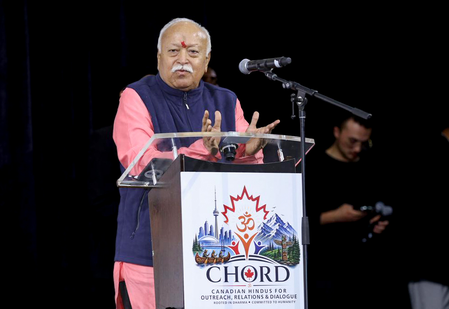
Bill Drexel, a senior fellow at the Hudson Institute, made the argument in a Wall Street Journal opinion article published after RSS chief Mohan Bhagwat addressed about 5,000 people at New York’s Madison Square Garden on August 29.
The event was billed as a celebration of “universal oneness”.
New York Mayor Zohran Mamdani, responding to calls that the booking be cancelled, described the RSS’s Hindu nationalist vision as “exclusionary” and its rise as “incredibly troubling”. He also acknowledged that the city had no authority over the private event.
The US Commission on International Religious Freedom (USCIRF) called for Bhagwat’s visa to be revoked, according to the article. Before his subsequent appearance in Toronto, nearly 270 organisations urged the Canadian government to bar him and consider designating the RSS a terrorist entity.
Groups in London also asked Mayor Sadiq Khan to deny Bhagwat access to any venue controlled by the city during his visit there.
Drexel argued that such efforts were unlikely to weaken the RSS because of its size, reach and influence in India.
“As with the campaign against Israel, the effort to isolate the RSS damages American interests more than its target,” he wrote.
The RSS holds about 83,000 regular neighbourhood gatherings across India, according to the article. These meetings include physical drills, songs, games and instruction about Hindu civilisation. Drexel said almost all of its estimated five million participants were unpaid volunteers.
He described the RSS as the vanguard of the broader Hindu nationalist movement and said it had helped create about 2,500 affiliated organisations. Its network includes religious groups, a labour union and a large private-school system.
“Western disapproval isn’t going to hamper an organisation this large and potent,” Drexel wrote. “Slamming the door on India’s most influential civil-society organisation accomplishes nothing, save empowering the factions of the RSS to which its critics most object, which tend to agree that there is little conversation to be had.”
Drexel said the organisation remained “massive, complex and quickly evolving”. He noted that its public activities include charitable and social-service programmes.
“One need not endorse the RSS’s views to know that it is imperative the US engage with it and seek to understand it,” Drexel wrote. He cited India’s economic rise and strategic importance in the Indo-Pacific and the Middle East.
–IANS
lkj/as