



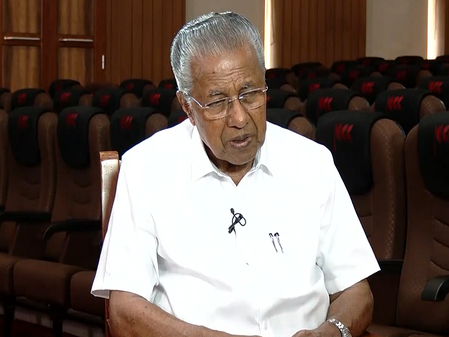
Thiruvananthapuram, March 21 (IANS) With Kerala heading to the April 9 Assembly polls, Chief Minister Pinarayi Vijayan has mounted a strong defence of his government’s decade-long record, positioning infrastructure expansion, social sector revival, and long-term planning as the cornerstone of the Left’s bid for a third consecutive term.
In an exclusive interaction with IANS, reflecting on his government’s journey since 2016, Vijayan said the Left Democratic Front assumed office at a time of “general discontentment” but moved swiftly to prioritise infrastructure as the engine of growth.
He also accused the Congress-led UDF of aligning with communal forces, while taking a swipe at defectors from the Left, claiming they would find little acceptance among the public.
“In several instances, the UDF is standing with communal forces. They have joined hands with the BJP in some locations during the local body elections. While selecting local body heads, they had a deal. This was evident in the state. They (UDF) are aligning with communal groups for a few votes and seats. We, the LDF, are not ready for such moves,” Chief Minister Vijayan said.
“Those who left the party (CPI-M) should not have done so. They are traitors to us and the people. They will not gain the acceptance of the people,” he added.
On the much-discussed Sabarimala issue, the Chief Minister said: “The Sabarimala issue did not seem to significantly impact the local body elections, even in Pandalam. The results in Pandalam were positive, and people had certain expectations which the government tried to address. Each local body has its own governance challenges, and specific issues likely influenced voting patterns in different areas.”
Pointing to the transformation in national highways, some stretches of which were recently inaugurated by the Prime Minister, he argued that visible improvements in connectivity underscore the state’s development trajectory.
The Chief Minister maintained that key sectors such as health, once in disarray, have undergone systematic strengthening.
In education, he said, the turnaround has been particularly striking.
Government schools, once facing closure with nearly five lakh students dropping out, were revived through an investment of Rs 5,000 crore, creation of 50,000 smart classrooms, upgraded laboratories, and enhanced teacher training.
He cited recognition from NITI Aayog as validation of these efforts.
On infrastructure financing, Vijayan credited the revival of the Kerala Infrastructure Investment Fund Board as a decisive factor.
From an initial plan of Rs 50,000 crore in 2016, investments rose to Rs 62,000 crore by 2021 and have now crossed Rs 1.10 lakh crore.
Major projects include the Hill Highway and Coastal Highway, with a combined outlay of Rs 10,000 crore, alongside an ambitious bridges programme that has already exceeded its initial target of 100, crossing 200 structures.
Looking ahead, Vijayan outlined “Vision 2031”, prepared in consultation with experts, detailing sector-wise development goals for the next five years.
Chief Minister Vijayan stressed that Kerala’s pandemic management drew global appreciation, asserting that the state effectively kept Covid-19 under control.
He also highlighted Kerala’s relatively low infant mortality rate compared to global benchmarks.
Higher education and research form another pillar of the roadmap.
With 18 of the country’s top 100 colleges located in Kerala, the government is now pushing for 13 centres of excellence and expanding skill development programmes to equip youth for global competition while attracting multinational companies to invest locally.
Politically, Vijayan dismissed the prospects of the Bharatiya Janata Party in Kerala, asserting that the state would not “open the door” to its entry and predicting it would fail to win a single seat.
Framing the next phase as an extension of a proven model, Vijayan said a “New Kerala” by 2031 is not aspirational rhetoric but an achievable outcome built on a decade of governance.
–IANS
sg/pgh