



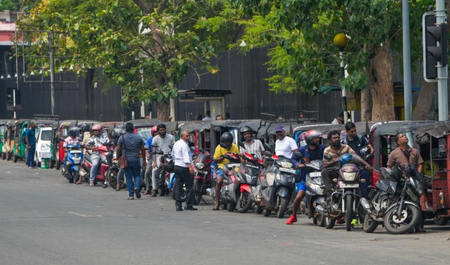
Colombo, March 24 (IANS) Sri Lanka’s Office of the Commissioner General of Essential Services has issued a set of guidelines to government institutions on the prudent use of fuel and energy amid possible disruptions to fuel imports caused by escalating tensions in West Asia.
The guidelines, issued to ministry secretaries, provincial and district secretaries, and heads of government and statutory institutions, called for measures to reduce fuel and electricity consumption across the public sector, reports Xinhua news agency.
Officials have been advised to avoid using individual vehicles to commute to work and instead use public transport or group transport whenever possible, according to the office.
Government institutions have also been instructed to prepare daily transport plans to reduce the number of vehicles used for field duties.
The guidelines set out steps to conserve electricity and energy, including maximising natural lighting, reducing the use of air conditioning by relying more on electric fans, and limiting elevator use by encouraging people to take the stairs.
Local government authorities have been directed to switch off street lights during unnecessary hours and temporarily turn off street lighting in non-high-security areas as a precautionary measure, the office said.
The guidelines further encourage heads of institutions to allow staff to work remotely where technological facilities are available instead of requiring physical attendance.
The office urged all public officials to act responsibly, set an example for the public, and extend maximum support to national energy conservation and security efforts.
Earlier on Saturday, Sri Lanka’s state-owned Ceylon Petroleum Corporation announced a revision of fuel prices.
All fuel products, including auto diesel, petrol and kerosene, saw price hikes ranging from 60 rupees (0.19 US dollars) to 90 rupees per litre effective from midnight on Saturday. Lanka IOC, another major petroleum company in Sri Lanka, said it would align its prices with the revised rates set by the corporation.
This marks the third price hike of fuel in Sri Lanka in less than a month’s time. Previously, the country’s petroleum companies adjusted fuel prices on February 28 and March 9. The price of auto diesel, for instance, has now reached 382 rupees per litre, compared to the pre-price-hike price of 281 rupees per litre.
–IANS
sd/