



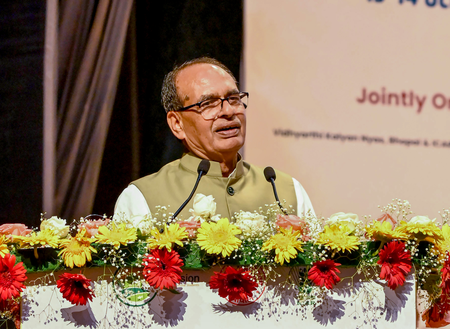
New Delhi, Nov 20 (IANS) Union Minister of Agriculture and Farmers Welfare and Rural Development, Shivraj Singh Chouhan, will dedicate India’s first “indigenous inactivated H5N1 Highly Pathogenic Avian Influenza (HPAI) virus vaccine” for poultry to the nation on Friday.
Bhopal-based ICAR-National Institute of High Security Animal Diseases (ICAR-NIHSAD) has developed a vaccine against the deadly animal disease ‘Bird Flu’, also known as Avian Influenza, officials said.
The vaccine will be unveiled at the institute and marks a major step toward strengthening disease control in the country’s poultry sector.
Highly Pathogenic Avian Influenza (HPAI), widely known as bird flu, poses a grave risk to chickens and other avian species, with outbreaks often resulting in total flock mortality rates.
In addition to necessitating mass culling and trade bans, bird flu disrupts international markets, drives up poultry product prices, and inflicts heavy financial losses on farmers.
Since the first reported case in India in 2006, the country has experienced over 500 outbreaks involving the H5N1 and H5N8 subtypes.
Official estimates indicate that a major outbreak could reduce India’s GDP growth by 1.5 per cent and put more than 20 per cent of the nation’s poultry population at risk.
Past outbreaks have already demonstrated this financial vulnerability: the 2006 outbreak resulted in estimated direct and indirect losses of Rs 2,200 crore to Rs 3,000 crore, while a separate outbreak in Manipur caused losses equivalent to 0.5 per cent of the state’s GDP.
In addition to agricultural losses, H5N1 carries serious public health implications.
According to the World Health Organization (WHO), 1,003 human cases of H5N1 avian influenza — resulting in 479 deaths — have been reported across 25 countries, including India, since 2003.
Virological studies show that the “H5N1 Clade 2.3.2.1a strain” has been responsible for most outbreaks in chickens, with recent infections also detected in mammals alongside three reported human cases.
Until now, no specific commercial vaccine was available to protect poultry against the circulating Clade 2.3.2.1a strain.
ICAR-NIHSAD’s indigenous vaccine fills this critical void by helping to protect poultry from the circulating strain, reducing economic losses for farmers, and limiting the virus’s transmission from chickens to other animals and humans.
–IANS
rs/