



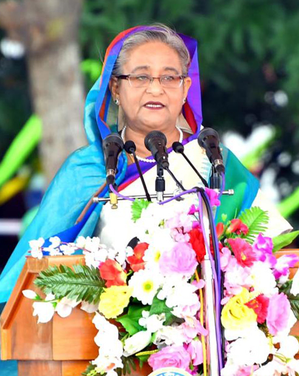
New Delhi, Sep 9 (IANS) Former Bangladesh Prime Minister Sheikh Hasina’s return home and her future there have been the subject of speculations and deductions, issues that have subsequently been addressed by those concerned, as reported in a section of the media.
Dhaka has been insisting that India extradite Hasina immediately, despite her repeated statements that she intends to return voluntarily in December.
After her ouster in August 2024, Bangladesh’s International Crimes Tribunal sentenced Hasina to death in absentia on allegations of crimes against humanity.
Reports from Dhaka note that officials have made it clear she will face execution upon return, with no chance to appeal.
Zahed Ur Rahman, Bangladesh Prime Minister Tarique Rahman’s Adviser on Information and Broadcasting, was quoted as saying that India “must send Hasina back” if bilateral relations are to normalise, reiterating his government’s views.
Referring to Hasina as “an accused”, “absconding accused”, and “convicted person sentenced to death”, he told the media in Dhaka that the government wants to bring her back rather than wait for her to return voluntarily.
“Even if she returns to the country, she will not have the opportunity to seek a review of the trial held against her,” he said, quoting the chief prosecutor of the International Crimes Tribunal, reported by The Daily Star on Tuesday. “Technically, the situation now is that she will arrive and the death penalty awaits her. We want to bring her back by capturing her,” he added.
Meanwhile, the deposed Premier herself expressed fears of being killed “at the airport” if she returns, reported Bengali news website The Wall Sunday. Bangladesh being her “own country”, she asked in the telephonic interview why she wouldn’t be allowed to return, while also expressing concern for her safety.
“Even if I return, they might try to kill me at the airport,” she maintained. Yet, she has consistently said that she will return to Bangladesh in December 2026 to surrender, reiterating her intention to come back on her own terms.
Similar apprehensions were shared by Shafiqul Alam, former Press Secretary to the then Chief Adviser of the interim government of Bangladesh, Muhammad Yunus. “If the BJP government allows her to cross into Dhaka via Benapole or Banglabandha and she is either mobbed or executed after exhausting her legal options, the BJP would face immense backlash at home. The Congress-led opposition, which maintains warm ties with Hasina, would heavily blame the BJP for her death,” he posted among seven points he shared on Facebook over Hasina’s possible return.
The Benapole border crossing lies in Bangladesh’s Jessore district, across Petrapole in West Bengal’s North 24 Parganas, while Banglabandha is a major inland port in northern Bangladesh close to the strategic narrow Siliguri Corridor that connects India’s Northeast to other parts of the country.
“Consequently, no Indian government would permit her return. Their only viable route is to negotiate a deal with a future friendly administration in Dhaka that guarantees her safety and rules out execution. Right now, no government in Bangladesh would agree to such terms; no one wants to repeat May 1981,” he added.
Alam appeared to refer to the May 30, 1981 assassination of then President Ziaur Rahman, father of the incumbent Prime Minister. However, he did not mention the assassination of the founding President of Bangladesh Sheikh Mujibur Rahman and his family on August 15, 1975. Hasina and her sister were the only survivors, then, being in abroad.
Alam also added that Hasina naming Sheikh Selim as her potential successor as leader of the Awami League is in anticipation that “her direct access to the media may soon be cut off”. Dhaka sees her virtual interactions as attempts to undermine its authority and influence international opinion.
Officials argue that allowing her to remain in India until December gives her space to continue shaping the narrative, something they are determined to prevent. Thus, while Dhaka insists on immediate extradition, framing it as a matter of justice and sovereignty, Hasina portrays her return as a voluntary act of accountability. Separate opinions, and yet they all reflect a similar fate for Hasina whenever she lands in Bangladesh.
— IANS
jb/uk