



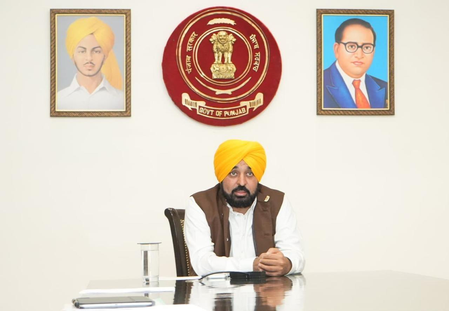
Chandigarh, Sep 6 (IANS) The Punjab Cabinet, chaired by Chief Minister Bhagwant Mann, on Sunday condemned the BJP-led Central Government for bypassing the state’s constitutional rights and established procedure.
Taking exception to the appointment of Justice Ashwani Kumar Mishra as Chief Justice of the Punjab and Haryana High Court without awaiting the views of the state government, the Cabinet resolved that the appointment and administration of oath should be put on hold until Punjab’s views are obtained and duly considered.
The Chief Minister’s Office stated, “The rights of Punjab have been violated by the Union government for a long time. In recent times, the interference from the Centre has increased to an unprecedented extent wherein the rights of Punjab as enshrined under the Constitution of India and several rules and regulations have been denied on multiple occasions.”
It stated, “The Union unanimously altered the rules of the Bhakra Beas Management Board (BBMB) by removing the traditional convention that guaranteed the Member (Power) was selected from Punjab, thereby diluting the state’s representation over its own river waters and dams. Further, the Union has proposed centralisation of Panjab University, which was strongly opposed by Punjab, but the Union has continued its interference to overpower the stronghold and authority of the people of Punjab by misusing its authority.”
The Punjab Cabinet pointed out, “The BJP-led Central government has also denied over Rs 9,000 crore of RDF dues to the government of Punjab, thereby inflicting great pain and suffering on the farmers who are the beneficiaries of the infrastructure sought to be created through RDF funds. “Similarly, the Union through the Prime Minister announced a relief package of Rs 1,600 crore after the devastating floods in 2025; however, not a single rupee of this package has been disbursed to Punjab till date.”
Pointing to the most recent notification of September 5, the Punjab Cabinet noted, “The Ministry of Law and Justice, Government of India, the President of India passed an order appointing Justice Ashwani Kumar Mishra as the Chief Justice of the Punjab and Haryana High Court. This appointment has been made without obtaining the consent of the state government, thereby bypassing all Constitutional norms and set procedures.”
The Cabinet stated, “The ‘Memorandum of Procedure for appointment and transfer of Chief Justices and Judges of High Court’, in its Para 6, clearly indicates that after receipt of the recommendation of the Chief Justice of India, the Union Minister of Law, Justice and Company Affairs would obtain the views of the state government. After receipt of the views of the state government, the Union Minister of Law, Justice and Company Affairs will submit proposals to the Prime Minister, who will then advise the President as to the selection.”
The Chief Minister’s Office noted, “As posted on July 25 by the Press Information Bureau, Government of India, in a reply to a Question appearing in Lok Sabha, the Union Minister for Law, Justice and Company Affairs informed the House that appointment of Judges in the higher judiciary is a continuous, integrated and collaborative process between the Executive and Judiciary. It requires consultation and approval from various constitutional authorities, both at the State and Central level.”
“In the instant case, the Collegium of the Supreme Court of India, vide minutes dated August 6 have recommended the appointment of Justice Ashwani Kumar Mishra, Acting Chief Justice of the Punjab and Haryana High Court, as the Chief Justice of the Punjab and Haryana High Court. On August 12, Punjab received the letter from Arjun Ram Meghwal, Minister of State for Law and Justice, for the consent of Punjab in terms of Para 6 of the ‘Memorandum showing the procedure for appointment and transfer of Chief Justices and Judges of the High Court’,” it added.
The Cabinet pointed out, “However, in complete disregard to the Memorandum of Procedures and established Constitutional norms, the Union has hurriedly notified the appointment of the Chief Justice of Punjab and Haryana High Court without awaiting response of the state government.”
It added, “It is pertinent to note that no clear time limit is prescribed for the state and the Governor to send its recommendation in the case of appointment of the Chief Justice.” “Whereas, in the year 2024, when a judge of Punjab and Haryana High Court, Justice Gurmeet Singh Sandhawalia, was recommended by the Collegium of the Supreme Court of India for his appointment as Chief Justice of Madhya Pradesh High Court, the same proposal was not notified by the Ministry of Law and Justice for more than two months and understandably on not receiving the recommendation from the Madhya Pradesh government. Later on, the Collegium and the Ministry of Law and Justice changed his appointment to the Himachal Pradesh High Court.
“As such, the feeling of perceived discrimination gets solidified in the sense that when a case of a Judge of Punjab is to be considered, it is dealt differently as that in a case of another Judge from another High Court getting appointed in Punjab,” it stated.
The Cabinet affirmed, “Such actions on the part of Central Government, especially on the issue of crucial appointments in judiciary, has compelled the state Cabinet to deliberate and express its concerns over the persistent issues affecting the state’s constitutional rights and equitable treatment within the Indian federal framework. In order to ensure transparency, procedural propriety and the maintenance of judicial uprightness, it is therefore imperative that the aforesaid appointment and administration of oath be put on hold until the views of Punjab, as contemplated under Paragraph 6 of the memorandum, are obtained and duly considered by the competent authority. Thereafter, the matter may be proceeded with in accordance with the procedure prescribed under the said memorandum.”
–IANS
vg/uk