



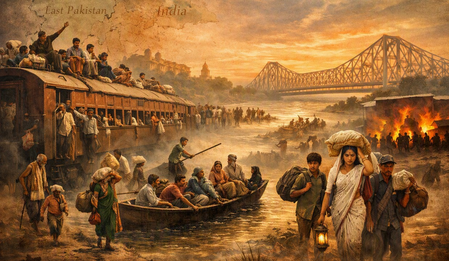
New Delhi, Aug 14 (IANS) It was the traumatic 1947 Partition‑era in East Pakistan. Ramesh Chandra and his family of eight were going through horror, locked in their sprawling house in Brahmanbaria as intermittent waves of marauders were being held at bay with boiling oil, jaggery or water poured from the roof. As their food and weapons of defence ran low, very late one night, when the din and threat seemed to lessen, the family crept out the back to begin a gruelling journey. They waded through streams, coaxed boatmen to cross wider and deeper water bodies, and walked until they reached Tripura. After a short stay, they walked to Assam, where they had relatives.
Years later, the family spread, and two generations lived through the trauma of Partition but breathed a sigh of relief as they struggled to earn their daily bread in different cities of India. Such refugee influx from East Pakistan mainly into Assam, Tripura and West Bengal was slower, prolonged and less visibly violent than the western part, which is why it receives less attention. Yet it reshaped the policies, politics, demography, and culture of eastern India through waves of migration from 1946 to the 1971 Bangladesh Liberation War, and beyond.
The arrival of millions of refugees from East Pakistan (later Bangladesh) into India had deep and lasting political consequences, especially in the three border states. Unlike Punjab’s sudden upheaval, the eastern influx was prolonged and layered, but it transformed electoral politics, ethnic relations and citizenship debates in ways that still reverberate. Rivers, forests and porous borders made monitoring difficult, and refugees blended into existing Bengali‑speaking populations.
Even before Partition, the infamous communal violence in Noakhali displaced almost 50,000 Hindus. The influx rose with Partition, with the formation of East Pakistan turning internal migration into cross‑border refugee flows. By May 1949, reports said Assam alone had 2,70,000 refugees, straining resources and sparking resentment among Assamese locals. Violence in Dhaka, Barisal and Khulna the next year triggered another wave, with refugees pouring into West Bengal towns like Nadia, 24 Parganas and Kolkata, often living in squatter colonies.
In 1964, more violence targeting Hindus broke out in East Pakistan, leading to renewed migration. Refugees settling in border districts of Assam and Tripura began triggering demographic shifts. The 1971 Bangladesh Liberation War saw perhaps the largest influx, with an estimated 10 million refugees fleeing genocide and war. As Bengali refugees began to threaten the marginalisation of indigenous tribes, resentment grew, especially in Assam between 1979 and 1985.
The influx forced India to grapple with belonging and identity, influencing later policies like the Citizenship Amendment Act (CAA) and National Register of Citizens (NRC). Refugee votes became decisive in Bengal, while in Assam and Tripura they triggered movements as migration intensified anxieties over land, language, and culture. This led to the Assam Movement (1979–1985), demanding detection and deportation of “foreigners,” and the 1983 Nellie Massacre, where over 2,000 people, mostly Bengali Muslims, were killed.
Though the Assam Accord of 1985, which set 1971 as the cut‑off date for citizenship, helped contain the situation somewhat, disputes continue. In Tripura, meanwhile, the Bengali refugee population grew significantly, altering the demographic balance and reshaping the state’s politics and identity.
West Bengal, too, was overwhelmed by the continuous influx. The then Left Front government, led by Jyoti Basu, reversed earlier pro‑resettlement promises. In 1979, it ordered the eviction of Bengali Hindu Dalit refugees settled on Marichjhapi Island in the Sundarbans, declaring the area a protected forest. What followed was forced eviction between January and May 1979 and deaths of Dalit refugees following a security blockade and police violence, still referred to as the Marichjhapi massacre. Official death estimates range within single digits, while survivor accounts and some reports suggest hundreds, some to over 600 fatalities.
Refugee colonies around Kolkata, Nadia and North 24 Parganas became hubs of political mobilisation, with subsequent governments eyeing these as vote banks. The migration in the east was slower, episodic and stretched over decades, but the violence was as real and brutal, though suffering was less visible elsewhere.
–IANS
jb/dan