



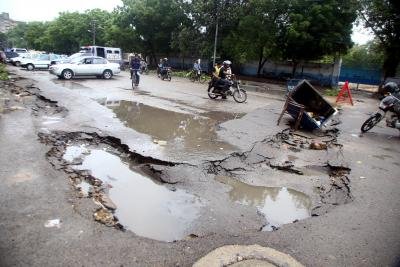
Islamabad, Aug 26 (IANS) People in Pakistan’s Karachi continue to suffer due to fragmented authority, overlapping jurisdictions, weak municipal institutions and an inadequate relationship between political power and administrative responsibility. Despite being Pakistan’s largest city and economic engine, Karachi demonstrates the country’s wider governance deficit, a report has detailed.
“Karachi is not merely a city in crisis. It is a warning about the consequences of a governance structure that has become too centralised, too politicised and too distant from the citizen. Pakistan’s largest city and economic engine should, by any reasonable measure, be a showcase of competent urban governance. Instead, it has become one of the clearest manifestations of the country’s wider governance deficit,” Syed Khawar Mehdi wrote in leading Pakistani daily ‘The Friday Times’.
The problem in Pakistan’s Karachi is not only about inadequate roads, traffic jams, worsening condition of infrastructure, unreliable municipal services and poor waste management. The failures spark questions about who governs Karachi, who controls its resources and who takes the decision regarding the city. After years of political continuity in Sindh, people in Karachi continue to face problems due to fragmented authority, overlapping jurisdictions, weak municipal institutions and an inadequate relationship between political power and administrative responsibility.
Responsibility is distributed among departments of the province, municipal bodies, cantonments, development authorities and other institutions, while meaningful accountability is difficult to find. Karachi is not only a problem but a critical case study, while Pakistan remains the subject.
According to the report in ‘The Friday Times’, good governance depends on several elementary principles like transparent decision-making, financial integrity, administrative competence, institutional accountability, participation of citizens, equitable distribution of resources and continuity of policy beyond individual governments. Considering these standards, Pakistan’s governance architecture remains weak. People have little influence over decisions that directly impact their routine lives, while local agencies do not have adequate financial autonomy, administrative authority and institutional continuity to do the work expected of them.
“The issue is therefore not Karachi versus Sindh, nor province versus federation. It is whether Pakistan chooses effective and accountable government over an entrenched culture in which authority is perniciously concentrated while responsibility remains blurred. The solution is not another layer of centralisation, but better-designed decentralisation. Pakistan’s governance debate has for too long revolved around personalities, parties, elections and constitutional confrontation while neglecting the institutional question that should matter most: how do we make government work for the ordinary citizen?,” questioned Mehdi.
Last month, Karachi was ranked as the world’s fourth least liveable city on the Economist Intelligence Unit’s (EIU) annual Global Liveability Index 2026, placing it 170th among 173 cities, local media reported.
The only cities which have been ranked below Karachi are – Dhaka, Damascus and Tripoli, Pakistan-based daily Dawn reported. The EIU’s ranking provides a globally recognised benchmark for urban liveability and resilience and assesses measuring indicators like healthcare, stability, culture and environment, education and infrastructure. It assesses the challenges presented to a person’s lifestyle in any given place.
Karachi received an overall ranking of 43 out of 100, and it scored 20 on stability, 54 on healthcare, 36 on culture and environment, 75 in education and 52 in infrastructure.
–IANS
akl/as