



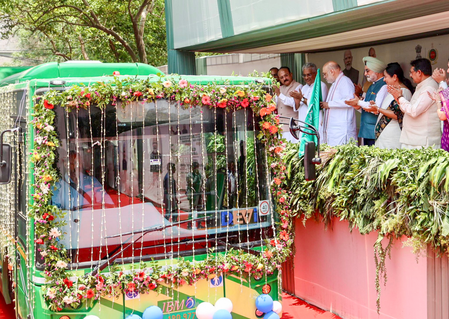
New Delhi, July 7 (IANS) Union Home and Cooperation Minister Amit Shah on Tuesday flagged off 300 new zero-emission electric buses, inducting them into the Delhi Transport Corporation (DTC) fleet.
The new fleet comprises 195 nine-metre electric buses under the ‘DEVI’ category and 105 state-of-the-art 12-metre electric buses.
During the event, Home Minister Amit Shah virtually laid the foundation stone for the state-of-the-art High-Security Prison at Narela to accommodate more than 250 inmates.
The project will be among the country’s most modern, technology-driven high-security prisons and will further strengthen the capital’s security infrastructure. The Home Ministry will provide Rs 100 crore for the project, while the remaining cost will be borne by the Delhi government, said an official statement.
Unlike conventional prisons, the High-Security Prison will be built on advanced technology and global security standards. Its radial-axial design will enable monitoring of every wing from a central control point, while each inmate will be housed in an individual cell, minimising the possibility of interaction, gang networking and other security risks, it said.
The prison will feature AI-enabled CCTV surveillance, body-worn cameras, biometric access control, automated locking systems, full-body scanners, X-ray baggage scanners, mobile signal jammers, video conferencing facilities, an in-house court complex, anti-tunnelling technology and a state-of-the-art command and control centre, it said.
Each cell will have an independent toilet and bathing facility to minimise unnecessary inmate movement. The project will set a new benchmark in security, surveillance, rapid response and technology-driven prison management, said the statement.
Union Minister of Environment, Forest and Climate Change Bhupender Yadav, Union Minister of State Harsh Malhotra, Lieutenant Governor Taranjit Singh Sandhu, Chief Minister Rekha Gupta, Delhi Cabinet Ministers Parvesh Verma, Ashish Sood, Manjinder Singh Sirsa and Pankaj Kumar Singh were present on the occasion.
Chief Minister Gupta said the newly inducted buses are low-floor, air-conditioned vehicles designed to provide passengers with safe, comfortable and accessible travel, including for persons with disabilities.
Each bus is equipped with CCTV cameras, panic buttons, real-time GPS tracking, a passenger information system and other advanced safety and smart features, she said.
With zero tailpipe emissions, these buses will play an important role in improving Delhi’s air quality, reducing carbon emissions and providing citizens with a quieter, more comfortable and environmentally friendly travel experience, she said.
With the addition of these buses, Delhi’s public bus fleet has grown to nearly 6,600 buses, including 4,845 electric buses and 1,755 CNG buses. The Delhi government aims to build a modern fleet of around 14,000 buses by 2028-29, she said.
To strengthen the infrastructure required for operating electric buses, state-of-the-art electric bus depots at Narela Sector A-1 and A-4, Rithala and Kohat Enclave were also inaugurated on Tuesday, said the statement.
The electric bus depots at Narela Sector A-1 and A-4 provide parking capacity for 250 DEVI electric buses. They have been developed with modern parking bays, internal roads and world-class operational and maintenance facilities, further strengthening Delhi’s electric mobility infrastructure.
Similarly, the Kohat Enclave electric bus depot has parking capacity for 30 electric buses and includes an administrative building, service pit, repair shop, washing pit, store, security room and electrical substation.
The depot will play a key role in strengthening feeder and last-mile connectivity. The Rithala electric bus depot has a parking capacity for 90 electric buses. Equipped with modern maintenance facilities, it will further enhance the efficiency and reliability of electric bus operations in Delhi, said the statement.
On the occasion, a state-of-the-art four-lane Automated Testing Station developed at the Nand Nagri DTC Depot was also inaugurated to make road safety more scientific and transparent.
The facility will carry out fully automated fitness testing of heavy, light and two-wheeler vehicles. It has the capacity to conduct fitness tests for 52,000 heavy and light vehicles and 20,000 two-wheelers every year.
Tests such as brake performance, suspension, headlight alignment, side slip, emission levels and underbody inspection will be carried out using modern technology without any human intervention. This will improve transparency, strengthen road safety and generate non-fare revenue for DTC every year, said the statement.
–IANS
rch/uk