



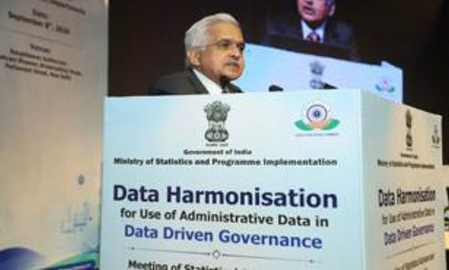
New Delhi, Sep 8 (IANS) The Centre on Tuesday launched a Quarterly Progress Report (QPR) portal on Data Harmonisation for use by all Union Ministries, departments and organisations with the aim of fostering greater coordination for data-driven governance and evidence-based policymaking across the government.
The report was launched at a workshop organised by the Ministry of Statistics and Programme Implementation (MoSPI) with the objective of strengthening the National Data System, promoting effective use and harmonisation of administrative data.
The QPR Portal is a technology-enabled platform for use by all Union Ministries, departments and organisations to report progress in identification and cataloguing of datasets made ready for dissemination, its metadata preparation, use of national and international standards, classifications and common unique identifiers in machine readable data, and performing quality checks as per Statistical Quality Assurance Framework (SQAF) by respective Ministries, departments and organisations of the Central government.
The QPR portal has automated validation, dashboards, cross-verification with the National Metadata Structure (NMDS) web portal and will provide analytical insights across Ministries, Departments and Organisations.
Launching the portal, Shaktikanta Das, Principal Secretary-2 to Prime Minister Narendra Modi, emphasised that trusted, timely and interoperable data is essential for evidence-based policymaking and data-driven governance.
He called for greater use of administrative data and statistical expertise across Ministries for policy formulation, monitoring and outcome assessment.
Speaking on the occasion, Ministry of Electronics and Information Technology (MeitY) Secretary S. Krishnan highlighted the importance of effective data sharing, harmonisation and interoperability across Ministries to strengthen evidence-based policymaking and improve governance.
He emphasised that the availability of high-quality data is fundamental to the successful deployment of Artificial Intelligence (AI) for governance.
He also stressed upon optimal utilisation of government data in view of rapid digitisation and the increasing availability of administrative data.
“Efforts should focus on utilising such data effectively for improved welfare outcomes, policy formulation and delivery of government services. Whole-of-government approach should be adopted. Existing resources, including statistical officers, India AI Mission experts, NIC personnel and other data professionals working across Ministries and Departments, should be leveraged,” he added.
MoSPI Secretary Saurabh Garg, underscored the need to move from siloed departmental data systems towards an integrated, interoperable and government-wide data ecosystem.
He emphasised harmonisation of concepts, definitions, classifications, identifiers, geographies, metadata and data structures for effective data utilisation.
He highlighted the complementary roles of Statistical Advisers in statistical leadership and quality assurance and Chief Data Officers in data governance and interoperability, supported by the National Data Governance Committee and the QPR on Data Harmonisation.
–IANS
sps/khz