



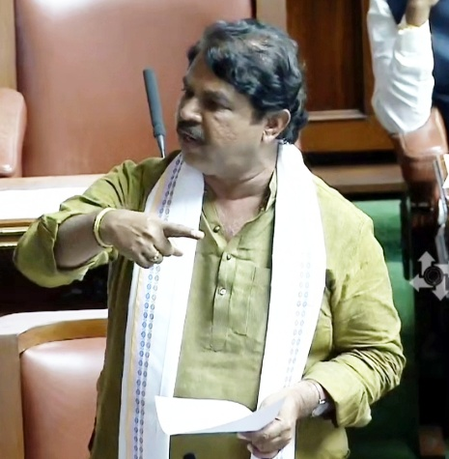
Bengaluru, Sep 21 (IANS) The Central government has issued a notification to implement the Kasturirangan report as per the National Green Tribunal (NGT) order and has not taken a voluntary decision on its own, senior Bharatiya Janata Party (BJP) leader and Leader of the Opposition R. Ashoka said on Monday.
Speaking in the Legislative Assembly during a special session called to discuss the Kasturirangan report and drought, Ashoka advised the state government to conduct a ground-level survey and appoint competent lawyers to make a convincing case in court.
He warned that implementation of the report would cause great hardship to farmers.
Ashoka said Congress ministers should stop claiming the Prime Minister issued the order, stressing that “there should be no politics in this.” He added that the NDA government had not issued the order, which was based on court directions.
He suggested Karnataka follow Kerala’s model, where the government conducted a ground-level survey, identified plantations and houses, and submitted a report to the NGT and Centre, which reduced the extent of the ecologically sensitive area.
Ashoka pointed out that Karnataka has 1,576 villages covering 20,668 sq km under the ecologically sensitive area mentioned in the Kasturirangan report, the largest among states.
He said satellite imagery had wrongly classified fields and coffee plantations as forest, creating problems for lakhs of farmers in ten districts.
He noted that lack of coordination between the Forest and Revenue departments was preventing road construction in villages.
“Even if a bridge collapses in the monsoon, it cannot be repaired; electricity connections cannot be given. If the Forest Department creates a buffer zone, difficulties will increase further,” he said.
Ashoka urged the government to prepare a ground-level survey report, submit it to the Centre and NGT, and appoint lawyers with environmental expertise to argue in the Supreme Court.
He cautioned that if the state government failed to act, the NGT would direct the Centre to implement the report.
Highlighting the importance of the Western Ghats, Ashoka said the region covers 1,64,280 sq km across six states, absorbs 40 lakh tonnes of carbon, and is home to eight biodiversity hotspots and more than 325 species.
He recalled that the Madhav Gadgil Committee, formed in 2010, had recommended stringent restrictions. Still, protests led to the constitution of the Kasturirangan Committee, which suggested declaring 37 per cent (59,940 sq km) as ecologically sensitive.
Ashoka said the Goa Foundation has been pressing for implementation of the Gadgil report and has approached the Supreme Court.
He noted that the NGT has directed that the 2017 notification should not be altered and the Centre has issued notifications multiple times as per tribunal directions.
He added that the Centre has now formed a committee headed by Sanjay Kumar, with a term till 2027.
–IANS
mka/dan