



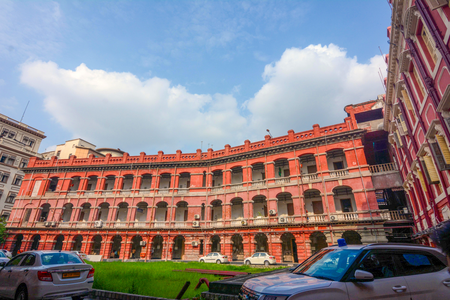
New Delhi, May 8 (IANS) Colour has long mirrored political change in West Bengal, vividly reflecting shifts in power over the last half-century. From the Left Front’s iconic red to the Trinamool Congress’s blue-and-white, political transitions in the state have often found expression through colour.
Just as Left leaders favoured red, former Chief Minister Mamata Banerjee turned Kolkata blue — a shade she said symbolised the idea that “the sky is the limit”. Her personal attire, a white saree with a blue border, became an extension of this political imagery. Over time, blue-and-white came to represent the Mamata-led Trinamool Congress across the state, particularly in the capital.
From government buildings, sundry facades, makeshift tents for meetings and rallies, to roadside curbs: political transitions over the last 50 years have been vividly reflected in colours. Most parts of the state literally changed colour, with the Left Front government’s era marked by “revolutionary red”, and the Trinamool Congress flipping it to blue-and-white.
The red facade of the earlier state secretariat, Writers’ Building, suited the communists, though it was painted much before, around the beginning of the twentieth century. Mamata, soon after assuming power in West Bengal, shifted the seat of governance to adjacent Howrah, to a building named “Nabanna” (new crop, or harvest). The facade, indeed, was painted in blue-and-white.
It was said during the shift out of the Writers’ Building that the building was in need of urgent repair and restoration. Hazards related to overcrowding and overuse, like electricity connections, unplanned eateries, and improper waste management, were also highlighted.
The building originally housed clerks when it was built in the eighteenth century by the British East India Company, and thus, the name. Built in 1777, the Writers’ Building has been a colonial icon and later the nerve centre of the state’s governance. However, during the 15 years of the Trinamool Congress regime, the restoration exercise could not be completed. And thus, the operational secretariat never returned to Kolkata’s centre at BBD Bagh.
This Kolkata nerve-centre of Dalhousie Square was renamed after the three brave freedom fighters — Binoy Basu, Badal Gupta, and Dinesh Gupta. The sprawling building stood empty and desolate throughout this time. With reports citing restoration work picking up in the iconic building, suggesting that the new secretariat under the Bharatiya Janata Party (BJP) government may return to the Writers’ Building, speculations are rife on a fresh coat of paint.
Meanwhile, not far away from the building stands the historic monument, renamed “Shaheed Minar” in 1969. Originally constructed by the British to honour their war heroes around 1828, the later state governments in Independent India rededicated the structure after over a century to the memory of the martyrs of the freedom movement.
The saturation of red, reflecting the Left’s dominance and its ideological branding across public spaces, went so deep that it once even decided to repaint the monument’s top. Mamata ended the Left’s 34-year uninterrupted rule in 2011 and shifted the state’s administrative headquarters from the Writers’ Building to Nabanna within two years. Thus, blue-and-white is on Bengal’s new political palette, reinforcing a new symbolism.
Even as speculations gain ground over reported changes, members of the new cabinet are scheduled to take the oath of office and secrecy on Saturday, at Kolkata’s green lung “maidan”, making a first such exercise.
–IANS
jb/skp