

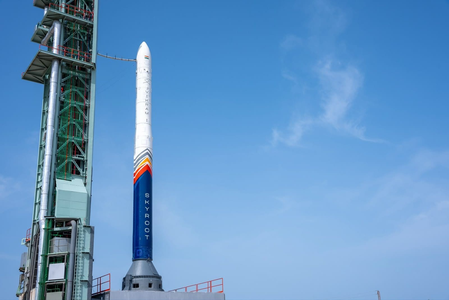
New Delhi, July 21 (IANS) India’s first privately developed orbital rocket Vikram‑1 reaching orbit marks a structural shift in India’s space sector from a state monopoly to a “multi-actor space ecosystem”, a new report has said.
“India is no longer just a low-cost extension of ISRO but a country building a diversified, multi-actor space ecosystem, with its own rockets, satellites and eventually its own crewed missions and space station,” the report from India Narrative said.
Vikram-1 extends a narrative that began with Chandrayaan-3’s landing and Aditya-L1’s solar mission, the report said noting that reforms that started around 2020 and created IN‑SPACe fuelled the success of this mission.
The report said that IN-SPACe enabled Skyroot to test its hardware and launch from ISRO’s own range at Sriharikota.
IN-SPACe integrates private launchers, satellite makers and downstream service providers into a single national ecosystem rather than leaving them to build parallel, isolated capability.
Hyderabad‑based startup Skyroot Aerospace, used advanced manufacturing techniques in the mission including all‑carbon composite motor casings, high‑performance solid motors and 3D‑printed propulsion components for the rocket.
These manufacturing techniques were the preserve of ISRO and a small circle of global aerospace giants until recently, the report noted.
“It carried technology demonstration payloads from Grahaa Space in India, from Cosmoserve, from Germany’s DCubed, and from Skyroot itself — proof that Indian private launch capability is already being tested by customers who could have gone almost anywhere else in the world,” the report noted.
Policy reforms in India’s space sector pushed the country from having a single space startup in 2022 to nearly 200 by 2024. The sector attracted roughly Rs 1,000 crore in just eight months of 2023, the report noted.
Policy makers plan to raise India’s share of the global space economy from about 2 percent in 2021 to 8 percent by 2030, and as much as 15 percent by 2047 and Vikram-1 proves that the industrial base to support them actually exists, the media house noted.
—IANS
aar/pk