



Washington, June 11 (IANS) The United States said on Thursday that it is in direct contact with India after New Delhi summoned the US Charge d’Affaires Jason Meeks to protest a series of attacks on commercial vessels carrying Indian seafarers in West Asia.
Responding to India’s diplomatic demarche, a US State Department official said Washington remains engaged with the Indian government on the matter.
“The Department of State is in direct contact with the Indian government regarding this matter,” the official told IANS.
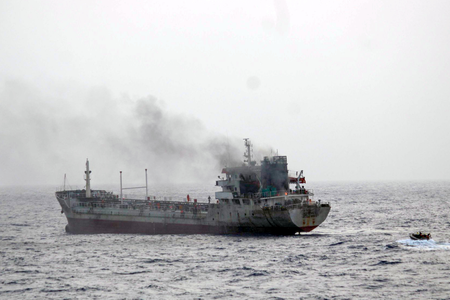
The statement came a day after India summoned the senior American diplomat in New Delhi and lodged what it described as a “strong protest” over recent attacks on vessels operating near the Strait of Hormuz, including the commercial ship Settebello off the coast of Oman, where three Indian nationals were killed.
India’s Ministry of External Affairs (MEA) said the attacks were a direct consequence of the ongoing conflict in the region and called for an immediate end to violence affecting commercial shipping.
“There have been several incidents involving Indian seafarers in West Asia in the last few days. We attach high importance to the welfare and well-being of our seafarers’ community. We need not re-emphasise this point. Yesterday, we condemned the attack on a ship off the coast of Oman in which, unfortunately, we lost three Indian nationals,” the MEA said on Thursday.
“We had summoned the US Charge d’Affaires here to register a strong protest. The continuing incidents of attacks on shipping in the region are deeply worrisome and a direct result of the ongoing conflict in the region. These attacks must cease and end. We also call for dialogue and diplomacy so that we can have an early return to peace and stability in the region,” the MEA added.
The MEA also said India had conveyed its concerns directly to the American side after the attack on Settebello.
“When this particular attack happened on the ship Settebello, we lodged a strong protest with the American side. We called in the American Charge d’Affaires, and he was conveyed our deepest concerns on the ongoing incidents of attacks, as also we registered a strong protest with them. We conveyed that the welfare of our seafaring community is very important and the attacks that are happening must stop,” the MEA spokesperson Randhir Jaiswal said.
“We also conveyed that dialogue and diplomacy is the way forward for peaceful resolution of the conflict and that there should be unimpeded access through the Strait of Hormuz in keeping with international law. So, we made our position very clear on each of these points while reiterating how important the lives of our people are, their welfare and safety,” he added.
India also stressed the importance of keeping the Strait of Hormuz open to international shipping.
The MEA said all three vessels involved in the recent incidents were foreign-flagged ships.
“As you would have seen in the various reports, as also in what was clarified through our statements and otherwise from this podium, the three ships that have been involved in the incidents are foreign-flagged. Two of them Palau-flagged, and the third one, which came under attack today, is Guinea-flagged. They are not Indian owned ships, they are all foreign flagships. I also understand that two of them are OFAC-sanctioned ships and one of them also is in the category of a non-compliant ship,” MEA spokesperson Jaiswal said.
Earlier on Thursday, the Indian Embassy in Oman reported another vessel incident off Oman’s Shinas port, adding to concerns over the safety of commercial shipping in the Gulf.
The Strait of Hormuz is one of the world’s most important energy transit routes, carrying a substantial share of global oil and gas exports. The waterway has become increasingly sensitive as tensions and military activity have escalated across the region.
India has one of the world’s largest seafaring workforces, with thousands of Indian nationals serving aboard merchant vessels operating in the Gulf and other international waters. New Delhi has routinely raised concerns over maritime security whenever regional conflicts threaten commercial shipping lanes.
–IANS
int/lkj/ksk/khz