



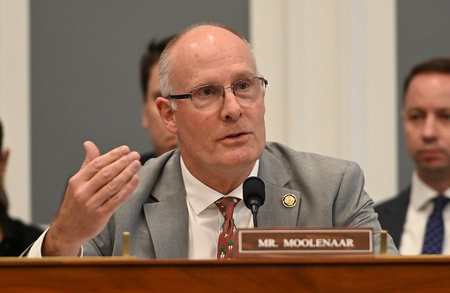
Washington, May 22 (IANS) A top House Republican on China has urged the Treasury Department to block American investments in Chinese biotechnology companies, warning that US capital and expertise are helping Beijing dominate the global pharmaceutical sector.
Powerful Republican Congressman John Moolenaar, who is chairman of the House Select Committee on the Chinese Communist Party, called on Treasury Secretary Scott Bessent to designate biotechnology as a “prohibited technology” under the Comprehensive Outbound Investment National Security (COINS) Act of 2025.
“The United States is engaged in a fierce biotechnology competition with the PRC, with crucial implications for our national and economic security as well as for the future of healthcare and the security of American medical data,” Moolenaar wrote in a letter dated May 21.
The Michigan Republican argued that China has pursued a “deliberate, state-directed strategy” to dominate pharmaceutical development, biologics manufacturing, and clinical research capabilities.
Moolenaar said US investments, licensing agreements, joint ventures, and intellectual property transfers are accelerating China’s biotech ambitions and helping Chinese firms climb the global pharmaceutical value chain.
“United States capital flowing to Chinese biotechnology companies through licensing agreements, joint ventures, and equity investments is fueling China’s strategy,” he wrote.
The letter cited data showing cross-border out-licensing transactions between multinational pharmaceutical firms and Chinese biotech companies totaled approximately $136 billion in 2025. It added that 48 per cent of global pharmaceutical licensing deals worth $50 million or more last year involved Chinese companies, compared to none in 2020.
Moolenaar specifically highlighted recent agreements involving major American drugmakers, including Eli Lilly and Bristol Myers Squibb.
According to the letter, Bristol Myers Squibb recently announced a partnership worth up to $15.2 billion with China’s Hengrui Pharma involving co-development of drug molecules and transfer of intellectual property and know-how.
Moolenar also raised concerns over China’s clinical trial system, describing it as “the cheapest and fastest human clinical trial system in the world” while alleging ethical concerns involving informed consent and involuntary participation.
The letter further claimed that some clinical trials are conducted at hospitals in Xinjiang and Chinese military hospitals, potentially exposing sensitive American biotechnology data and intellectual property to the Chinese military.
Moolenaar warned that failing to restrict outbound biotech investments could create strategic US dependence on China similar to vulnerabilities in rare earth minerals and semiconductor supply chains.
“I respectfully recommend that the Treasury Department cover biotechnology as a prohibited technology through the implementation of the COINS Act as soon as possible,” he wrote.
–IANS
lkj/rs