



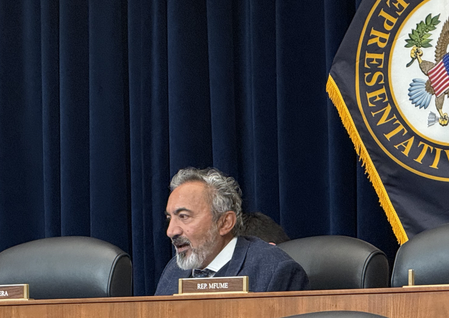
Washington, Feb 12 (IANS) Lawmakers urged the State Department to back the repeal of the Cold War-era Jackson-Vanik amendment for Central Asian nations, arguing that the outdated provision hampers US investment and undercuts strategic competition with Russia and China.
During a House subcommittee hearing on South and Central Asia, Democratic Rep. Ami Bera pressed Assistant Secretary of State for South and Central Asian Affairs Paul Kapur to support legislative efforts to remove the trade restriction.
“The repeal of Jackson-Vanik, which really is a Cold War relic that doesn’t really apply to today’s world,” Bera said, arguing that it “does inhibit US companies from fully investing in some of the Central Asian nations.”
He described the issue as bipartisan, noting that administrations of both parties have acknowledged that the measure is outdated.
“It hasn’t been a partisan issue,” Bera said, adding that Secretary of State Marco Rubio had also recognised that it “is a relic of the past.”
Bera framed the repeal as strategically necessary.
“They want our companies investing in their critical minerals, energy resources, etc. And they’re in a tough neighbourhood between Russia and China,” he said.
Kapur agreed with the characterisation.
“Yes, sir, this is a great example of a bipartisan issue,” he responded.
“We believe that Jackson-Vanik is a relic of the Cold War. As you said, the secretary has said the same thing, and we appreciate bipartisan support here,” Kapur added.
Bera urged swift action. “Let’s get it done,” he said.
The exchange highlighted growing congressional interest in strengthening US economic engagement in Central Asia, a region increasingly viewed through the lens of strategic competition.
Central Asian states, rich in critical minerals and energy resources, sit between Russia and China and have sought greater diversification of trade and investment partners.
Kapur’s broader testimony framed US engagement as helping regional partners build “strategic capacity” and integrate into the global economy while preserving sovereignty.
By removing trade-era restrictions, lawmakers argued, Washington could unlock greater US private-sector participation and offer alternatives to Chinese and Russian influence.
The bipartisan tone of the discussion stood out in a hearing otherwise marked by sharper exchanges over Afghanistan and Indo-Pacific priorities.
The Jackson-Vanik amendment, enacted in 1974, tied US trade relations to freedom-of-emigration requirements in Soviet-bloc countries.
While many former Soviet states have since received permanent normal trade relations status, the amendment’s lingering application to parts of Central Asia has been viewed by policymakers as an outdated barrier to deeper economic engagement in a region of growing geopolitical significance.
–IANS
lkj/sd/