



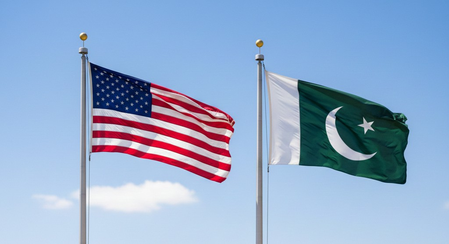
Washington, Feb 12 (IANS) The United States has described Pakistan as “another important partner” in South Asia, outlining cooperation on critical minerals, trade and counterterrorism even as lawmakers highlighted regional tensions and the risks of instability.
Testifying before a House subcommittee hearing on US policy in South and Central Asia on Wednesday (local time), Assistant Secretary of State for South and Central Asian Affairs Paul Kapur said Washington is working with Islamabad to strengthen economic and security engagement.
“Pakistan is another important partner in the region,” Kapur told lawmakers.
“We’re working together with Pakistan to realise the potential of its critical mineral resources,” he said, describing efforts that combine “US government seed financing with private sector know-how to the benefit of both of our countries.”
Kapur said economic ties are expanding. “Our trade, energy, and agriculture are expanding as well,” he noted.
He framed the approach within a broader regional strategy, stating, “This will require us to help our partners build strategic capacity, enabling them to integrate into the world economy, preserve their autonomy, and contribute to a free and open region.”
Security cooperation, he added, remains central. “Our ongoing counterterrorism cooperation helps Pakistan combat internal security threats while addressing transnational dangers that could harm our partners.”
The hearing also revisited Pakistan’s long and complex history with militancy. Referencing his academic work, Kapur said: “The point of the book was to look back at Pakistani strategy and discuss how the Pakistanis had interacted with militant and terrorist groups.”
He acknowledged the broader challenge of combating extremist networks. “That’s one of the challenges of dealing with terrorism, that there are small numbers of people that blend into the population. It’s very hard to know,” he said.
Lawmakers underscored the high stakes of regional stability. Democratic Rep. Sydney Kamlager-Dove noted that “India and Pakistan fought their most serious military conflict in decades, risking nuclear escalation in a region of 2 billion people,” describing it as “a reminder of the indispensable role of US Diplomacy.”
Kapur did not elaborate on the current status of India-Pakistan tensions but emphasised that US engagement across South Asia is designed to prevent destabilising dominance by any single power.
“A hostile power dominating South Asia might exert coercive leverage over the world economy,” he said earlier in the hearing.
The renewed US focus on Pakistan’s mineral sector comes amid the broader efforts to diversify global supply chains and reduce strategic dependence on China in key sectors.
The testimony suggested that Pakistan continues to occupy a consequential space in Washington’s calculations — as a security partner, a mineral resource hub, and a key actor in a region where instability can carry global repercussions.
US-Pakistan relations have fluctuated over the past two decades, shaped by counterterrorism cooperation, tensions over Afghanistan, and concerns about extremist networks.
–IANS
lkj/sd/