

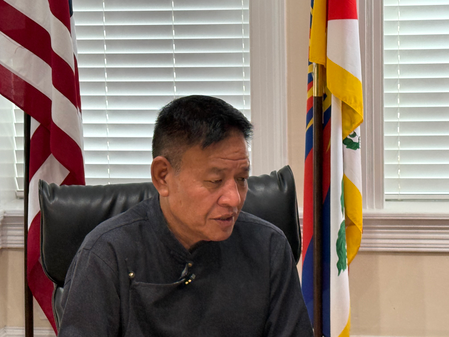
Washington, Nov 13 (IANS) US funding for Tibetan exile programmes has fallen sharply under the Trump administration’s foreign aid cuts, although part of the money has been restored after discussions with American officials, the elected Tibetan political leader Penpa Tsering has told IANS.
In an exclusive interview in Washington, the Sikyong of the Central Tibetan Administration (CTA) said his team was seeking clarity from the State Department over both current assistance and the procedures that would determine funding in coming years.
Before the cuts, about $12 million had been allocated for the Central Tibetan Administration and Tibetan communities in exile, he said. Another $2 million came through a refugee and migration programme for health-related needs.
Tsering said the latter programme had been cut and foreign assistance suspended as part of broader changes in Washington. But his administration had managed to secure the return of $6.8 million of the previously available support.
“We managed to get back 6.8 million from last year,” he said.
He said the reinstated amount was important at a time when many other recipients had struggled to recover funding. The remaining $5 million from the principal allocation had been subject to a rescission, and further decisions would depend on the next budget cycle, he noted.
Tsering said proposals for another funding round were due by November 18. Assistance previously associated with the 2024 and 2025 fiscal years was now spread over a longer period, he explained, adding that officials had indicated extensions would also be available under the 2026 budget.
The financial uncertainty has been compounded by changes inside the State Department and the closure of the US Agency for International Development, which previously administered several international assistance programmes.
Tsering said he had held an extended meeting with State Department leadership and programme officials to understand which offices would oversee Tibetan initiatives, how money would be distributed and what would happen to existing commitments.
A separate $10 million had been designated for programmes benefiting Tibetans inside Tibet, he said. Those projects were not managed directly by the Central Tibetan Administration and depended on other implementing organisations.
“There is another separate 10 million for Tibetans inside Tibet,” he said.
Tsering said the problem was how the US government could implement the programmes following USAID’s closure, especially when operating inside Tibet had become increasingly difficult since 2018.
He said his team remained hopeful that Washington would continue assistance, but acknowledged that recovering every dollar of the earlier allocations would be difficult because the administration was focused on cost reductions.
His appeal was also political. Tibetan leaders, he said, had long argued that supporting a nonviolent movement cost relatively little compared with conflicts and military interventions.
“it costs only a few millions to support nonviolence,” he said, describing his movement’s preference for negotiations with China.
Tsering emphasised that Washington was not the Tibetans’ only major source of assistance. India, he said, had provided essential support in education, rehabilitation and humanitarian services over decades.
“Indian government is our biggest support,” he said, adding that India’s backing went far beyond what could be measured by a single budget line.
The Central Tibetan Administration is based in Dharamsala, India, and represents Tibetan communities in exile. It maintains contact with foreign governments and legislators on humanitarian support and Tibetan cultural and religious rights, while seeking a negotiated settlement with Beijing.
–IANS
lkj/ksk