

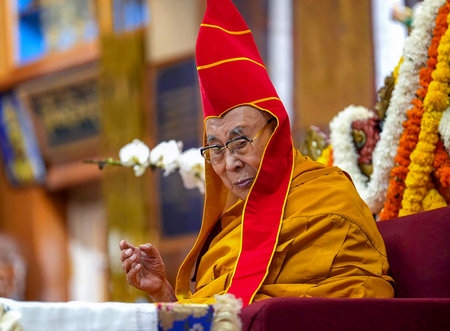
Washington, Nov 13 (IANS) China is preparing to assert control over the selection of the next Dalai Lama in an attempt to gain greater authority over Tibetan Buddhism, Sikyong Penpa Tsering, the elected political leader of the Central Tibetan Administration, has said.
In an exclusive interview with IANS in Washington, Tsering said the dispute over the Dalai Lama’s reincarnation had become a central concern for Tibetans and for governments that defend religious freedom.
“They believe that if they can control the next Dalai Lama’s reincarnation, they can control the whole of Tibet,” he said, referring to the Chinese authorities.
Tsering accused Beijing of demanding loyalty to the Communist Party inside monasteries even as it claimed a right to supervise one of Tibetan Buddhism’s most sacred traditions.
He said monasteries were being pushed away from religious scholarship and towards political education, including the study of Chinese leader Xi Jinping’s ideas. These requirements, he argued, were incompatible with Buddhist practice.
China has issued rules governing the recognition of reincarnated religious figures, he said, and wants to retain the final authority in any decision about the 15th Dalai Lama.
Tsering said the current Dalai Lama had made his own position clear before his 90th birthday in July 2025. According to Tsering, the spiritual leader had said he would be reborn in “a free world”, rather than under the supervision of China’s government.
He argued that the right to determine a religious succession belonged to the spiritual tradition itself, not to an atheist ruling party.
“So a government that does not believe in any religion, how can they be responsible for a sacred religious tradition that we have been following over the years, centuries, which is very unique to Tibetan Buddhism,” he asked.
Tsering also invoked the case of the Panchen Lama recognised by the Dalai Lama, whose whereabouts have remained unknown to the Tibetan leadership. He said this experience reinforced concerns about Beijing’s role in future religious appointments.
“We still don’t know whether he’s alive or not,” he said.
He accused China of promoting its own Panchen Lama and suggested that Beijing might use that figure in the process of identifying a successor to the Dalai Lama. He described such an arrangement as unacceptable to Tibetans who follow the present spiritual leader.
Tsering said Tibetans were preparing for the eventual transition, while relying on the Dalai Lama’s own public guidance on reincarnation. The question was not simply who would be recognised, he argued, but whether Tibetans would be free to practise their faith without state interference.
He said the issue attracted concern across party lines in the US. He pointed to US legislation on Tibet, updated in 2020, which he said provided for sanctions against Chinese officials involved in interference with the Dalai Lama’s succession.
“So here we have a very strong position from the US government,” he said.
He drew a parallel with India, saying its religious diversity and commitment to freedom of belief made it an important partner for Tibetans. He said Tibetans would continue to defend their own process for recognising a future Dalai Lama.
–IANS
lkj/ksk