



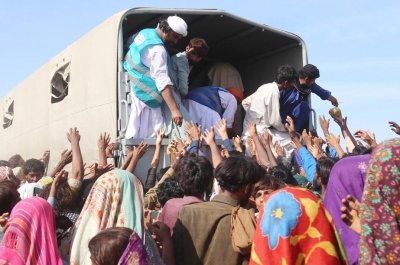
Islamabad, Feb 19 (IANS) A new assessment by the United Nations (UN) has revealed that around 7.5 million people in Pakistan face high levels of food insecurity and malnutrition after a year that witnessed heavy monsoon floods, prolonged drought, dry spells, and a rise in violence.
From December 2025 to March 2026, around 1.25 million people will face ’emergency’ levels of acute food insecurity, characterised by large food gaps and high levels of acute malnutrition, the Integrated Food Security Phase Classification (IPC) report said. Immediate lifesaving assistance is required to prevent a “catastrophe” for over a million people in Pakistan in emergency levels of food insecurity.
Residual 2025 monsoon flood impacts, drought, and localised insecurity have weakened agriculture and pastoral livelihoods, reduced production, impacted markets, and squeezed coping capacity.
Furthermore, seasonal factors have added to the crisis with the lean season reducing farm labour and income opportunities and harsh winter conditions in some areas have further impacted access and livelihoods, according to the statement released by UN.
Food access has been impacted in some areas of Pakistan by weak purchasing power, market dependence, price volatility, and indebtedness, according to the statement released by UN. Wheat flour has also been flagged as particularly concerning during the lean season.
Last month, a report stated that Pakistan is struggling to afford food and education. A 20-year comparison of household consumption in Pakistan showcases a structural reallocation of funds towards fixing living costs instead of spending it on food, revealed a new poll released by Gallup Pakistan.
Data from the Household Integrated Economic Survey (HIES) reveals that the share of money spent by households on food reduced from 43 per cent to 37 per cent between 2005 and 2025. During the same period, housing and utilities have increased from 15 per cent to a quarter of household budgets, an editorial in Pakistan’s leading daily ‘The News International’ mentioned.
“Gallup analysis finds that, when viewed alongside weaker real incomes and evidence of declining food quantities, this trend likely reflects households cutting back on food consumption to cope with rising fixed expenses, like housing and utilities, rather than food becoming more affordable. This is also not the only analysis to find that Pakistanis are cutting back on food,” it highlighted.
The HIES 2024-25 survey revealed that people facing moderate-to-severe food insecurity had increased from one in six to one in four between 2018-19 and 2024-25, making it harder for residents of Pakistan to survive in the present and the prospects for future also do not look bright.
“According to the Institute of Social and Policy Science (I-SAP)’s 15th annual report on ‘Public Financing of Education’ families are now bearing the majority of spending on education; a first in the nation’s history. Of the Rs 5.03 trillion total cost of education, household spending accounts for Pakistani Rupees (PKR) 2.8 trillion while the public sector pitches in PKR 2.23 trillion,” the editorial detailed.
The household spending comprises Pakistani Rupees (PKR) 1.31 trillion spent on paying private school fees, PKR 613 billion on tuition and shadow education and PKR 878 billion in other expenses. The disparity comes amid people preferring private education system for their children and major issues related to the adequacy of the public education system.
Around 20 million children remain out of school and it appears that people who can afford to send their children to private schools and tutors are the ones who will be able to receive education in Pakistan, The News International opined.
–IANS
akl/as