



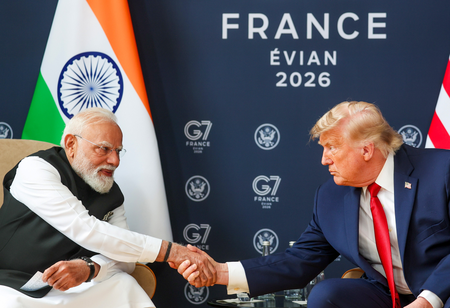
Washington, Sep 17 (IANS) US President Donald Trump has welcomed Prime Minister Narendra Modi’s efforts to tackle illicit opium poppy cultivation and strengthen supply chain security, while identifying India among 23 major drug transit or illicit drug-producing countries for fiscal year 2027.
The determination makes clear that inclusion on the broader list does not necessarily reflect a government’s performance in fighting drugs. India was not among the four countries separately designated as having “failed demonstrably” to meet their international counterdrug obligations.
“I welcome Prime Minister Modi and the Government of India’s efforts to address illicit opium poppy cultivation and bolster supply chain integrity,” Trump said.
“I look forward to continued cooperation through the United States-India Drug Policy Framework.”
The presidential determination was submitted to Congress on September 15 and released in a September 16 media note. It sets out Washington’s assessment of drug production, trafficking and international cooperation.
Alongside India, the broader list includes China, Pakistan, Afghanistan, Mexico and Colombia. The determination does not set out specific shortcomings in India’s counterdrug efforts. Its passage on India welcomes the government’s measures and points to further bilateral cooperation.
“A country’s presence on the foregoing list is not necessarily a reflection of its government’s current counterdrug efforts, or coordination with the United States,” the determination states.
Trump separately designated Afghanistan, Bolivia, Myanmar — referred to as Burma in the document — and Colombia as having failed demonstrably during the previous 12 months to make substantial efforts to meet their counterdrug obligations.
He also determined that US assistance to Bolivia, Myanmar and Colombia was currently vital to American national interests.
The praise for India contrasted with demands for stronger action from China, Canada and Mexico. Trump accused China of remaining the world’s largest producer of many precursor chemicals used to manufacture fentanyl, methamphetamine and other illicit synthetic drugs.
He said he had raised the issue directly with Chinese President Xi Jinping. According to the determination, China introduced licensing requirements last year for companies exporting designated precursor chemicals to North America at Trump’s request.
However, Trump said criminals continued to evade those controls by using unregulated chemicals. He called on Beijing to place additional precursor chemicals and substances under control and strengthen cooperation to enable prosecutions.
On Canada, he alleged that clandestine laboratories continued to produce fentanyl and that precursor chemicals and synthetic drugs were entering the United States through Canadian territory. He urged action against laboratories and criminal networks.
Trump credited Mexican President Claudia Sheinbaum’s administration with greater drug seizures, the dismantling of clandestine laboratories and additional security deployments along the shared border.
But he urged Mexico to increase port inspections, strengthen industry participation in supply chain security and prosecute officials accused of helping cartels.
The determination also removed Venezuela from the category of countries judged to have failed demonstrably to fulfil their drug control commitments. Trump cited cooperation with its interim government and said he expected continued, measurable progress against trafficking.
The broader country list is based on statutory definitions in the Foreign Assistance Act of 1961. Geographic, commercial and economic factors can place a country on it because they allow drugs or precursor chemicals to be produced or transported, even where authorities undertake robust enforcement.
–IANS
lkj/sd/