



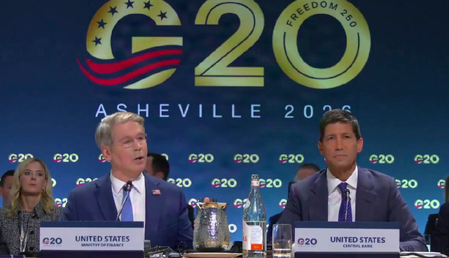
Asheville, Sep 2 (IANS) US Treasury Secretary Scott Bessent has warned G20 economies that persistent global imbalances, fuelled by subsidies, restricted market access and over-reliance on exports, are hurting workers, weakening supply-chain resilience and creating economic tensions.
Addressing a G20 discussion on global imbalances, Bessent said durable growth required economies to compete on productivity, innovation and investment rather than policies that push excess production into international markets.
“Excessive and persistent imbalances inhibit growth, deepen economic vulnerabilities, and spill across borders in many ways to strain global prosperity,” Bessent told the meeting.
He said the problem was particularly serious when non-market policies produced weak domestic consumption, distorted investment and excessive dependence on exports for economic growth.
Bessent placed responsibility on national governments, arguing that global imbalances reflected deliberate and cumulative policy decisions rather than accidental economic outcomes.
“Global imbalances do not arise by accident. They’re cumulative, they’re the cumulative result of policy choices on savings, consumption, investment, subsidies, market access, and exchange rates,” he said.
“When those choices distort competition, the costs are born by workers, businesses, and supply chains around the globe,” he added.
Bessent said a key objective of the G20 work stream was to build a common understanding of when imbalances become excessive, why they persist and how their effects spread across national economies.
The process would also examine the policy choices needed to restore equilibrium.
G20 deputies and technical officials have worked on the issue since April and reached broad agreement on several principles, according to Bessent.
Members agreed that imbalances were most concerning when they were excessive, persistent and larger than could be justified by underlying macroeconomic fundamentals. Such imbalances could produce damaging spillovers for other countries.
They also found that prolonged imbalances could impede growth, worsen the imbalances faced by other economies and increase economic vulnerabilities.
Bessent said those distortions could concentrate supply chains, reduce resilience and contribute to global economic tensions.
Both surplus and deficit economies had a common interest in addressing the problem, the meeting was told. That placed the responsibility for corrective action on countries at both ends of global trade and financial imbalances.
The discussions also recognised a significant role for the International Monetary Fund and the Organisation for Economic Co-operation and Development in monitoring imbalances and recommending policies to reduce them.
Bessent called for greater rigour in their surveillance and policy advice, saying stronger assessments could help make the case for appropriate domestic action by G20 members.
He also urged the institutions to remain focused on their principal economic mandates.
“That worked the strongest when these institutions remain disciplined around their mission instead of devoting disproportionate time and resources to ideological excursions,” Bessent said.
The meeting was expected to examine policy measures being undertaken by G20 members and invited countries to reduce excessive and persistent imbalances. Bessent also flagged possible risks to the financial sector and called for continued vigilance.
The Group of 20 brings together major developed and emerging economies, including India, the United States, China, Japan, Germany and Brazil. Its members account for most of the world’s economic output and international trade.
The IMF conducts economic surveillance of its member countries and assesses risks to global financial stability. The OECD studies economic policy and develops standards and recommendations covering trade, investment, taxation, productivity and other areas.
–IANS
lkj/sd/