



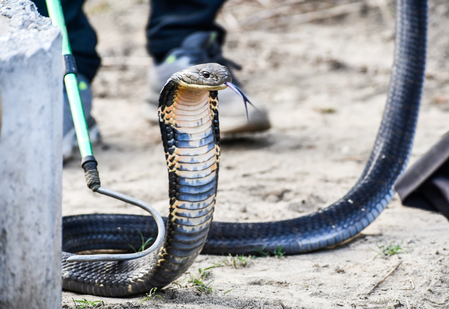
Kolkata, Aug 25 (IANS) The Evolutionary Venomics Lab (EVL) has carried out vital research on the spectacled cobra (Naja naja), one of the most venomous snakes found in nearly all parts of the country.
This snake contributes to nearly 58,000 snakebite deaths in India annually. Hence, the research is crucial in developing more efficient anti-venoms to save lives.
The research has also all but dispelled the theory that spectacled cobras migrated from Asia to Africa. In fact, it is the other way around. N. naja moved to Asia from Africa during the Miocene (23 to 5.3 million years ago). It moved through the Middle East. These reptiles then moved from India to Sri Lanka millions of years ago.
“The spectacled cobra is among the most iconic and clinically significant species, recognised as one of India’s ‘big four’ snakes responsible for a large number of snakebite-related fatalities. As a generalist with a near-countrywide distribution, N. naja exhibits considerable geographic variation in morphology, behaviour, and venom composition. Yet, its evolutionary history, phylogenetic diversity, and biogeographical origins remain poorly understood,” a research paper published by the lab says.
Researchers sequenced nuclear and mitochondrial markers from nearly 100 snakes across the major biogeographical regions of the Indian subcontinent to fill this knowledge gap.
“Our results support an African origin for the genus Naja and support a Miocene dispersal of N. naja into South Asia. Unlike many widely distributed snakes, N. naja does not exhibit any evidence of phylogeographic subdivision within India, indicating that it is a largely panmictic mainland species,” the researchers have said.
Kartik Sunagar, an associate professor at EVL who has been involved in this research, explains what this means.
“This is not just a matter of naming snakes. When a species is spread across a vast area, rivers, mountains, deserts, climate, or sea-level changes can separate populations. Over thousands or millions of years, these isolated populations may evolve independently. Eventually, what we once called one species may turn out to be several,” he writes.
After the research, “Across mainland India, the spectacled cobra appears to be largely one connected genetic population. Despite all the visible variation in colour, marking, ecology, and venom, the genetic data did not support the presence of multiple deeply separated species,” he says.
So, why is this important? “If different populations have different venoms, evolutionary histories, or levels of relatedness, the knowledge can influence how we think of anti-venom, conservation and snakebite biology,” Sunagar explains on his website.
However, the Sri Lankan N. naja, which the researcher believes moved to the island from India when sea levels were low, is genetically distinct. Such research is extremely important for developing anti-venoms.
In 2024, the EVL developed a synthetic anti-venom. The ultimate aim is to bring down the number of anti-venoms that need to be stocked to treat snakebites.
–IANS
jg/dan