



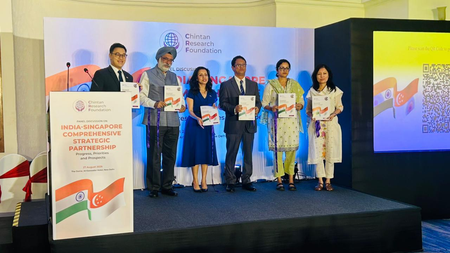
New Delhi, Aug 28 (IANS) Singapore’s ASEAN Chairmanship next year could create opportunities for innovative trilateral, plurilateral and multilateral formats of regional cooperation, with India participating as an equal stakeholder, emerged as a key takeaway from a panel discussion convened by the Chintan Research Foundation (CRF) in New Delhi.
The discussion, titled “India-Singapore Comprehensive Strategic Partnership: Progress, Priorities and Prospects”, was held alongside the official release of a CRF report with the same title.
Convened a week after the fourth India-Singapore Ministerial Roundtable (ISMR) in Singapore, the event brought together the Deputy High Commissioner of Singapore to India and prominent representatives from the policy, academic, think tank and wider strategic communities in India and Singapore, the CRF said in a press release.
The discussion examined the evolution of India-Singapore relations, the complementarities between the two countries and opportunities to advance their Comprehensive Strategic Partnership amid wider geopolitical, geoeconomic and technological changes across the Indo-Pacific.
The relationship is anchored in strong political ties, a deepening economic partnership and confidence in India’s long-term growth prospects. Bilateral trade has roughly tripled since the conclusion of the Comprehensive Economic Cooperation Agreement (CECA) about two decades ago, while Singapore has continued to be a leading source of foreign investment into India.
Skills development, advanced manufacturing and green connectivity have emerged as increasingly important areas of cooperation. New skilling centres, the upcoming National Centre of Excellence for Advanced Manufacturing in Chennai, and the India-Singapore Green and Digital Shipping Corridor reflect the expanding and forward-looking nature of the partnership.
A key takeaway from the discussion was that bilateral ties have moved well beyond their traditional foundations in trade and investment and have developed into a multidimensional strategic partnership covering defence, technology, digital connectivity, maritime security, infrastructure, education, skills and regional cooperation.
Major milestones include the 2005 CECA, the elevation of bilateral ties to a Strategic Partnership in 2015 and the upgrade to a Comprehensive Strategic Partnership in 2024.
Singapore has also emerged as an important economic and strategic gateway for India’s engagement with Southeast Asia and the wider Indo-Pacific. The growing institutionalisation of bilateral ties has further reinforced Singapore’s significance to India’s Act East Policy and Indo-Pacific vision.
At the same time, the partnership provides both countries space to preserve strategic autonomy while working with regional and like-minded partners towards an open, inclusive and rules-based regional order.
Green infrastructure, shipping, semiconductors, multimodal logistics, artificial intelligence and digital governance, smart and green ports, critical minerals, deep-sea cooperation, skills development and advanced manufacturing were identified as key areas for the next phase of bilateral cooperation.
The partnership also has wider regional significance in the context of ASEAN-led regional architecture, maritime connectivity and India’s growing role as a consequential Indo-Pacific power. Greater cooperation in the Indian Ocean, maritime security and the provision of regional public goods offer scope for further expansion, while new initiatives could complement ASEAN-led institutions and existing regional mechanisms.
Singapore’s ASEAN Chairmanship next year could provide a platform to explore scalable trilateral, plurilateral and multilateral partnerships involving ASEAN members and other regional stakeholders, with India participating as an equal stakeholder in delivering practical regional outcomes.
Potential areas include digital public infrastructure, artificial intelligence, semiconductors, advanced manufacturing, supply-chain resilience, green and smart infrastructure, maritime domain awareness, anti-piracy, transnational crime, undersea connectivity and Indian Ocean security.
The discussion also highlighted the potential for stronger engagement between Singapore and Indian states, particularly manufacturing and technology hubs in southern India. Such subnational cooperation could translate strategic convergence at the national level into commercially viable partnerships, investment opportunities and deeper economic linkages.
The discussion underlined that India-Singapore relations have developed into one of India’s most substantive and multidimensional partnerships in the Indo-Pacific. The next challenge is to translate the already ambitious agenda into visible, scalable and durable outcomes.
Sustained institutional follow-through, stronger private-sector participation and effective implementation of initiatives emerging from the ISMR framework will be important to maintaining momentum. The next phase of the Comprehensive Strategic Partnership will therefore be shaped not only by the depth of bilateral cooperation but also by the ability of India and Singapore to leverage their complementarities to contribute to stability, connectivity, innovation and prosperity across the wider Indo-Pacific.
–IANS
rs/dpb