



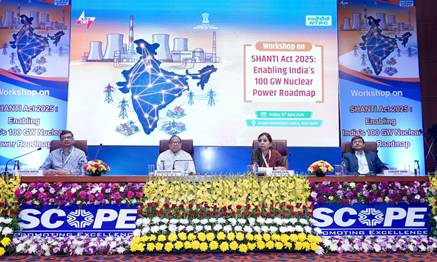
New Delhi, April 17 (IANS) The government conducted a workshop on the operationalisation of the SHANTI Act, 2025, to scale India’s nuclear capacity to 100 GW to meet long-term energy security and Net Zero targets, an official statement said on Friday.
Gurdeep Singh, CMD, NTPC, highlighted the importance of nuclear energy in the overall energy mix and emphasised the need to accelerate preparatory activities such as land identification and site studies to enable timely construction of new nuclear plants.
He also underlined the need for partnerships in technology and the supply chain.
Referring to the SHANTI Act, he noted that it has opened the sector for private participation, allowing industries to consider nuclear energy as a viable clean power source.
Early formulation of rules and guidelines would facilitate faster progress, Singh said. He stressed the importance of ensuring long-term fuel availability, maintaining safety, and achieving broader energy security objectives.
The Central Electricity Authority (CEA), in association with the Ministry of Power, Department of Atomic Energy (DAE), and NTPC Limited, organised the high-level workshop.
Seema Jain, Member (Finance), Department of Atomic Energy focused on the necessity of financial preparedness, the development of robust risk-sharing mechanisms, and the evolution of institutional frameworks to support large-scale nuclear deployment.
She stressed fostering global technological partnerships and developing innovative and financing mechanisms to accelerate the growth of the nuclear sector, the statement from the Ministry of Power said.
Ghanshyam Prasad, Chairperson, CEA underscored nuclear power as crucial for reliable, 24/7 clean energy to support India’s growing demand while simultaneously meeting international climate commitments.
He emphasised secure, uninterrupted supply of nuclear fuel through diversification of sources and the establishment of long-term procurement arrangements.
Detailed discussions were held on provisions in SHANTI Act, 2025 relating to private sector participation, the graded liability framework, and the harmonization of the new act with the Electricity Act, 2003.
Over 150 delegates from state ministries, central ministries, regulators, developers, engineering consultancy companies, academic institutions and industry associations attended the workshop.
–IANS
aar/pk