



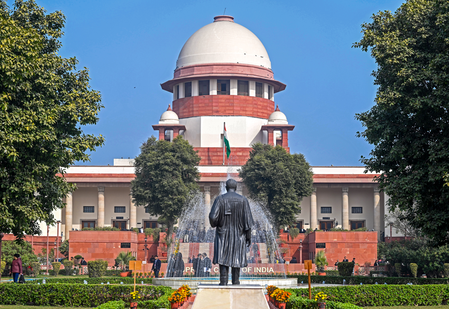
New Delhi, June 11 (IANS) The Supreme Court on Thursday held that a municipal authority cannot be saddled with liability under the Motor Vehicles Act (MVA) for injuries caused by the fall of a tree branch on a stationary autorickshaw during heavy rain, ruling that such an incident do not arise out of the “use of a motor vehicle” in the manner contemplated under the law.
However, a bench of Justices Sanjay Karol and N. Kotiswar Singh, invoking its powers under Article 142 of the Constitution to ensure “complete justice”, enhanced compensation payable to the injured claimant from Rs 17.10 lakh to Rs 25 lakh.
The apex court was hearing an appeal filed by the Commissioner, Bruhat Bengaluru Mahanagara Palike (BBMP), challenging a Karnataka High Court judgment which had apportioned liability for compensation among the municipal corporation, the insurer of the autorickshaw, and the Horticulture Department of the Karnataka government.
The case arose from an incident on June 23, 2007, when respondent K.K. Umesh Kumar was travelling in an autorickshaw from Queens Road to Chinnaswamy Stadium in Bengaluru.
Due to heavy rain, the vehicle was stopped by the roadside. While it was stationed under a tree, a branch detached and fell on the autorickshaw, causing serious injuries to the passenger.
A Motor Accident Claims Tribunal had dismissed the compensation claim, treating the incident as a natural calamity.
After multiple rounds of litigation, the Karnataka High Court awarded compensation of Rs 17.10 lakh and directed that 25 per cent be paid by the BBMP, 50 per cent by the insurer of the autorickshaw, and the remaining 25 per cent by the state Horticulture Department.
Examining the concept of “Act of God” and the liability of public authorities, the Supreme Court observed that municipal corporations are under a duty to maintain roadside trees and ensure periodic upkeep.
“A tree has been on the side of the road for many years. Because it is part of the city, the Municipal Corporation does have a duty to ensure that those trees are looked after, from the point of view of not only keeping the trees hale and healthy but also that periodic maintenance thereof is undertaken to ensure that unfortunate incidents such as these do not happen,” the Justice Karol-led Bench said.
At the same time, the top court cautioned against imposing unrealistic standards on civic authorities.
“It would be unrealistic to expect that authorities of the Corporation can maintain a constant vigil over each tree/shrub,” the judgment said.
Turning to the legal question under the Motor Vehicles Act, the Supreme Court held that although the expression “arising out of the use of motor vehicles” has received a liberal interpretation in previous judgments, the present case stood on a different footing.
“In other words, the motor vehicle itself does not play an active role in the accident. It is not part of the proximate cause of the accident. For that reason, a claim under Section 166 specifically may not be appropriate,” the apex court held.
It observed that if the respondent had been standing under the tree as a pedestrian rather than sitting inside the autorickshaw, the outcome would have been no different, demonstrating the absence of a sufficient causal connection between the vehicle and the accident.
“The unfortunate falling of a branch was within contemplation of neither any authority nor even the driver of the autorickshaw. In these circumstances, it would be unfair to fasten the liability upon the appellant (Corporation) under the MVA,” it observed.
Despite settling the legal issue in favour of the municipal corporation, the Supreme Court said it could not ignore the severe condition of the injured claimant, who suffered permanent paraplegia with bladder and bowel incontinence.
“A person who has suffered such life-altering grievous injuries, being left in lurch, without any money to sustain himself, does not appeal to the conscience of justice,” it remarked.
Observing that the compensation awarded by the Karnataka High Court was inadequate and based on a “somewhat technical approach”, the apex court enhanced the compensation to Rs 25 lakh along with interest from the date of filing of the claim petition.
Exercising its extraordinary powers under Article 142, the Supreme Court directed that the existing apportionment of liability among the BBMP, the insurer and the Horticulture Department would remain undisturbed and ordered all parties to deposit the compensation amount within four weeks.
“It is within our domain, as the final Court of the country, to ensure the law, as implemented, especially in cases like these, is humane and in accordance with the salutary principles of the Constitution,” the judgment said.
–IANS
pds/vd