



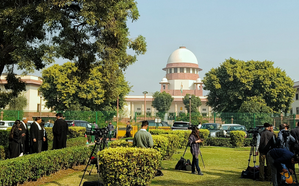
New Delhi, May 6 (IANS) The Supreme Court has cancelled the bail granted by the Allahabad High Court to a man accused in a dowry death case from Uttar Pradesh, terming the relief “not sustainable in law” and cautioning courts against taking crimes against women “very lightly”.
A Bench of Justices J.B. Pardiwala and Vijay Bishnoi allowed the appeal filed by the father of the deceased woman and directed the accused husband to surrender before jail authorities within one week, failing which coercive steps may be taken.
The case relates to the death of a woman, who was found dead under suspicious circumstances at her matrimonial home in Ghaziabad on July 11, 2024, within seven years of her marriage solemnised in February 2019.
An FIR lodged by the deceased’s father alleged that despite spending over Rs 30 lakh at the time of marriage, including an i20 car, cash, jewellery and household articles, the husband and his family continued demanding an SUV and an additional Rs 10 lakh as dowry.
According to the complaint, the woman was subjected to physical and mental harassment, beaten, abused, and threatened with death over the dowry demands.
The FIR further alleged that shortly before her death, the deceased had informed her father over the phone that her in-laws had been assaulting her and threatening to kill her.
Investigation in the case culminated in a charge sheet against the husband and his parents under various provisions of the Bharatiya Nyaya Sanhita, 2023, and the Dowry Prohibition Act, 1961.
The Allahabad High Court had granted bail to the accused husband in August 2025, observing that the cause of death was “asphyxia as a result of ante-mortem hanging” and referring to an alleged delay in lodging the FIR.
Setting aside the bail order, the Supreme Court said the Allahabad High Court committed an “egregious error” while exercising discretion in favour of the accused in such a serious offence.
“When bail is prayed for, the High Court is expected to consider the nature of the crime and a prima facie case. The allegations levelled by the father in the FIR do disclose more than a prima facie case,” the Justice Pardiwala-led Bench observed.
It added that the deceased had died in her matrimonial home within seven years of marriage and there were serious allegations of dowry harassment, attracting the statutory presumption under Section 118 of the Bharatiya Sakshya Adhiniyam, 2023.
Referring to the post-mortem report, which recorded multiple ante-mortem injuries, including contusions on the face, chest, and arms, as well as a ligature mark around the neck, the top court said, “The post-mortem report indicates a ligature mark measuring 32 x 2 cm around the neck. What does this indicate? Prima facie, it suggests that the deceased was strangled to death.”
Expressing concern over rising dowry deaths, the Supreme Court said that young married women were being “killed mercilessly” in matrimonial homes for want of dowry. “A young girl does not get married to be killed mercilessly at her matrimonial home for want of dowry. This is a serious problem in some sections of the society in this country, more particularly in the States of Uttar Pradesh, Bihar and Karnataka, respectively,” the Justice Pardiwala-led Bench said, adding that despite educational progress and efforts to empower women, they continue to suffer due to dowry demands after marriage.
Citing official data, the apex court noted that 6,156 people lost their lives in dowry death cases across the country in 2023, with Uttar Pradesh recording the highest number of such deaths at 2,122, followed by Bihar with 1,143.
It further observed that bail courts must remain cautious so that their orders are not perceived by society as trivialising serious crimes against women. “All that we want to convey is that a bail court at any level should remain very careful to ensure that its order… should not be seen or read by the society at large that the courts are taking serious crimes against women very lightly,” the Justice Pardiwala-led Bench said.
While cancelling the bail, the apex court clarified that the observations made in its order were confined to the question of bail and should not influence the trial court while deciding the guilt or innocence of the accused.
Setting aside the Allahabad High Court’s order, the Supreme Court directed that the trial be completed expeditiously, preferably within one year. The top court also directed that a copy of its order be forwarded to the Registrar General of the Allahabad High Court for being placed before the Chief Justice.
–IANS
pds/dpb