



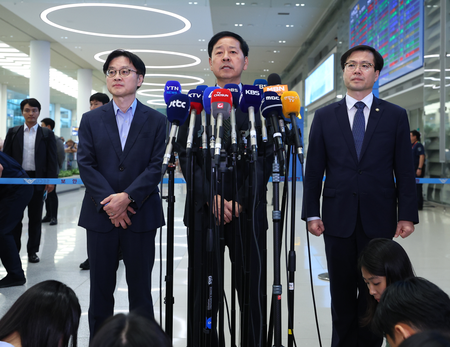
Seoul, June 4 (IANS) South Korean Trade Minister Yeo Han-koo has urged the United States to resolve pending trade issues between the two countries, including the latter’s recent announcement of the results of the Section 301 probe into imports related to forced labour, within the boundaries of the bilateral tariff agreement finalised last year, Yeo’s office said on Thursday.
Yeo held a meeting with U.S. Trade Representative (USTR) Jamieson Greer on the sidelines of the OECD Ministerial Council Meeting held in Paris, according to the Ministry of Trade, Industry and Resources, shortly after the office of USTR proposed imposing tariffs of 10 percent, or 12.5 percent, on imported goods from 60 economies over their alleged failure to enforce an import ban on goods produced with forced labour.
South Korea, China and Japan are among 54 economies that could be subject to the proposed 12.5 percent tariff as a result of the USTR’s forced labor probe under Section 301 of the 1974 Trade Act, reports Yonhap news agency.
“I made it clear that not only the outcomes of the latest Section 301 probe but also other future bilateral trade issues should be addressed within the framework of the Korea-U.S. tariff agreement rather than through the imposition of new tariffs,” Yeo said in a press release, noting that he reaffirmed Washington’s intention to uphold the bilateral trade deal.
Under the tariff deal finalised late last year, the U.S. agreed to lower its reciprocal tariffs on South Korea to 15 percent from 25 percent in exchange for Seoul’s US$350 billion investment pledge.
“We will continue to work closely with the U.S. side and respond calmly to the remaining Section 301 procedures to ensure that bilateral trade issues are managed in a stable and constructive manner,” Yeo added.
South Korea is also subject to a separate USTR investigation into what it calls “unfair” trade practices related to “structural” excess capacity and production, along with China, Japan and 13 other economies.
The U.S. has been carrying out trade investigations to replace country-specific “reciprocal” tariffs that were struck down by the Supreme Court in February. Section 301 is a legal provision that allows the USTR to investigate unfair foreign trade practices on a country-by-country basis.
—IANS
na/