

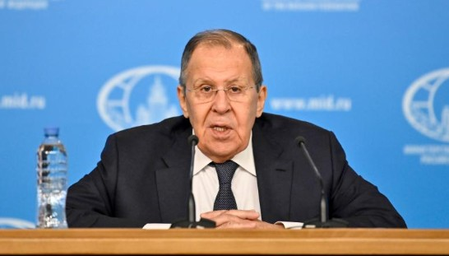
Moscow/Tehran, April 14 (IANS) Russian Foreign Minister Sergei Lavrov has stressed the need to avoid a fresh escalation of conflict during a conversation with his Iranian counterpart, Abbas Araghchi, while reaffirming Moscow’s willingness to assist in efforts aimed at resolving the ongoing crisis.
According to a statement from Russia’s Foreign Ministry, as reported by TASS, Lavrov highlighted the urgency of preventing renewed hostilities and reiterated that the situation cannot be resolved through military means.
“Lavrov emphasised the importance of preventing a relapse into armed confrontation, reaffirmed Russia’s continued readiness to assist in resolving the crisis, which has no military solution, and recalled Russia’s initiative to develop a Concept for Ensuring Security in the Persian Gulf with the participation of all littoral states and the support of extra-regional countries capable of exerting a positive influence on the course of negotiations,” the ministry said in its account of the telephone conversation.
During the exchange, Araghchi briefed Lavrov on the recent Iranian-American talks held in Islamabad on April 11. He also conveyed concerns regarding US actions in sensitive maritime regions, warning of broader implications.
According to Iran’s state-linked Fars News agency, Araghchi said that US activities in the Persian Gulf and the Strait of Hormuz could have serious consequences for regional and global peace and stability.
The Russian Foreign Ministry said Moscow “welcomed the continued commitment to continuing diplomatic efforts and finding solutions that would address the root causes of the conflict and achieve long-term stabilisation in the region, taking into account the legitimate interests of the Islamic Republic of Iran and its neighbours.”
Lavrov also extended condolences to his Iranian counterpart over a recent loss within Iran’s diplomatic community.
The Russian minister expressed his “sincere condolences to Araghchi in connection with the brutal murder of the former head of Iran’s Foreign Ministry and head of Iran’s Strategic Council on Foreign Policy, K. Kharrazi, as a result of an airstrike.”
Meanwhile, Lavrov has arrived in China for a two-day official visit to discuss the bilateral cooperation across key sectors, as well as the ongoing conflicts in Ukraine and West Asia.
Earlier on Monday, the Russian Foreign Ministry announced that during his visit to China from April 14-15, the Foreign Minister will hold talks with his Chinese counterpart, Wang Yi.
“The two countries’ foreign ministers will discuss a wide range of bilateral cooperation issues, prospects for contacts at various levels, and international collaboration, with a focus on joint work within the UN, BRICS, SCO, G20, APEC, and other multilateral mechanisms and forums. A detailed exchange of views is expected on a number of hot topics and regional issues, including the Ukrainian crisis and the situation in the Middle East,” it added.
This also came as Russian presidential spokesperson Dmitry Peskov on Monday admitted that the US blockade of the Strait of Hormuz is likely to impact international markets negatively.
“Most likely, such actions will continue to negatively impact international markets; this can be assumed with a high degree of certainty,” the Kremlin spokesman was quoted as saying by Russia’s leading Tass news agency during a regular media briefing in Moscow.
Responding to another question, he asserted that details on the US blocking of the Strait of Hormuz remain unclear.
“Many details here remain unclear and incomprehensible, so I would refrain from any substantive comments at this time,” Peskov commented on the US threat of blocking the strait.
On Sunday, the United States made it clear that it will begin enforcing a sweeping maritime blockade of vessels entering or exiting Iranian ports from April 13, escalating tensions after high-stakes talks between Washington and Tehran failed to yield agreement on key issues, including Iran’s nuclear programme.
–IANS
sd/