



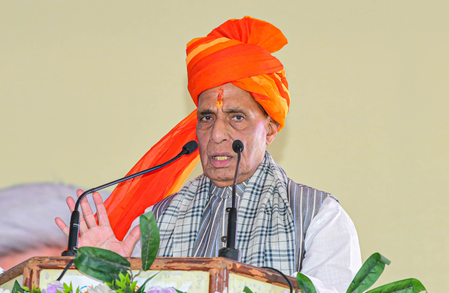
Jaipur, May 14 (IANS) Union Defence Minister Rajnath Singh said that the concept of “One Nation, One Election” had its early conceptual roots in the thinking of former Vice President Bhairon Singh Shekhawat, who believed that simultaneous elections would save time and resources while ensuring continuity in development work.
He noted that the idea has now become a major subject of national debate under the present government.
Recalling Shekhawat’s contribution to India’s democratic framework, he also highlighted his steadfast commitment during the Emergency and his role as Chairman of the Rajya Sabha in establishing new parliamentary traditions.
The Defence Minister was addressing the unveiling ceremony of the statue of the late Bhairon Singh Shekhawat in Jodhpur on Thursday.
He said Shekhawat always prioritised integrity, transparency, and ethics in politics. Rising from a modest farming background to become the Vice President of India, his life journey remains an inspiration for millions.
He added that Shekhawat’s values, discipline, and dedication to duty will continue to guide both society and political life.
Rajnath Singh said that the late former Vice President Bhairon Singh Shekhawat was a living symbol of democratic values and the politics of public service.
He said Shekhawat envisioned prosperity in every household of Rajasthan, employment for every hand, and dignity for every citizen.
He added that both India and Rajasthan are witnessing rapid development today, while the world recognises India’s growing global stature under the leadership of PM Modi.
Singh said the idea of “One Nation, One Election” had its conceptual roots in Shekhawat’s thinking, as he believed simultaneous elections would save time and resources while ensuring continuity in development work.
He noted that the idea is now a major subject of national debate under the present government.
He also recalled Shekhawat’s steadfast commitment to democracy during the Emergency and his contributions as Chairman of the Rajya Sabha in setting new parliamentary traditions.
Highlighting his governance philosophy, the Defence Minister said Shekhawat’s Antyodaya approach aimed to uplift the last person in society and received international recognition.
He said Chief Minister Bhajanlal Sharma is carrying forward the same spirit by reaching out to villages and strengthening grassroots development.
He expressed confidence that the Chief Minister would be remembered as a successful and impactful leader.
He further noted that rural water supply in Rajasthan has expanded significantly, rising from about 11.68 lakh households in 2019 to more than 60 lakh households by March 2025.
Singh also said that Bhairon Singh Shekhawat and former Prime Minister Atal Bihari Vajpayee together strengthened democratic values, dialogue-based politics, and governance ethics.
Referring to the 1998 Pokhran nuclear tests, he said Rajasthan had once again played a historic role in demonstrating India’s strategic strength.
Chief Minister Bhajanlal Sharma said that Shekhawat was a guardian of democratic norms, a voice for the poor, and a symbol of ethical politics.
He said Shekhawat consistently worked for farmers, labourers, and the most marginalised sections of society, giving practical shape to Pandit Deendayal Upadhyaya’s philosophy of Antyodaya.
He added that Shekhawat took several landmark decisions in administrative reforms, fiscal discipline, water conservation, rural development, education, healthcare, and social welfare.
He said Shekhawat always believed that politics should not be limited to governance but should bring dignity and hope to the last person in society.
The Chief Minister said Shekhawat’s rise from a farming family to the highest constitutional offices reflected his integrity, dedication, and simplicity.
He said Shekhawat, popularly known as the “Dharti Putra,” remained deeply connected to rural life and continued to inspire generations through his grounded personality and public service ethos.
–IANS
ar/dan