



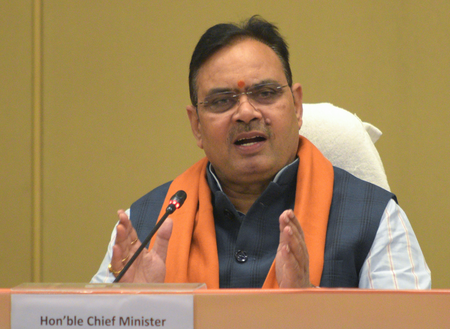
Jaipur, Feb 19 (IANS) The Rajasthan government, under the leadership of Chief Minister Bhajan Lal Sharma, has initiated steps to promote ease of doing business and ease of living by gradually eliminating unnecessary compliances and reducing regulatory burdens for businesses and citizens, an official said.
Officials said the state government is working on simplifying rules and procedures across key sectors, including land use, building and construction, labour, business licensing, and public utilities. The action plan has been finalised under the guidance of Chief Secretary V. Srinivas.
As part of the action plan, the state government will study the Andhra Pradesh model to reduce procedural delays, including eliminating land conversion requirements for certain categories of land use.
Amendments are being considered in building bylaws and master plans to enable automatic mixed land-use development, based on the principle that all activities will be permitted unless explicitly prohibited. Zone-wise lists of prohibited activities will be clearly defined to enhance transparency and regulatory clarity.
The government also plans to liberalise the industrial land allotment policy to ensure optimal utilisation of vacant land in industrial clusters.
Measures are being proposed to promote affordable housing for workers in industrial areas and encourage public-private partnerships for infrastructure such as wastewater treatment plants and fire safety systems. Building bylaws and fire safety regulations will be updated to align with global best practices, including rationalising height restrictions and setback norms.
To streamline approval processes, nodal agencies may be designated as single points of contact for building and construction clearances, industrial approvals, and health department licences.
A working group chaired by the Additional Chief Secretary (Industries) will be constituted, with representatives from the Energy, Urban Development, Local Self Government, Labour, and Pollution Control Board departments, to rationalise business licensing procedures and eliminate duplicate approvals.
The government is also considering lifetime registration for shops and commercial establishments through information-based deemed licensing, along with permitting round-the-clock operations.
Licensing procedures for weighing and measuring instruments will be simplified, with automatic approvals based on self-declaration and reduced inspections for low-risk categories.
Power distribution companies may also provide electricity connections based on self-declaration to facilitate faster access to essential services.
To accelerate industrial investment, the single-window clearance system will be further strengthened to reduce project approval timelines and promote priority sectors.
A unified state-level directory of government and private testing facilities for micro, small, and medium enterprises (MSMEs) will be created, along with a centralised digital repository of all state laws, rules, regulations, and government orders to improve accessibility and compliance.
To implement these regulatory reforms comprehensively, the state government plans to introduce legislation based on a draft prepared by the Central government, incorporating state-specific recommendations before seeking approval.
Officials noted that the Rajasthan government had earlier enacted the Rajasthan Public Trust (Amendment of Provisions) Act to promote trust-based governance.
Building on this initiative, the Rajasthan Public Trust Act 2.0 was announced in the State Budget for 2026–27 as part of broader governance and regulatory reforms aimed at enhancing transparency and public participation.
–IANS
arc/pgh