



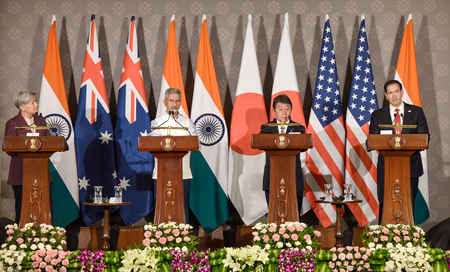
New Delhi, June 11 (IANS) The future utility of the Quad will not be defined by its transformation into an ‘Asian NATO’ or by rhetorical rivalry with Beijing. Instead, its relevance will depend on whether it can evolve into a flexible strategic mechanism capable of stabilising an increasingly fragmented maritime and economic order stretching from the Pacific to the Gulf, a report has stated.
During the recent visit of US Secretary of State Marco Rubio to India, the consistent public response underscored that New Delhi remains one of Washington’s most important strategic partners, that the Quad continues to hold relevance, and that “cooperation is expanding into maritime security, supply chains, AI, critical minerals, and energy”.
However, the broader debate surrounding the visit also reflected a persistent “misconception”— that the Quad’s relevance is primarily contingent on how forcefully the United States chooses to confront China. This interpretation increasingly appears outdated, former Indian diplomat Raghu Gururaj wrote in ‘India Narrative’.
According to Gururaj, Quad’s effectiveness should be assessed across a set of key strategic dimensions.
“The Gulf region remains volatile. The possibility of escalation involving Iran, worsening disruptions in the Strait of Hormuz, more attacks on shipping infrastructure, or wider energy instability – all continue to cast uncertainty over global markets. Simultaneously, the Indo-Pacific faces persistent tensions in the South China Sea, Taiwan Strait, and Indian Ocean. These are no longer disconnected issues,” the seasoned diplomat mentioned.
“The same shipping arteries that carry Gulf energy sustain Asian manufacturing, Indo-Pacific trade, and global supply chains. A disruption in Hormuz reverberates through Tokyo, Mumbai, Singapore, Sydney, and beyond. The strategic geography of this century has effectively fused the Gulf and Indo-Pacific into one interconnected maritime system. This is precisely where the Quad’s future relevance emerges,” he added.
Gururaj stressed that the grouping’s greatest strength is not rooted in collective defence commitments but in the coordination of strategic capacity across member nations.
“The United States provides unmatched naval reach and intelligence capabilities. India contributes geographic centrality across the Indian Ocean and growing maritime operational depth. Japan brings advanced technological and industrial capabilities. Australia contributes surveillance, interoperability, and regional connectivity across the Indo-Pacific sea lanes. Together, these capacities create a distributed stabilising framework rather than a formal alliance structure,” he stated.
“If the Quad can preserve freedom of navigation, coordinate naval presence, deter coercion, secure choke-points, and maintain Indo-Pacific stability without becoming a formal alliance, then it remains strategically successful,” he noted.
He further said that the joint statement’s emphasis on maritime domain awareness, undersea cable security, coast guard coordination, logistics interoperability, cyber resilience, and critical sea lanes points to the Quad’s evolution into a “security network” rather than a formal alliance.
Highlighting the significance of the Quad in the evolving global security landscape, Gururaj said, “What the ongoing Gulf War has demonstrated is that countries want balancing mechanisms but not bloc confrontation. This is especially true for India. The QUAD fits that model perfectly, as it can not only be flexible enough and credible enough for deterrence but also broad-based enough to include trade, technology and maritime security.”
–IANS
scor/ksk/as