



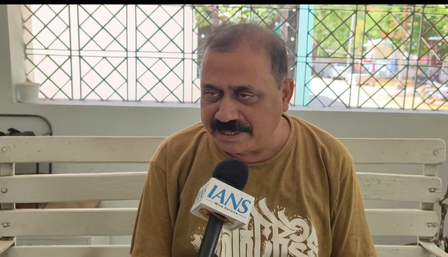
Vadodara/Gir Somnath, May 8 (IANS) Vadodara-based historian and conservation specialist Chandrashekhar Patil on Friday described Prime Minister Narendra Modi’s upcoming visit to the Somnath Temple on May 11 as an important moment for Sanatan Dharma, saying “the temple continues to represent Indian self-confidence, cultural revival and faith despite centuries of invasions”.
Patil was reacting to an article shared by the Prime Minister ahead of the visit, in which Narendra Modi wrote that Somnath was not merely a pilgrimage site but “a shining symbol of India’s eternal faith, renaissance and unbreakable national self-confidence”.
PM Modi also said that no society’s sentiments could be suppressed indefinitely and that communities could rise again with dignity and strength.
Responding to the Prime Minister’s article and social media post, Patil said, “He has specially mentioned that he will visit the Somnath Temple on May 11. In his tweet, he said that Somnath is a symbol of self-confidence, Indian renaissance and Sanatan culture. This is a very important statement.”
“He is going to visit the Somnath Temple in Gujarat for darshan on May 11, and this is a very big moment for Sanatan Dharma,” he added.
Patil said the history of Somnath remained significant because the temple retained its identity and faith despite repeated attacks over centuries.
Referring to the raid on the temple more than 1,000 years ago by Mahmud of Ghazni, he said valuables including silver, diamonds and other ornaments were taken away and claimed that parts of the Shivling were also removed.
“If I want to give a little information, then around 1,029 years ago Mahmud of Ghazni came here and the Somnath Temple was looted. A very large quantity of silver, diamonds and jewellery was taken away from here and parts of the Shivling were also carried away,” Patil said.
“The silver was melted and coins were made from it. Those coins are very important because they can still sometimes be found. The speciality of those coins is that it is written in the Prakrit language from where the silver was looted and what its purpose was. On the reverse side, there is praise of the Somnath Temple,” he added.
Patil, who described himself as a conservation specialist working on Indian history, said the “continued memory of Somnath after more than a millennium showed the enduring cultural importance of the temple”.
“I believe this is extremely important because even after more than 1,000 years people still remember these events. People like us preserve such things,” he said.
He further noted, “I also have one such coin connected to the Somnath plunder. One can still read what was written on it and understand the importance attached to Somnath. What was done at that time has today become an important historical document for us.”
Patil also linked the Prime Minister’s visit to the broader political and cultural significance attached to Sanatan Dharma in contemporary India.
“Prime Minister Modi is specially going there for darshan, and that itself is very important. Recently, he won the election in West Bengal and Sanatan Dharma was also an important issue there. In that symbolic context too, he is specially visiting Somnath. If Sanatan Dharma is not worshipped in India, then where will it be?” he said.
In the article shared on Friday, PM Modi said the visit would coincide with 75 years since the inauguration of the restored Somnath Temple by India’s first President Rajendra Prasad.
He recalled attending the Somnath Swabhiman Parv earlier this year, which marked 1,000 years since the first recorded attack on the temple, and described Somnath’s history as a journey “from ruin to renewal” or “from Vidhvans to Srijan”.
The Prime Minister also paid tribute to figures associated with the restoration and protection of the temple, including Sardar Vallabhbhai Patel, K.M. Munshi, Ahilyabai Holkar and Rajendra Prasad.
Highlighting the government’s “Vikas Bhi, Virasat Bhi” approach, PM Modi said spiritual centres across India had been modernised while preserving their traditional identity.
Referring to pilgrimage sites including Kashi Vishwanath Temple, Kedarnath Temple, Ram Mandir Ayodhya and Mahakaleshwar Jyotirlinga, PM Modi said efforts had been made to equip them with modern facilities without affecting their traditional character.
The Prime Minister also announced that special pujas would be organised at Somnath for the next 1,000 days in tribute to those who sacrificed for the temple over the centuries.
–IANS
mys/rad