



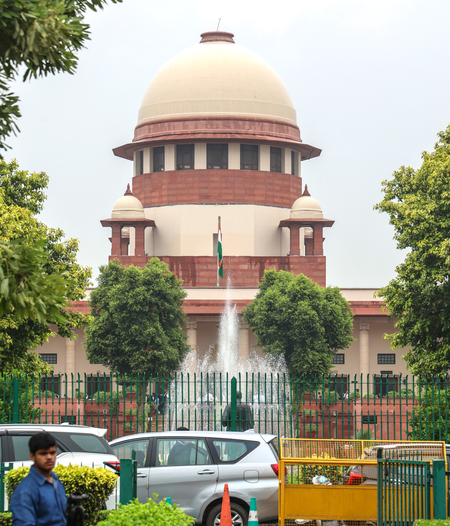
New Delhi, Sep 16 (IANS) A Public Interest Litigation (PIL) has been filed in the Supreme Court challenging the Centre’s recent framework permitting Merchant Discount Rate (MDR) on specified high-value Unified Payments Interface (UPI) transactions above Rs 2,000, alleging that the move is arbitrary, discriminatory and imposes a nationwide financial burden without adequate statutory safeguards.
The plea, filed by advocate Anjan Datta through advocate Ashutosh Dubey, has challenged the Gazette Notification published on September 14, 2026, under Section 10A of the Payment and Settlement Systems Act, 2007, as well as the framework announced on September 15 for imposing MDR on specified person-to-merchant (P2M) UPI transactions above Rs 2,000.
According to the petition, the new framework proposes a 0.4 per cent MDR on P2M UPI transactions above Rs 2,000, capped at Rs 300 for transactions of Rs 75,000 and above, with separate rates for certain sectors.
“The challenge is not to the legitimate objective of maintaining secure and resilient payment infrastructure. It is to the manner in which a nationwide compulsory payment burden has been created, classified and distributed without publication of the complete operative instrument, statutory source, underlying cost study, minutes, methodology, safeguards or enforceable anti-pass-through mechanism,” the plea stated.
The petitioner has claimed that the framework, proposed to take effect from October 15, creates different thresholds and categories without disclosing the empirical basis or principles underlying them.
“The Rs. 2,000 transaction threshold, the Rs. 1 lakh monthly-receipt classification, the differential sector rates, and the Rs. 75,000 cap are unsupported in the public domain by disclosed data or determining principles,” the plea stated.
The petition further claimed that a transaction of Rs 2,001 would attract a percentage charge while a Rs 2,000 transaction would not, describing such “cliffs” as capable of distorting behaviour and creating unequal treatment among similarly placed merchants.
The plea also questioned the manner in which the detailed MDR framework has allegedly been introduced, contending that essential rate-making and classification decisions cannot be delegated to an unincorporated steering committee without clear legislative standards, publication and regulatory supervision.
“Essential rate-making and classification choices cannot be sub-delegated without clear legislative policy, standards, publication and regulatory supervision,” the petition stated.
The petitioner has sought production of the complete record relating to the decision, including the statutory basis, constitution and authority of the UPI and Services Steering Committee, its decision and minutes, and the legal basis for prescribing rates and distributing MDR among private ecosystem participants.
The PIL has also sought quashing or suspension of the framework insofar as it imposes MDR on UPI transactions above Rs 2,000.
Alternatively, it has sought reconsideration after transparent consultation, publication of empirical data and an impact assessment, along with safeguards for micro and small enterprises.
The PIL comes amid the Centre’s explanation that the revised framework is aimed at making the UPI ecosystem financially sustainable.
The Union Finance Ministry said on Wednesday that UPI processed 24.5 billion transactions in August 2026 and that a small fee on high-value merchant transactions would help fund infrastructure, cybersecurity and support for small merchants in Tier III-VI towns and rural areas.
The ministry has maintained that UPI remains free for customers and that person-to-person transactions will continue to remain free irrespective of the amount.
It has also said merchants earning up to Rs 1 lakh per month through UPI QR codes will continue to enjoy zero charges, while over 95 per cent of merchant payments below Rs 2,000 will remain free.
The Reserve Bank of India (RBI) has separately described the introduction of MDR on large-value UPI transactions as an important step towards strengthening the long-term sustainability of the digital payments ecosystem, while stressing that all UPI transactions will remain free for users.
In his PIL filed under Article 32 of the Constitution, the petitioner asserted that he has no personal interest in the matter and has approached the apex court in public interest, given the widespread use of UPI among consumers and small merchants across the country.
–IANS
pds/rad