



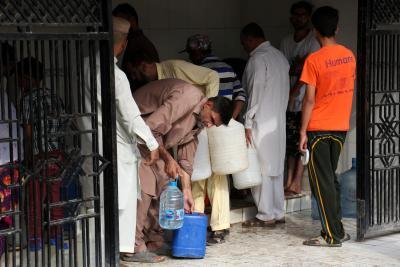
Islamabad, Aug 28 (IANS) Pakistan’s deteriorating water scarcity has often been attributed to climate change, an increase in population or shrinking glaciers, but the crisis has also occurred due to political choices, failure of institutions, and the gradual privatisation of a resource that should be accessible to each individual, according to a local media report.
Per capita water availability in Pakistan has reduced from more than 5,000 cubic meters in the early 1950s to less than 900 cubic meters currently, resulting in the country being below the internationally recognised threshold for water scarcity. Currently, groundwater in Pakistan supplies around 70 per cent of domestic water, around 90 per cent of household needs in rural areas, and over half of agricultural irrigation, according to a report in The Express Tribune.
People of Pakistan cannot trust the water flowing from their taps, it noted, adding that corporations, however, earn by selling the same public resource to people in plastic bottles. The packaged water industry flourished as governments did not provide safe drinking water. As the people in Pakistan did not receive a water supply, multinational companies transformed a public necessity into a commercial product, it said.
The business model of beverage companies depends on an outdated legal framework, under which firms which buy land above productive aquifers can legally extract groundwater at negligible cost before selling purified water to people at prices hundreds of thousands of times more than the extraction charges they pay, according to the report. Over the years, major bottling firms in Pakistan have extracted billions of litres of groundwater, with nearly half of that water lost during processing, according to Supreme Court audits.
“The real battle for Pakistan’s future is not simply over rivers or reservoirs. It is over whether water remains a shared public inheritance or becomes another resource captured by wealth and power,” the Express Tribune report stated.
Earlier in July, Quetta, the capital and largest city of the province of Balochistan, was facing a severe water crisis with groundwater levels dropping to dangerously low levels and official supplies from the Water and Sanitation Agency (WASA) either completely stopped or severely restricted in many residential areas.
Residents of areas, including Sariab, Sirki Road, Samungli Road, Jinnah Town, Qambarani Road, Satellite Town, Sabzal Road, and Khayaban-e-Agha, were facing problems due to water shortage. Elderly people, women and young children in Quetta were forced to travel long distances on foot to fetch water.
Many houses in Quetta had received no tap water for the past six months, severely affecting their routine life. Speaking to The Express Tribune, residents of Quetta said that they don’t receive water despite paying their WASA bills regularly. The issue has not been resolved despite multiple complaints from residents, with officials only providing verbal assurances.
–IANS
akl/vd