



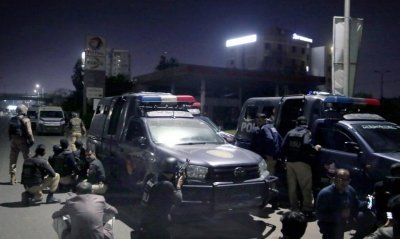
Islamabad, July 13 (IANS) Ranked first in the 2026 Global Terrorism Index, Pakistan remains mired in a massive, never-ending war within its borders. According to the figures released by the Pakistan Institute for Conflict and Security Studies (PICSS) in April, the country witnessed 1,045 incidents and 1,139 deaths in 2025 alone, the highest fatality level in over 10 years. A major reason behind the bloodshed is the resurgence of the Tehreek-i-Taliban Pakistan (TTP) which accounted for over half of these deaths. The violence is majorly occurring in Khyber Pakhtunkhwa and Balochistan and the root cause of this endless unrest is the dominance of Punjab, a report has highlighted.
Pakistan has four provinces: Sindh, Balochistan, Punjab and Khyber Pakhtunkhwa. However, over the years, critics and local residents have started calling Pakistan as “Punjab-istan” due to the dominance of the province over the rest of Pakistan. The centralised control of Punjab has resulted in other provinces feeling marginalised, a report in Asian News Post stated.
For decades, people of Balochistan have claimed that Pakistan annexed their land illegally and have demanded independence, control over their own natural resource and the protection of their distinct culture. Balochistan is the richest province in Pakistan in terms of natural gas, coal, copper, and gold and serves as the central hub for the China-Pakistan Economic Corridor (CPEC). However, Balochistan’s contribution to the national GDP is only five per cent.
Local residents have said that foreign investments, particularly Chinese megaprojects, have been planned to grab wealth of Balochistan to serve the country’s Punjabi elite. This anger has resulted in formation of militant separatist groups like the Balochistan Liberation Army (BLA) which boasts around 6,000 fighters along with the Balochistan Liberation Front (BLF), United Baloch Army (UBA) and Baloch Republican Army (BRA), the Asian News Post report mentioned.
Khyber Pakhtunkhwa has also remained a hotspot, witnessing a sharp rise in violence since Taliban returned to power in Afghanistan. The unrest in the province is largely due to Islamist militancy, spearheaded by the TTP, the Islamic State Khorasan Province (ISKP), and the Hafiz Gul Bahadur Group.
Currently, poverty in Sindh, which earlier used to be prosperous hub of trade and agriculture, stands at 45 per cent. Sindh is facing a 62 per cent water shortage. A canal project has become a point of difference between the provinces of Pakistan. In 2024, Pakistan President Asif Ali Zardari approved the construction of “six strategic canals”. However, protests erupted in Sindh after the Cholistan Canal was inaugurated in 2025, fearing the project would divert its essential water to upstream Punjab. The project was ultimately put on hold after the government faced backlash from public.
Pakistan-occupied Gilgit-Baltistan does not have full constitutional status and people of the region lack representation in Pakistan’s parliament. Locals face unemployment and prolonged power outages in PoGB as federal government exploits the region’s hydropower and mineral resources for national benefit. Frustrated by the situation, massive protests led by local activists have been held in PoGB recently.
“Instead of addressing these deep-rooted issues of economic disparity and political exclusion, Islamabad has largely relied on military crackdowns. The most disturbing outcome of this is the epidemic of ‘enforced disappearances’. Activists, especially from Balochistan and KP who speak out against resource exploitation, frequently go missing. According to the government’s own Commission of Inquiry on Enforced Disappearances (COIED), over 10,500 cases were reported between 2016 and 2024,” the report in Asian News Post detailed.
“Independent human rights organisations argue the actual numbers are much higher. Baloch separatists alone claim that more than 5,000 of their people have vanished over the decades. Until Islamabad stops treating its own provinces as resource colonies and starts focusing on genuine political inclusion and human rights, Pakistan will remain a country at war with itself,” it added.
–IANS
akl/as