



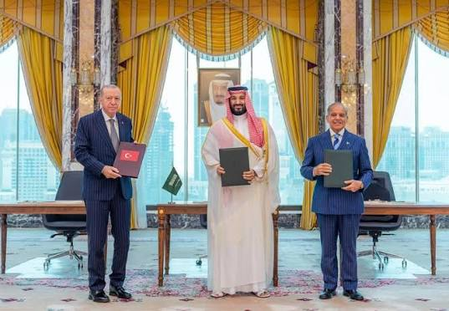
Islamabad, Aug 16 (IANS) A fresh wave of optimism appears to be taking hold in Pakistan over the Makkah Joint Defence Agreement, with a perception being nurtured that the pact could bring foreign investment, Saudi financial support, oil on deferred payments, and greater employment opportunities for Pakistanis in the Gulf, according to a report.
The expectations surrounding the agreement are being compared with the enthusiasm generated by the China-Pakistan Economic Corridor (CPEC), which was once projected as a transformative economic opportunity capable of changing Pakistan’s financial fortunes and bringing widespread prosperity to the country.
The Makkah Joint Defence Agreement is a defence pact involving Pakistan, Saudi Arabia and Turkey that was signed into force on August 7. According to the joint statement issued in Makkah, “any armed attack against any one of the three states shall be regarded as an attack against them all”.
The latest assessment has highlighted how Pakistan’s political and public discourse repeatedly turns towards external partnerships in the hope that they will provide a breakthrough for the country’s economic and strategic challenges.
“Waiting for a miracle to happen is an old practice of Pakistan’s power elite. Every few years, the ruling establishment constructs a new narrative of hope: that a breakthrough is just around the corner, prosperity is waiting beyond the horizon, and Pakistan needs only remain patient for the miracle to unfold,” Muhammad Amir Rana wrote in an opinion piece titled ‘Endless wait for a miracle’ published in leading Pakistan daily, Dawn.
The article recalled the period when the CPEC was formally launched in 2015; it was widely described as a “game changer”. It noted that streets in Islamabad were covered with Pakistani and Chinese flags, creating a strong impression that the partnership between the two countries would fundamentally transform Pakistan’s economic destiny and usher in a new period of growth and prosperity.
However, more than a decade after the launch of the CPEC, the report said that the promised economic transformation remains incomplete and Pakistan continues to face serious challenges.
“But more than a decade after its launch, the promised transformation remains incomplete. Pakistan continues to struggle with debt, inadequate exports, weak productivity and recurring balance-of-payments crises. It still depends on IMF programmes, financial deposits, loan rollovers and other forms of support from friendly countries, including China and Saudi Arabia,” the article read.
Rana argued that the experience of CPEC demonstrates the limitations of depending on external partnerships as a replacement for difficult domestic economic reforms. While foreign investment and strategic partnerships can provide support, they cannot by themselves resolve the structural problems affecting Pakistan’s economy or guarantee long-term economic transformation.
The report further observed that the latest defence pact could strengthen Pakistan’s strategic position, but suggested that the psychological pattern behind the country’s expectations remains largely unchanged — “Pakistanis have been conditioned to look outward for a change in their fate” — Rana noted in the article.
According to the report, Pakistan’s repeated search for external assistance reflects a broader tendency to expect a major breakthrough from partnerships with other countries rather than from reforms and improvements within the country itself.
Rana expressed the hope that an Independence Day would eventually arrive when optimism among Pakistanis would be rooted in achievements made domestically rather than expectations of external rescue.
“One wishes an Independence Day would come when our optimism is the result of something Pakistan had achieved at home — an economic transformation initiated by our own policies; functioning institutions; sustainable peace in Balochistan; stable relationships with Afghanistan and India; the elimination of all insecurities; the rule of law; and, above all, the return of true democracy,” he wrote.
The report concluded that despite being repeatedly confronted with economic and political crises, Pakistan continues to look beyond its borders for solutions and rescue, with each new strategic or diplomatic partnership raising hopes of the breakthrough that previous initiatives failed to fully deliver.
–IANS
sd/vd